
Why stability testing matters for generic drugs
When you pick up a generic pill at the pharmacy, you expect it to work just like the brand-name version. But how do you know it won’t fall apart on the shelf? That’s where stability testing comes in. The FDA doesn’t just approve generic drugs based on how they perform in a lab - they need proof they’ll stay safe and effective for months, even years, under real-world conditions. Without this testing, a medication could lose potency, break down into harmful chemicals, or fail to dissolve properly in your body. For generics, this isn’t optional. It’s the backbone of approval.
The FDA requires every generic drug to prove it matches the brand-name drug in quality, strength, purity, and stability. That means if the brand-name drug has a 3-year shelf life, the generic must prove it can last just as long - without changes that affect safety or performance. This isn’t about copying a formula. It’s about proving that your version, made with your equipment, your ingredients, and your packaging, behaves the same way over time.
What the FDA actually requires
The FDA’s rules for stability testing are detailed, specific, and non-negotiable. Under guidance Q1A(R2) and the 2018 ANDA Q&A document, manufacturers must test at least three primary batches of the drug product. These aren’t small trial runs - they must be made at pilot scale, following current Good Manufacturing Practices (cGMP). Each batch represents a real production run, not a lab curiosity.
Testing isn’t just about checking if the pill still looks the same. It’s about measuring physical, chemical, biological, and microbiological changes. That includes:
- Active ingredient content - does it still have the right amount of medicine?
- Impurity levels - are new chemicals forming as the drug ages?
- Disintegration time - will the tablet break down in your stomach like it should?
- Preservative effectiveness - especially for liquids or multi-dose injectables
- Container closure integrity - will the bottle or blister pack keep moisture and air out?
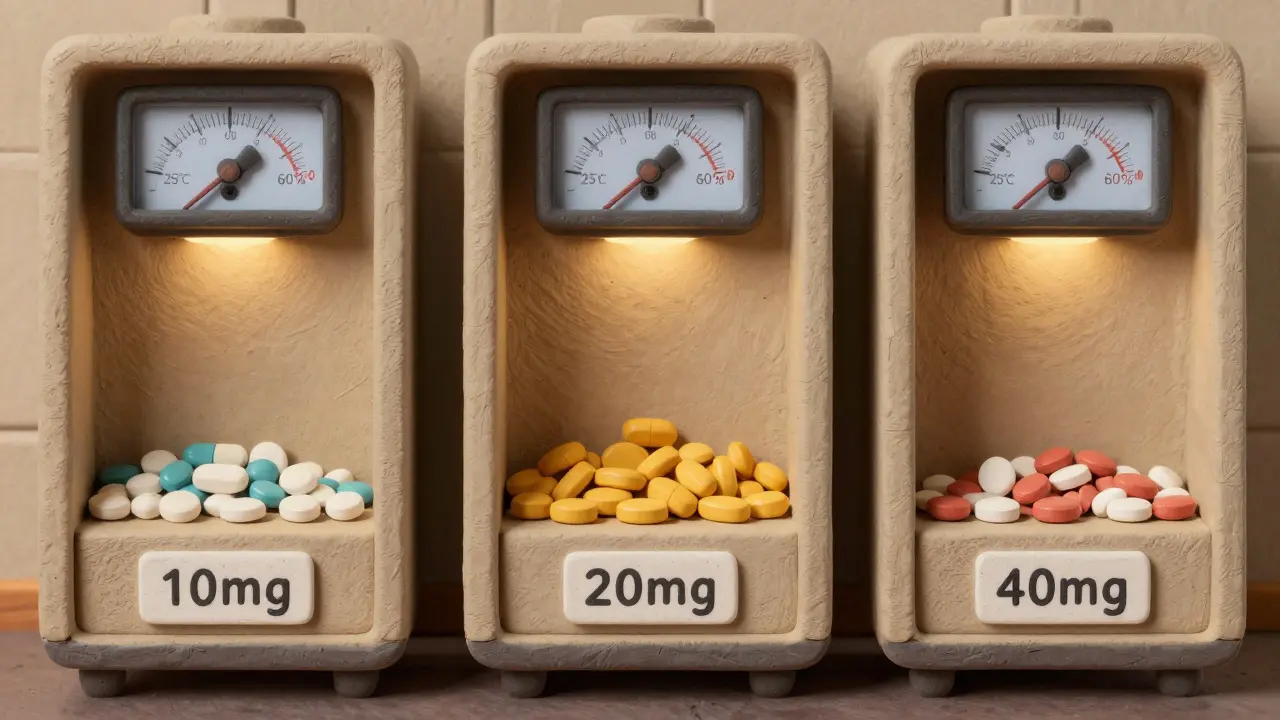
There are two types of studies: long-term and accelerated. Long-term studies run under real storage conditions - typically 25°C ± 2°C and 60% ± 5% humidity. These must cover at least 12 months before an ANDA can be submitted. Accelerated studies push the drug harder: 40°C ± 2°C and 75% ± 5% humidity. Six months of this data is required for submission. The idea? If a drug degrades quickly under stress, it’ll likely degrade faster in real life. Accelerated data helps predict shelf life, but long-term data confirms it.
Testing frequency matters too. For products with a shelf life of 12 months or more, you must test:
- Every 3 months in the first year
- Every 6 months in the second year
- Annually after that
And you can’t skip any strengths or container sizes. If you’re making 10mg, 20mg, and 40mg tablets in bottles and blister packs, you need stability data for each. The FDA does allow bracketing and matrixing - testing only some strengths or sizes if you can scientifically prove the rest behave the same. But you still need to justify it. No shortcuts.
How generics differ from brand-name drugs
Many assume generics have looser rules. They don’t. The core requirements are identical. Both must follow ICH Q1A(R2). Both need three batches. Both need long-term and accelerated data. The difference isn’t in the rules - it’s in the data they can use.
Brand-name companies spend years building stability data from scratch. They test dozens of batches across multiple manufacturing sites. Generics don’t have to do that. They can reference the brand-name drug’s data to support their shelf-life claim. But here’s the catch: they still have to test their own product. Why? Because even a tiny change in manufacturing - a different binder, a slightly different drying process, or a new supplier for the capsule shell - can alter how the drug degrades.
Generics also don’t need to run forced degradation studies as extensively. Since the brand-name drug’s breakdown pathways are already mapped, the generic manufacturer just needs to show their product follows the same pattern. That saves time and money. But if their drug breaks down in a way the original doesn’t, the FDA will reject it. No exceptions.
Why so many applications get rejected
Stability testing is the #1 reason generic drug applications get rejected. Dr. Jane Axelrad, former FDA Deputy Director for Generic Drugs, found that in 2019, stability issues caused 34.6% of Complete Response Letters. That’s more than chemistry, bioequivalence, or labeling combined.
What goes wrong? Here are the most common failures:
- Missing or incomplete protocols - 98.3% of completeness failures are due to vague or missing test methods. You can’t just say “we tested potency.” You need to specify the exact USP method, instrument settings, and acceptance criteria.
- Inadequate data points - skipping tests, not hitting the required time points, or using too few batches.
- Unvalidated methods - if your test doesn’t reliably detect changes, the FDA won’t trust it. 31.2% of stability-related rejections cite this.
- Storage condition failures - stability chambers must stay within ±2°C. FDA inspections in 2022 found 18.4% of data invalidations were due to temperature excursions. One facility had average deviations of 4.7°C, happening 2.3 times per month.
- Bad sampling plans - taking samples at the wrong times, not preserving them properly, or losing track of which batch is which.
These aren’t minor oversights. They’re systemic failures. The FDA doesn’t just look at the numbers - they look at your process. Did you monitor your chambers in real time? Did you document every deviation? Did you validate your equipment? If not, you’re not ready for approval.
How manufacturers are adapting
Smart companies aren’t waiting for rejection letters. They’re fixing problems before they happen. Top generic manufacturers are adopting automated environmental monitoring systems - 78.4% of the top 25 now use them. These systems track temperature, humidity, and alarms in real time, with cloud backups and alerts if something goes off. No more handwritten logs that get lost.
Many are also doing pre-submission meetings with the FDA. These aren’t casual chats. They’re formal reviews of your stability protocol before you submit. Companies that do this reduce their deficiency rates by 42.6%. That’s huge. It means fewer delays, lower costs, and faster approval.
Another trend: using bracketing and matrixing more effectively. Instead of testing every single strength and package, manufacturers now design studies that cover multiple variations with fewer tests. For example, if you test the highest and lowest strengths, and prove they’re the most sensitive to degradation, the FDA may accept that as representative of the middle strengths. In 2022, 67.3% of ANDAs that requested bracketing got approval.
And for newer production methods like continuous manufacturing, the FDA now requires direct comparisons between traditional and continuous batches. You can’t just assume they behave the same. You have to prove it with stability data.
The cost and future of stability testing
Stability testing isn’t cheap. It costs an average of $487,500 per ANDA - about 18.7% of total development costs. For a company filing 10 applications a year, that’s nearly $5 million just on stability. And it’s getting more expensive.
The FDA’s 2025 draft guidance proposes major changes:
- 24 months of long-term data instead of 12 - meaning you’ll need to wait longer before submitting.
- Quality by Design (QbD) requirements - you’ll need to build stability into your process from day one, not test it after the fact.
- New rules for nanomaterials - a growing category of complex generics.
- Photostability testing - more requirements for drugs sensitive to light.
The International Council for Harmonisation is also updating Q1C(R2), which will add climate zone-specific storage rules. That affects 73.2% of generic drugs. And the FDA is piloting blockchain for stability data verification - imagine tamper-proof, time-stamped records of every test result.
Industry analysts predict stability testing costs will rise 22.4% by 2027. But approval times may drop. Why? Because as manufacturers adapt, fewer applications will fail. The FDA’s goal isn’t to make life hard - it’s to make sure every pill you take is safe, no matter who made it.
What this means for patients
At the end of the day, all this testing isn’t about paperwork. It’s about you. When you take a generic blood pressure pill, you need to know it won’t suddenly lose its power. When you use a generic inhaler, you need to be sure the dose is still accurate. Stability testing ensures that.
The FDA doesn’t approve generics because they’re cheaper. They approve them because they’re equivalent. And stability data is the proof. Without it, a generic drug is just a copy that might not work. With it, you get the same medicine at a fraction of the cost - safely and reliably.
As regulations get stricter, some manufacturers complain it’s too burdensome. But the data doesn’t lie: when stability testing is done right, patients get better outcomes. And that’s the only metric that matters.
Do generic drugs need the same stability testing as brand-name drugs?
Yes. Both generics and brand-name drugs must follow the same ICH Q1A(R2) guidelines. They both need three pilot-scale batches, long-term and accelerated stability studies, and testing for potency, impurities, and physical characteristics. The difference is that generics can reference the brand-name drug’s degradation data but still must test their own product to prove it behaves the same way.
How long does stability testing take for a generic drug?
You need at least 12 months of long-term data and 6 months of accelerated data before submitting an ANDA. But because testing starts during development, the full process often takes 18-24 months. The FDA won’t approve a drug until the long-term data covers the proposed shelf life - so if you’re claiming a 3-year shelf life, you need 3 years of data before final approval.
Can a generic drug have a longer shelf life than the brand-name version?
No. The FDA requires that a generic drug’s shelf life cannot exceed that of the reference listed drug (RLD). Even if your data shows your version lasts longer, you can’t claim it. The expiration date must match the RLD to ensure equivalence. If the brand-name drug expires in 2 years, your generic must too.
What happens if a generic drug fails stability testing after approval?
If stability issues arise after approval - like unexpected degradation or impurity spikes - the manufacturer must notify the FDA immediately. The agency can issue a recall, require labeling changes, or suspend manufacturing. In extreme cases, the approval can be revoked. Post-market stability monitoring is mandatory, and manufacturers must continue long-term studies even after the drug is on the market.
Are there exceptions to the three-batch requirement?
Rarely. The FDA requires three batches to show consistency across production runs. Exceptions are only considered for very small-volume drugs or those with extreme stability challenges, and even then, you need strong scientific justification. The FDA may accept two batches if one is a large-scale commercial batch and the other is a pilot batch - but only with prior approval.
How does the FDA verify stability data during inspections?
During inspections, FDA reviewers check raw data, calibration records, environmental logs, and method validation reports. They compare test results across batches and time points. They may request original chromatograms, instrument printouts, and sample storage records. They look for consistency, traceability, and adherence to the approved protocol. Any missing data, unexplained deviations, or unvalidated methods can lead to a 483 observation or warning letter.


