
Cholesterol Medication Calculator
When statins don’t work for you, what’s next? For millions of people who can’t tolerate statins due to muscle pain, fatigue, or other side effects, the search for effective cholesterol-lowering options feels personal and urgent. Two medications-ezetimibe and bempedoic acid-have emerged as real-world solutions backed by clinical trials, not just theory. They don’t replace statins, but they fill a critical gap for those who can’t take them.
How Ezetimibe Lowers Cholesterol Without Statins
Ezetimibe, sold under the brand name Zetia, works in a completely different way than statins. Instead of blocking cholesterol production in the liver, it stops your gut from absorbing cholesterol from food. It targets a protein called NPC1L1 in the small intestine, cutting dietary cholesterol uptake by about half. This might sound small, but it adds up.
As a standalone treatment, ezetimibe typically lowers LDL (bad) cholesterol by 15-22%. That’s not as strong as a statin, which can knock down LDL by 30-55%. But here’s the key: when you add ezetimibe to a low-dose statin, you get an extra 18-25% drop in LDL. For many people, that’s enough to reach their target without cranking up the statin dose-and avoiding muscle pain in the process.
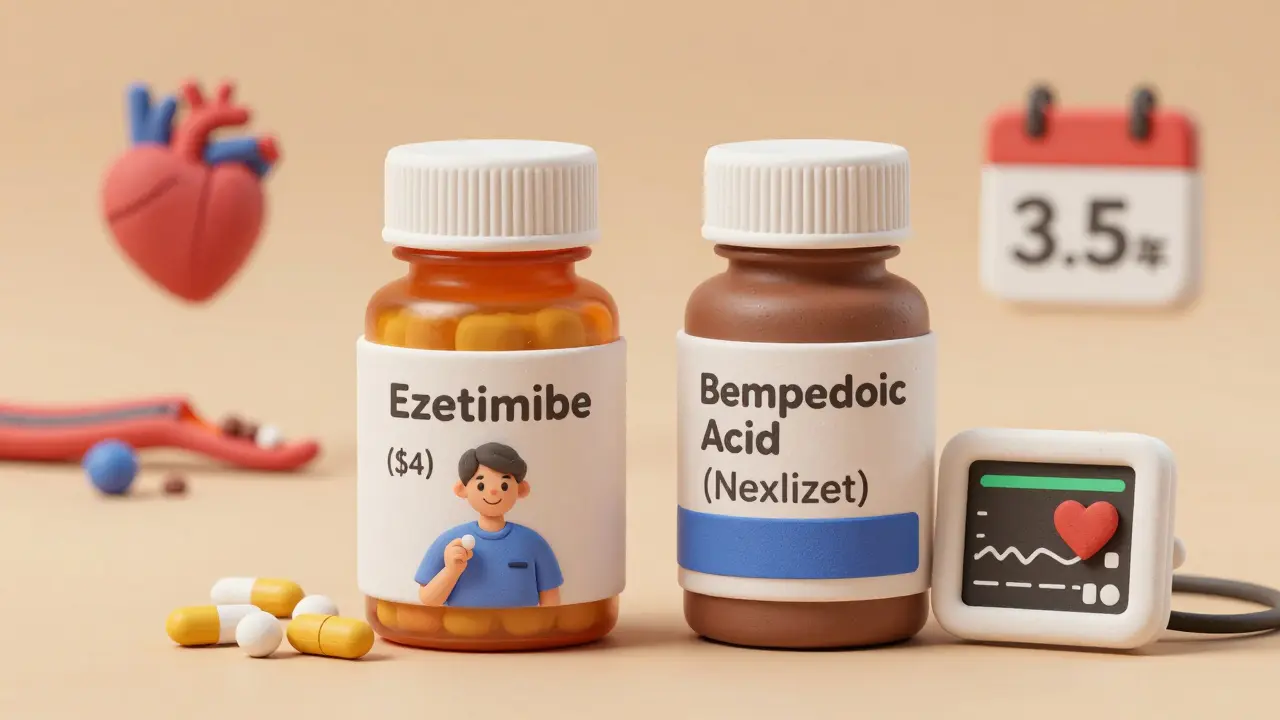
It’s also one of the most affordable options. Generic ezetimibe costs as little as $4 a month through Medicare Part D. That’s a fraction of what newer drugs cost. Patients report few side effects. The most common? Mild stomach upset or diarrhea, but nothing like the muscle aches that drive people off statins.
Bempedoic Acid: A New Kind of Cholesterol Drug
Bempedoic acid (brand name Nexletol) is newer, approved by the FDA in 2020, and designed for one thing: helping people who can’t take statins. Its biggest advantage? It doesn’t touch muscle tissue.
Unlike statins, which block HMG-CoA reductase everywhere in the body-including muscles-bempedoic acid only activates in the liver. It works earlier in the cholesterol-making pathway, blocking an enzyme called ACL. Because skeletal muscle doesn’t have the enzyme needed to activate it, muscle pain stays low. In the CLEAR Outcomes trial, only 5.1% of people on bempedoic acid reported muscle symptoms, compared to 6.8% on placebo. That’s almost the same as taking a sugar pill.
As a single pill, bempedoic acid lowers LDL by 17-23%. When paired with ezetimibe (in the combo drug Nexlizet), that jumps to 35-40%. But the real breakthrough? It cuts heart attacks, strokes, and heart-related deaths by 13% over three and a half years. That’s not just about numbers on a lab report-it’s about staying alive.
How Do They Compare to Statins?
Statins still win on raw power. High-dose atorvastatin or rosuvastatin can slash LDL by 50-55%. That’s why guidelines still put them first. But for the 7-29% of people who can’t tolerate statins, that’s not an option.
Here’s the hard truth: ezetimibe and bempedoic acid aren’t as strong. But they’re not useless. In a 2023 trial, adding bempedoic acid to a statin-ezetimibe combo lowered LDL by 22.9%, while doubling the statin dose only got 7.5%. For people already on the highest tolerable statin, bempedoic acid is often the only next step that actually works.
PCSK9 inhibitors like Repatha and Praluent lower LDL even more-up to 60%-but they’re injections given every two weeks and cost over $1,000 a month. Bempedoic acid and ezetimibe are pills. Once daily. Easy to take. That matters.
Real People, Real Results
Online forums tell stories that clinical trials can’t capture. On Reddit, one user wrote: “Switched from atorvastatin to bempedoic acid. My LDL dropped from 142 to 101. No muscle pain. I feel like myself again.” Another said: “Ezetimibe dropped my LDL by 18 points. Not worth the co-pay.”
On GoodRx, Nexletol has a 3.7/5 rating. About 42% say it works. But 76% complain about the cost. Without insurance, it’s around $231 a month. Ezetimibe? $4. That’s why so many stick with it-even if the results are modest.
PatientsLikeMe data shows ezetimibe has a 7.1/10 effectiveness rating from nearly 2,000 users. Bempedoic acid? 6.2/10. That gap isn’t about science-it’s about expectations. People expect statin-level results. These drugs don’t deliver that. But they deliver something else: safety, consistency, and a way forward.
Who Should Take These Medications?
Not everyone needs them. You’re a good candidate if:
- You’ve tried at least two different statins at different doses and still have muscle pain
- Your doctor confirmed you’re truly statin-intolerant-not just had a bad reaction once
- You have heart disease, diabetes, or very high LDL (over 190 mg/dL)
- You’re already on the highest tolerable statin but still not at your LDL goal
Doctors usually test this carefully. A rechallenge-trying statins again under supervision-is often required before switching. It’s not a quick fix. It’s a calculated move.
Cost, Safety, and What to Watch For
Ezetimibe is safe for most people, including those with mild kidney issues. No special monitoring needed beyond regular cholesterol checks.
Bempedoic acid has a few red flags. It can raise uric acid levels, which might trigger gout in some people. About 12% of real-world users report joint pain-higher than the 2% seen in trials. That’s something to watch. Also, it’s not safe if your kidney function is below 30 mL/min. And you can’t take it with high doses of simvastatin or pravastatin-it can make those statins too strong.
There’s also a small risk of tendon rupture-about 1 in 200 people. It’s rare, but if you feel sudden pain in your shoulder, ankle, or Achilles, stop the drug and call your doctor.
What’s Next for These Drugs?
The combo pill Nexlizet (bempedoic acid + ezetimibe) got FDA approval in 2024. It’s becoming the go-to for patients who need more than either drug alone. In Europe, bempedoic acid is now approved for primary prevention in high-risk patients-even without heart disease yet.
Research is ongoing. The CLEAR CardioTrack trial, due in late 2025, is using ultrasound to see if bempedoic acid actually shrinks plaque in arteries. If it does, that’s a game-changer.
Market trends show growth. Bempedoic acid sales hit $412 million in 2023. Ezetimibe still leads in prescriptions-over 12 million in the U.S. yearly-because it’s cheap and reliable. But as more people get diagnosed with statin intolerance, demand for alternatives will rise.
Bottom Line: A Real Option, Not a Perfect One
There’s no magic bullet if statins aren’t working for you. But ezetimibe and bempedoic acid are not just backups-they’re legitimate, evidence-based tools. Ezetimibe is the affordable, gentle starter. Bempedoic acid is the stronger, outcome-proven option for those who need more.
They won’t drop your LDL by 60%. They won’t be as cheap as generic statins. But they’ll let you live without muscle pain, reduce your heart risk, and keep you on track. For many, that’s enough.


