
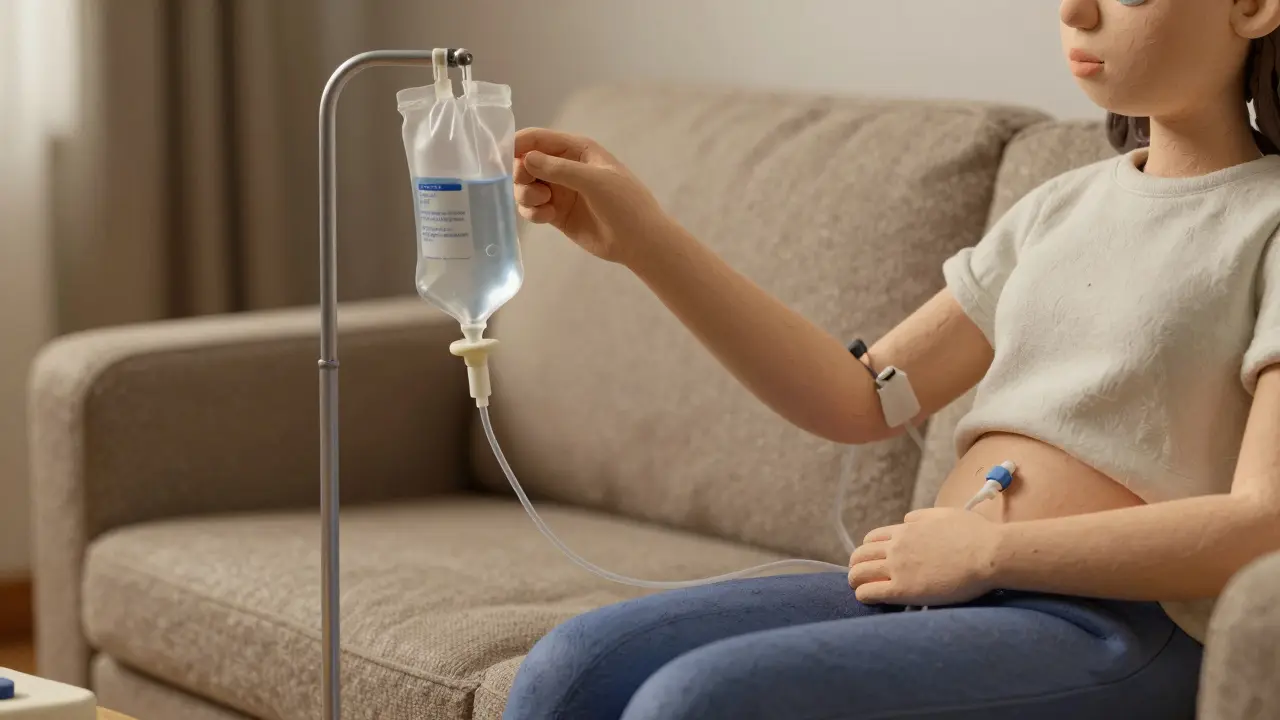
Managing kidney failure doesn't mean you have to spend hours in a clinic. Home dialysis options like peritoneal dialysis (PD) let you manage treatment on your terms. But with two main types-CAPD and APD-how do you choose? Let’s break down what each really means for your daily life.
What is Peritoneal Dialysis?
Peritoneal dialysis uses your abdominal lining as a filter. A soft tube (catheter) is placed in your belly during a minor surgery. Dialysis fluid flows in and out, removing waste and excess fluid. Unlike hemodialysis, which requires a machine at a clinic, PD works at home. It’s a continuous process that mimics how healthy kidneys work. This means fewer blood pressure swings and less dietary restrictions compared to clinic-based treatments.
CAPD: Manual Exchange Process
Continuous Ambulatory Peritoneal Dialysis (CAPD)A manual dialysis method where patients exchange fluid several times a day without a machine, using gravity to drain and fill the abdomen. Here’s how it works:
- You drain old fluid from your abdomen through the catheter
- Fill with fresh dialysate solution (1.5-3 liters per exchange)
- Let it sit for 4-6 hours before draining again
- Repeat 3-5 times daily, each taking 30-40 minutes
No machines are needed-just gravity. You can do exchanges while sitting or lying down. This makes CAPD ideal for people who want flexibility during the day. But it means carrying fluid bags, which adds up to 4-6 pounds of weight. According to US Renal Data System (USRDS) 2021 data, CAPD users have a 0.68 episodes of peritonitis per patient-year. That’s higher than APD due to more manual handling.
APD: Automated Nighttime Treatment
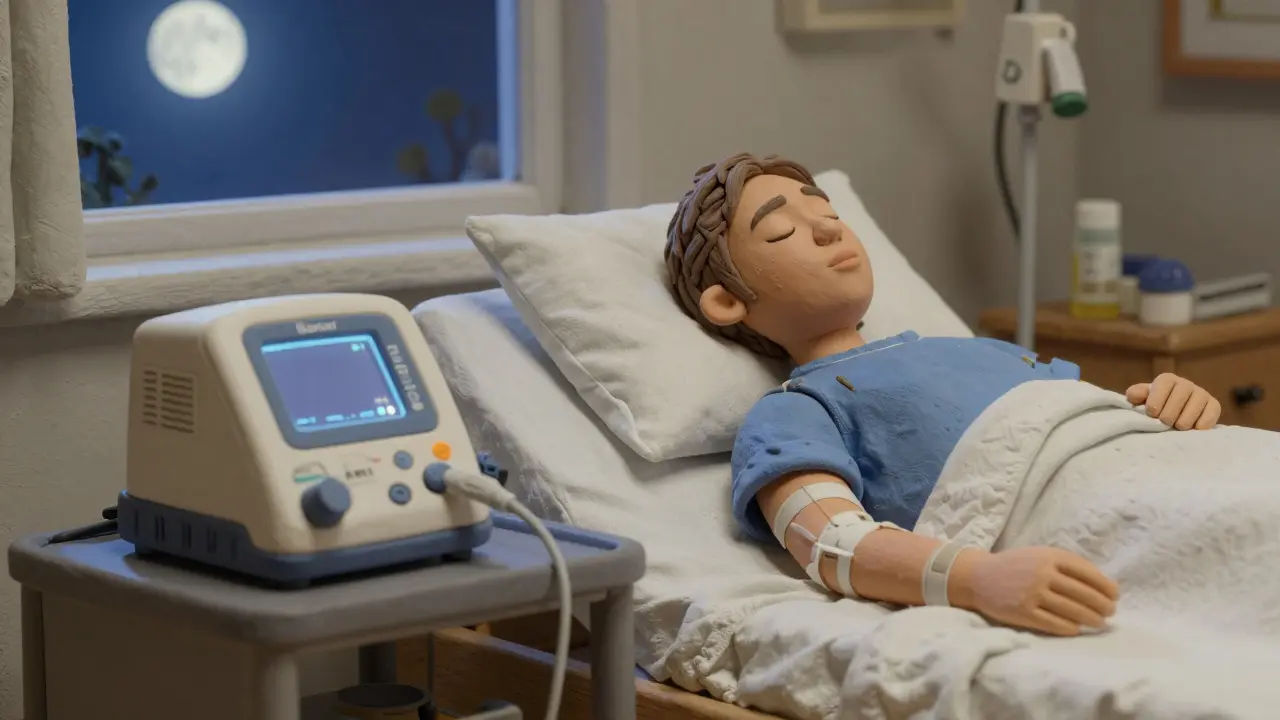
Automated Peritoneal Dialysis (APD)A method using a cycler machine to perform exchanges overnight while you sleep, freeing up daytime hours. Here’s how it works:
- Set up the cycler before bed (takes about 15 minutes)
- Machine automatically fills, drains, and cycles fluid for 8-10 hours
- Wake up with clean fluid in your abdomen
- No daytime exchanges needed
Modern cyclers like the Baxter AmiaA next-generation automated peritoneal dialysis cycler featuring AI-driven fluid management and remote monitoring capabilities. or Fresenius Sleep-SafeA compact dialysis cycler designed for quiet operation and user-friendly controls. weigh 15-25 pounds and need a small space. They run at 35-45 decibels-like a quiet library. This means less disruption to sleep than older models. APD users report 3.2 more hours of sleep nightly compared to CAPD users, per Mayo Clinic 2022 data. The machine handles everything, reducing manual errors by 25% according to DaVita’s 2022 study.
Key Differences: CAPD vs APD
| Factor | CAPD | APD |
|---|---|---|
| Process | Manual exchanges 3-5 times daily | Automated exchanges overnight (8-10 hours) |
| Equipment | None beyond standard supplies | Automated cycler machine (e.g., Baxter Amia) |
| Daily Time Commitment | 2-3 hours total (exchanges) | 1 hour for setup; sleep through treatment |
| Sleep Impact | Uninterrupted sleep | Machine noise may disrupt sleep (35-45 dB) |
| Peritonitis Risk | 0.68 episodes per patient-year | 0.52 episodes per patient-year |
| Monthly Cost | $50-75 for supplies | $75-100 (includes cycler rental) |
| Best For | Travelers, those with limited space | Working adults, night shift workers |
Factors to Consider When Choosing
Your choice depends on your life situation. Let’s look at real-world scenarios:
- Age and mobility: If you’re over 75 or have arthritis, CAPD might be easier. Manual exchanges require fine motor skills, which can be tough with stiff joints. But if you’re younger and tech-savvy, APD’s automated system may fit better.
- Work schedule: A teacher like "DialysisDave" on the American Kidney Fund forum says CAPD lets him exchange during planning periods. Meanwhile, an ER nurse named "NightNurse82" prefers APD to sleep through treatment while working night shifts.
- Home environment: APD needs space for the cycler and an electrical outlet. CAPD works anywhere-no power required. If you live in a small apartment or travel often, CAPD is simpler.
- Health complications: If you have high blood pressure or fluid overload issues, APD’s continuous overnight treatment offers better control. Studies show 22% fewer hypertension emergencies with APD versus CAPD.
Dr. Michael J. Germain, past president of the American Society of Nephrology, explains: "CAPD remains the gold standard for patients over 75 due to cognitive simplicity, while APD offers superior quality-of-life metrics for working-age adults." But Dr. Beth Piraino from UPMC argues: "Modern APD cyclers with remote monitoring have reduced technical barriers so much that we should consider APD first-line for all eligible patients under 65."

Practical Steps for Starting Home PD
Before choosing, talk to your nephrologist. They’ll assess your:
- Physical ability to handle exchanges
- Home environment (space, electricity access)
- Residual kidney function
Training takes 10-21 days. CAPD training focuses on sterile technique and manual handling. APD training adds cycler operation and troubleshooting. Both require:
- Dedicated storage space (4x4 feet for supplies)
- Access to clean water for rinsing
- A reliable support team (nurses, technicians)
For APD users, test your cycler’s noise level in your bedroom. Some cyclers vibrate loudly on carpeted floors. For CAPD users, practice exchanges in different locations-like a hotel bathroom-before traveling.
Real-Life Experiences
On Reddit’s r/kidneydisease, CAPD users praise portability (78% positive mentions) but complain about daytime disruptions (63% negative). APD users love nighttime treatment (85% positive) but struggle with machine maintenance (52% negative). One user shared: "My Baxter Amia cycler had a power glitch during a storm. It took 2 hours to reset, but the 24/7 support team walked me through it. That’s why I stick with APD." Another CAPD user said: "I carry my dialysate bags in a backpack. I’ve done exchanges in parks, airports, and even during a flight. No machine means no power worries."
FAQ
Can I switch between CAPD and APD later?
Yes, many patients switch based on changing needs. For example, a young person starting with CAPD might move to APD when they start a demanding job. Or an older adult might switch from APD to CAPD if they lose electricity access. Your care team will retrain you for the new method. About 15% of home PD patients switch modalities within 5 years.
What happens if my APD cycler breaks down?
Most cycler providers offer 24/7 support. If it malfunctions, they’ll guide you through emergency steps or send a replacement. In the meantime, you can switch to manual CAPD exchanges temporarily. For example, Fresenius reports 95% of APD programs include same-day cycler replacement service. Always keep extra dialysate bags on hand for emergencies.
Is CAPD cheaper than APD long-term?
Not necessarily. While CAPD supplies cost $50-75 monthly and APD runs $75-100 due to cycler rentals, APD often reduces long-term costs. Better fluid control means fewer hospital visits for high blood pressure or heart issues. USRDS 2021 data shows APD users save 15-20% on medications over 5 years. Medicare covers both modalities equally, so out-of-pocket costs depend on your insurance plan.
Can I travel with APD?
Yes, but it’s trickier than CAPD. APD cyclers need electricity, so you’ll need to plan for power sources during travel. Many providers ship cycler accessories to your destination. Some airlines allow cyclers as medical equipment in carry-on luggage. CAPD is simpler for travel-just pack fluid bags in your luggage. But APD users report fewer disruptions during long trips since treatment happens while sleeping.
How do I know if I’m a good candidate for home PD?
Your doctor will check for:
- Good vision and hand mobility for exchanges
- Adequate space for supplies or a cycler
- Support system (family or caregivers)
- Stable health without severe heart or lung issues
Only about 10-12% of U.S. dialysis patients use home PD. If you’re healthy enough for surgery and motivated to learn, you’re likely a candidate. Rural patients may face access challenges, but telehealth training is expanding rapidly.


