
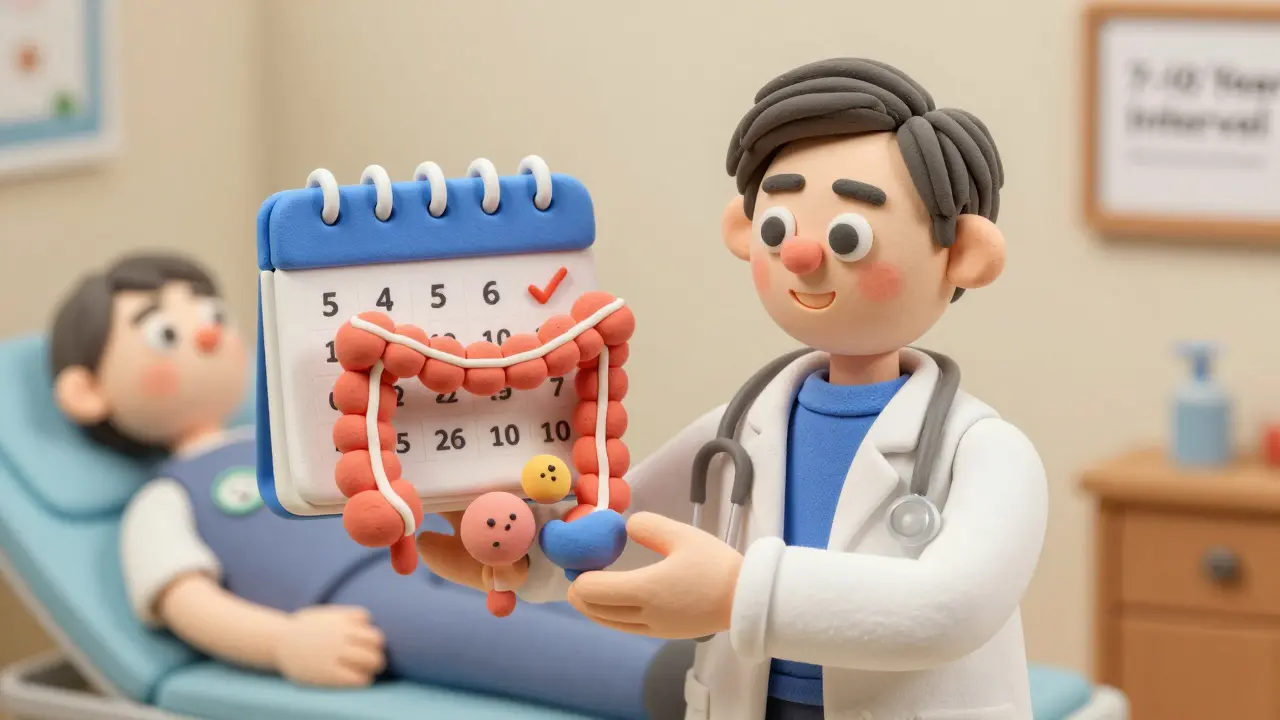
How Long Until Your Next Colonoscopy After Polyps Are Found?
If you’ve had a colonoscopy and polyps were removed, you’re probably wondering: when do I need to go back? It’s not a one-size-fits-all answer. The timing depends on what kind of polyps you had, how many, how big they were, and how they looked under the microscope. Getting the timing right matters-too soon and you’re wasting time, money, and comfort. Too late and you risk missing something serious.
Most people think if you get one polyp, you’re back in five years. That used to be true. But guidelines changed in 2020, and now many people can wait much longer-up to 10 years. Others need to return in just three. Understanding why helps you make better decisions and avoid unnecessary procedures.
Low-Risk Polyps: You Might Not Need to Come Back for 7 to 10 Years
If you had one or two small adenomas (the most common type of precancerous polyp) that were less than 10 millimeters in size, your risk of developing colorectal cancer in the next decade is very close to someone who had a completely normal colonoscopy. That’s why major guidelines now recommend waiting 7 to 10 years before your next colonoscopy.
This shift was based on long-term studies tracking thousands of patients. One study showed that 98.7% of people with one or two small adenomas remained cancer-free after 10 years. That’s nearly the same as people with no polyps at all. Extending the interval reduces unnecessary procedures and cuts down on risks like bowel perforation or bleeding from repeat colonoscopies.
But here’s the catch: many doctors still recommend five years out of habit. A 2020 study found that 81% of U.S. gastroenterologists who knew the updated guidelines still told patients to return in five years. Why? Fear of lawsuits, uncertainty about polyp classification, or just not keeping up with changes. Don’t let outdated advice push you into an early repeat. Ask your doctor: “Based on the 2020 US Multi-Society Task Force guidelines, does my polyp profile qualify for a 7-10 year interval?”
More Polyps or Bigger Ones? Time to Come Back Sooner
When you have more polyps-or they’re larger-the risk increases. If you had three or four adenomas, all under 10 mm, the recommended interval drops to 3 to 5 years. This isn’t because these polyps turn cancerous fast-it’s because having multiple small ones suggests your colon is more likely to develop new ones over time.
If you had five or more adenomas of any size, you’re in a higher-risk group. Your next colonoscopy should be in 3 years. Same goes if any polyp was 10 mm or larger, even if it was just one. Size matters. A 12 mm adenoma has a significantly higher chance of containing advanced changes than a 6 mm one.
Also, if any polyp had villous features or high-grade dysplasia, you’re being monitored more closely. These terms sound technical, but they mean the cells were growing in a way that’s closer to cancer. Even if fully removed, your colon needs closer watch. A 3-year interval is standard here.
Serrated Polyps: A Different Path, Different Rules
Not all polyps are adenomas. Serrated polyps-especially sessile serrated lesions (SSLs)-follow a different cancer pathway. They’re trickier to spot during colonoscopy because they’re flat, pale, and blend in with normal tissue. That’s why they’re often missed.
If you had one or two SSLs under 10 mm, you can wait 5 to 10 years for the next colonoscopy-same as low-risk adenomas. But if you had three to four SSLs, come back in 3 to 5 years. Five or more? Back in 3 years.
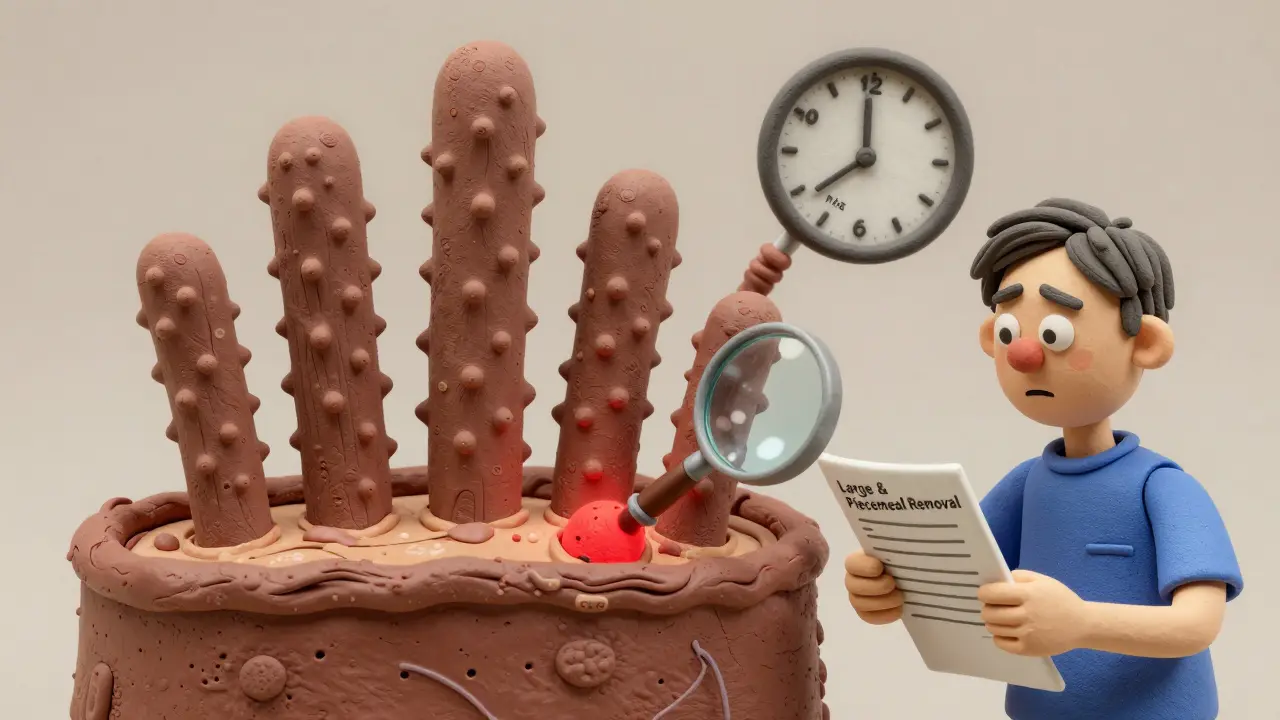
Here’s where it gets messy: if you had a large serrated polyp-say, 10 mm or bigger-or if it was removed in pieces (piecemeal resection), the rules tighten. Many experts now recommend a 6-month follow-up to make sure nothing was left behind. This isn’t about cancer risk yet-it’s about confirming complete removal. If the follow-up is clean, then you can go back to the standard interval.
Hyperplastic polyps (HPs) are usually harmless-but if they’re 10 mm or larger, they’re treated like SSLs until proven otherwise. So if your pathology report says “hyperplastic polyp, 12 mm,” expect a 3-5 year interval. Don’t assume it’s low risk just because the name sounds benign.
What About Polyps Removed in Pieces?
Large polyps-especially those over 20 mm-are often removed in pieces because they’re too big to take out whole. That’s called piecemeal resection. It’s common, but it raises a concern: could some tissue be left behind?
Guidelines differ slightly here. In the U.S., the standard is a 6-month follow-up to check for any remaining tissue. In the UK and Europe, some guidelines suggest two follow-ups: one at 2-6 months and another at 18 months. The goal is the same: make sure the area is clear before returning to long-term surveillance.
Don’t skip this follow-up. A 2023 study found that nearly 15% of large polyps removed piecemeal had residual tissue at the 6-month check. If caught early, it can be removed before it turns dangerous. Waiting a year or more risks missing this window.
Why Do Guidelines Vary Between Countries?
You might notice differences if you’ve read guidelines from the U.S., Europe, or the UK. That’s because each region uses slightly different data. The U.S. guidelines (USMSTF) are more conservative in their risk thresholds. The UK’s BSG/ACPGBI guidelines, for example, allow intervals over 10 years for patients with just one or two small adenomas, based on long-term data from their national screening program.
Europe’s ESGE guidelines give doctors more flexibility, suggesting a 3-6 month window for large polyp resection instead of a fixed 6 months. This lets clinicians tailor follow-up based on how clean the resection looked and how good the bowel prep was.
But here’s the key point: your doctor should follow the guidelines used in your country’s public health system. In the UK, that’s the BSG/ACPGBI/PHE guidelines. In the U.S., it’s USMSTF. Don’t be confused by international variations-ask which standard your provider is using.
Why Do So Many People Get Colonoscopies Too Soon?
Despite clear guidelines, overuse of colonoscopy is a real problem. A 2022 survey found that only 37% of U.S. gastroenterologists could correctly identify all the risk categories in the 2020 guidelines. The biggest gap? Serrated polyps. Only 28% knew the correct interval for one or two small SSLs.
Primary care doctors, who often send patients for follow-up, are even less familiar. Many still believe “one polyp = five years.” This leads to unnecessary procedures. In the U.S., about 64% of early repeat colonoscopies happen because of provider error-not patient risk.
It’s not just about cost. Each colonoscopy carries small risks: bleeding, infection, bowel perforation. Too many procedures mean more complications. And if you’re getting one every three years when you should wait seven, you’re exposing yourself to avoidable risk.
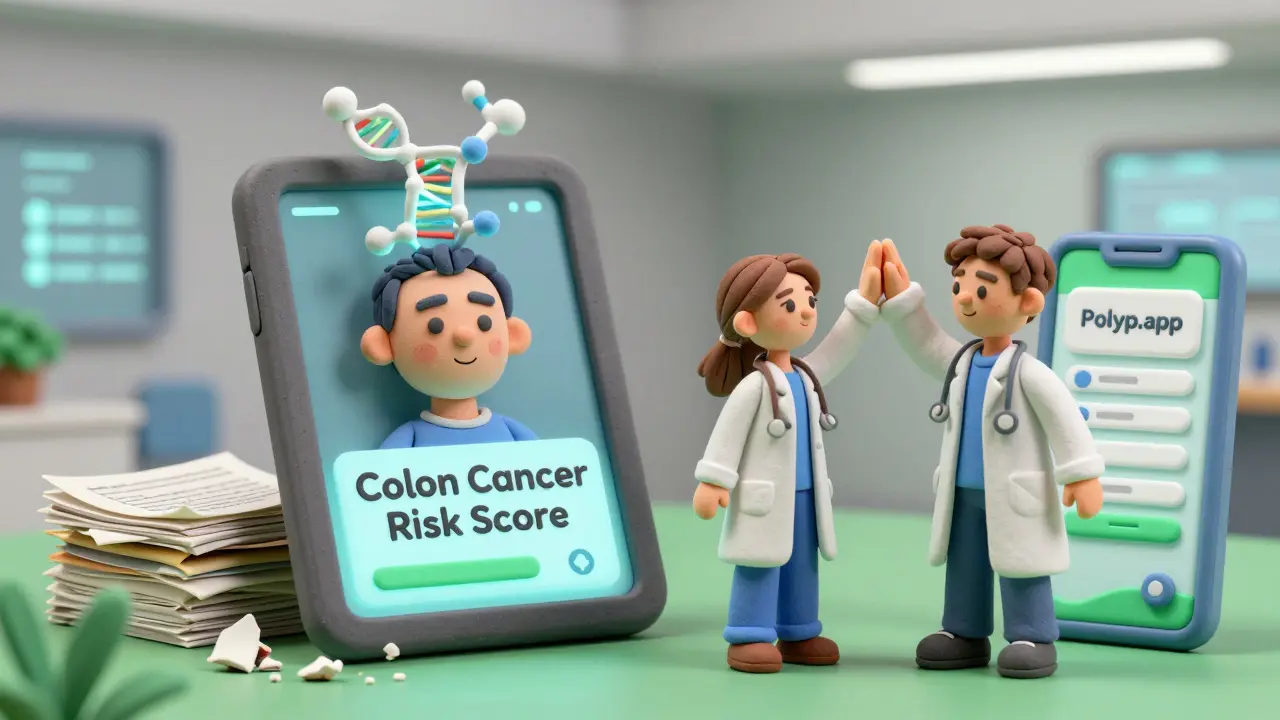
Tools like Polyp.app-a free calculator developed by Massachusetts General Hospital-are helping. It takes your polyp details and spits out the right interval. Ask your doctor if they use it. If not, you can download it yourself.
What’s Next? Personalized Surveillance Is Coming
The future of colonoscopy surveillance isn’t just about counting polyps. Researchers are now testing blood and stool tests that look for DNA changes linked to cancer risk. Trials are underway to see if we can use molecular markers to decide who needs a colonoscopy in three years versus ten.
Imagine a future where your next colonoscopy isn’t scheduled by polyp count-but by your personal risk score. That’s coming. But for now, stick to the guidelines. They’re based on real data from millions of patients.
What If You’re Over 75?
Age matters. Most guidelines stop routine surveillance after 75, unless you’re at high risk. Why? The risk of complications from colonoscopy rises with age, and the benefit of finding a slow-growing polyp drops. If you’re 78 and had a single small adenoma at 70, you likely don’t need another colonoscopy.
But if you have serrated polyposis syndrome (a rare condition where dozens of serrated polyps form), surveillance continues-even past 75. Your doctor should have flagged this if it applied to you.
What Should You Do After Your Colonoscopy?
- Ask for a copy of your pathology report. Know exactly what was found: type, size, number, location.
- Ask your doctor: “Based on the 2020 USMSTF guidelines, what’s my exact risk category?”
- Don’t assume “polyp = 5 years.” Ask if you qualify for 7-10 years.
- If you had a large or piecemeal resection, confirm whether a 6-month follow-up is needed.
- Use tools like Polyp.app to double-check the recommended interval.
- Write down your next appointment date and set a reminder. Don’t rely on your doctor’s office to call you.
Final Thought: Your Colon, Your Schedule
You’ve already done the hard part-you got screened. Now make sure the next step is right. Don’t let outdated advice or confusion push you into unnecessary procedures. The goal isn’t to have colonoscopies every few years-it’s to prevent cancer with the fewest, safest checks possible.
Know your polyp type. Know your interval. Ask questions. And don’t be afraid to push back if your doctor says “five years” when you should be waiting longer.
How soon should I get my next colonoscopy after having one small adenoma removed?
If you had one or two small adenomas (less than 10 mm), current U.S. guidelines recommend waiting 7 to 10 years for your next colonoscopy. This is based on studies showing cancer risk is nearly the same as someone with a normal colonoscopy. Many doctors still say five years out of habit, but the updated guidelines support longer intervals for low-risk cases.
Are serrated polyps as dangerous as adenomas?
Sessile serrated lesions (SSLs) are not the same as adenomas, but they can still lead to cancer-just through a different pathway. They’re harder to spot and remove completely. If you have one or two SSLs under 10 mm, you can wait 5-10 years. But if they’re larger, numerous, or removed in pieces, you’ll need a follow-up in 3-6 months and then possibly every 3-5 years. Don’t assume they’re harmless just because they’re not called adenomas.
Why do I need a follow-up colonoscopy in 6 months after a large polyp was removed?
Large polyps (over 20 mm) are often removed in pieces, which increases the chance that some tissue remains. A 6-month follow-up isn’t about cancer risk-it’s about checking that the area was fully cleared. If tissue is left behind, it can grow back and become dangerous. This follow-up is a safety step, not a sign you’re high-risk.
Can I skip my next colonoscopy if I feel fine?
Colorectal cancer often causes no symptoms until it’s advanced. Feeling fine doesn’t mean you’re safe. Polyps grow slowly, and the goal of surveillance is to catch them before they turn cancerous. Skipping your recommended interval based on how you feel is risky. Stick to the timeline based on your polyp type and number, not your symptoms.
What if my doctor recommends a colonoscopy sooner than the guidelines say?
Ask why. There are valid reasons-like poor bowel prep, incomplete polyp removal, or a family history of cancer. But if your polyps were small, few, and fully removed, and your doctor says “five years” when guidelines say “ten,” it might be outdated advice. Request a copy of your pathology report and ask if the recommendation matches the 2020 USMSTF guidelines. You have the right to understand the reasoning.
