
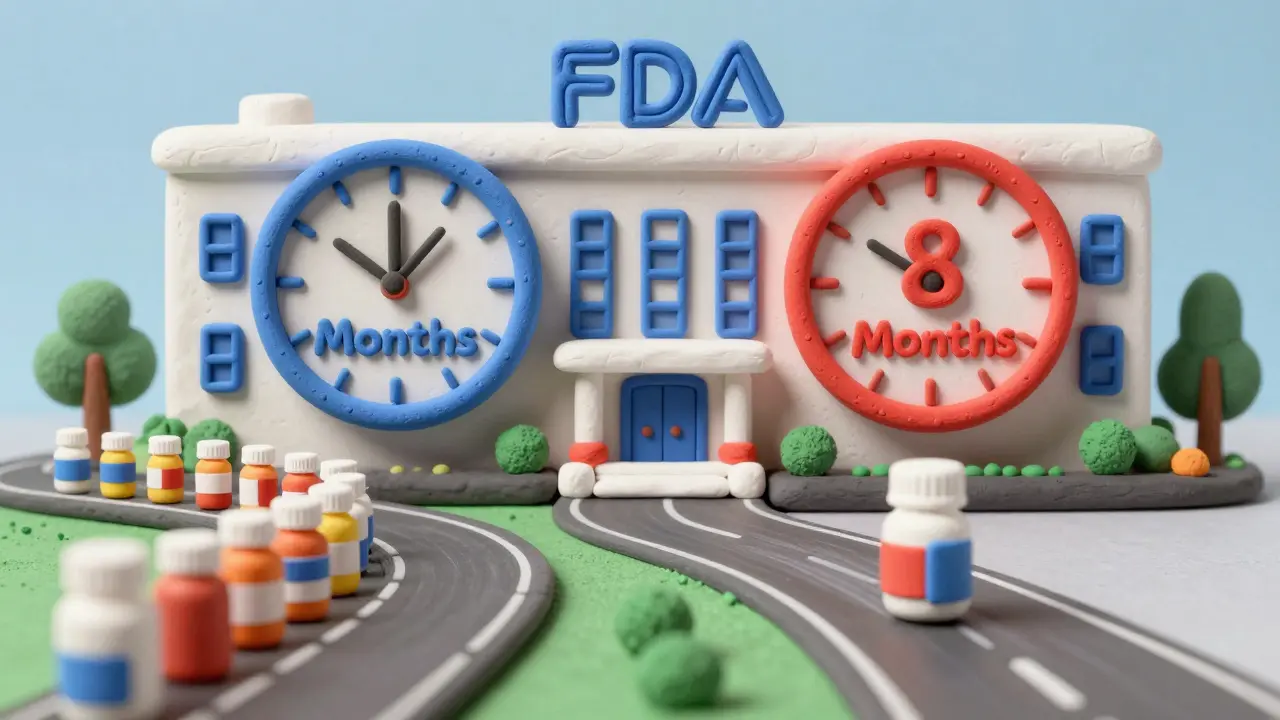
Getting a generic drug approved is not just about proving it works. It is also about timing. The U.S. Food and Drug Administration (FDA) uses two main clocks to measure how fast they review your application. One clock runs for 10 months. The other runs for 8 months. That two-month difference can mean the difference between capturing billions in revenue or watching competitors take the market first. Understanding which clock applies to your Abbreviated New Drug Application (ANDA) is the single most important strategic decision in regulatory affairs today.
If you are a sponsor submitting an ANDA, you need to know exactly where your product fits. Are you chasing a patent expiration? Are you addressing a drug shortage? Or are you manufacturing in the United States? Each of these factors changes your review speed. Let’s break down how the FDA decides who gets the fast lane and who waits in line.
The Two Clocks: Standard vs Priority Review
Under the current Generic Drug User Fee Amendments (GDUFA) III agreement, which runs through fiscal year 2027, the FDA has set strict targets for itself. These are not suggestions; they are contractual commitments backed by user fees paid by industry.
- Standard Review: This is the default path for most generic applications. The Target Action Date (TAD) is 10 months from the date the FDA officially files your application.
- Priority Review: This accelerated path has a TAD of 8 months. It is reserved for specific high-value or high-need scenarios.
It is crucial to understand that the "clock" does not start when you submit your paperwork. It starts only after the FDA completes the initial filing review. This initial check takes up to 74 days. If your application is incomplete, the FDA issues a Refuse-to-Receive (RTR) letter. You then have to fix the errors and pay a new filing fee-$164,880 as of fiscal year 2024-to restart the process. Once the application is deemed "filed," the 10-month or 8-month countdown begins.
Who Qualifies for Priority Review?
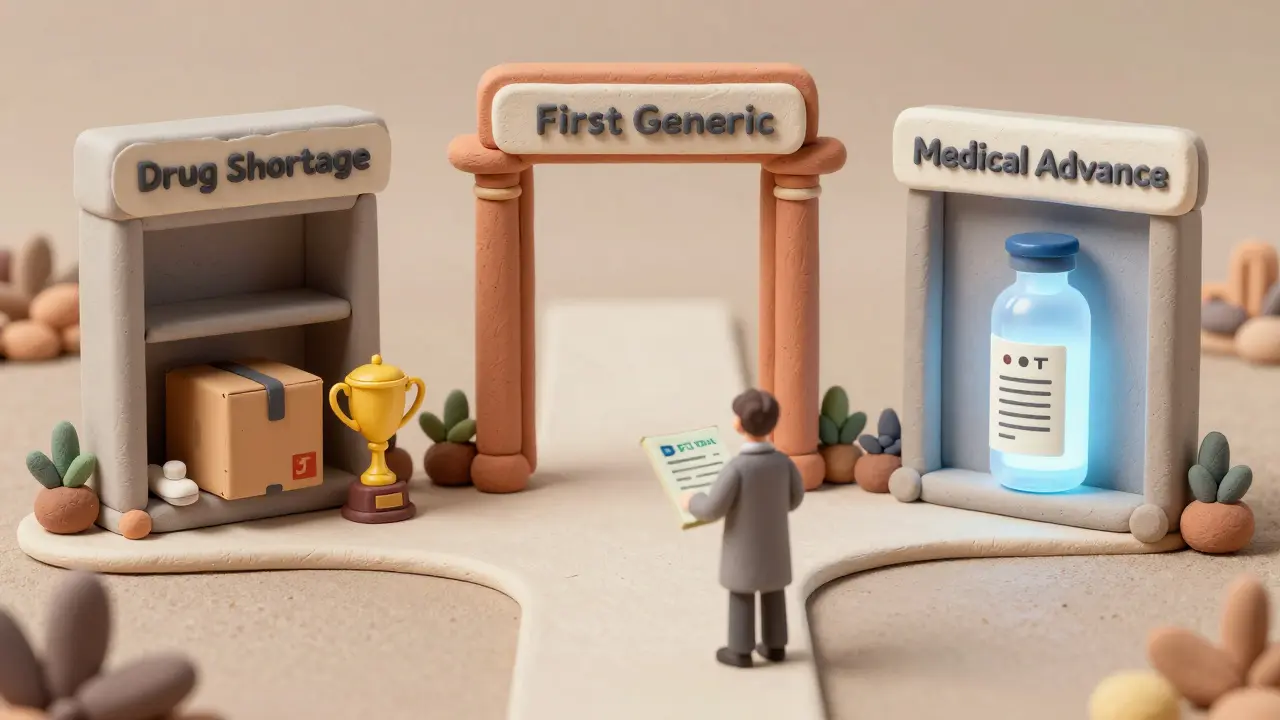
You cannot simply ask for priority review because you want it faster. The FDA grants this status based on three specific criteria defined in their Manual of Policies and Procedures (MAPP 5240.3). Your ANDA must meet at least one of these conditions:
- First Generic Status: You are the first applicant to submit a substantially complete ANDA for a drug product that has no existing generic competition. This usually means you are challenging the brand-name patent or waiting for exclusivity to expire. These products often get 180 days of marketing exclusivity, making them incredibly valuable.
- Drug Shortage: Your product addresses a drug listed on the FDA’s Drug Shortages database. If patients cannot get a medication, the FDA prioritizes getting a safe alternative to market quickly.
- Medically Important Advance: Your generic offers a significant improvement over existing therapies, such as a better dosage form or reduced side effects, though this is rarer for simple generics.
In fiscal year 2022, the FDA showed it could hit these goals. About 83% of priority review applications met the 8-month target, while 72% of standard reviews met the 10-month goal. But hitting the target is not guaranteed. Complex chemistry or manufacturing issues can pause the clock if the FDA asks for more information.
The New Wildcard: The Domestic Manufacturing Pilot
Here is where things got interesting recently. In October 2023, FDA Commissioner Robert M. Califf announced a major shift. The agency launched the ANDA Prioritization Pilot Program. This initiative adds a fourth way to get priority review: by manufacturing in the United States.
This pilot was born out of necessity. During the pandemic, supply chain breaks revealed that the U.S. relies heavily on foreign sources for active pharmaceutical ingredients (APIs). To fix this, the FDA created incentives for companies to bring production home.
To qualify for this specific priority track, you must prove three things:
- Your pivotal bioequivalence testing was done in the U.S. (or you have a valid waiver).
- Your finished dosage forms are manufactured in a U.S. facility.
- Your active pharmaceutical ingredients (APIs) come exclusively from U.S. suppliers.
This is a tall order. Right now, only about 12% of ANDA sponsors meet all three criteria. Most APIs still come from Asia or Europe. However, the incentive is huge. Dr. John Jenkins, a former FDA director, noted that the two-month acceleration in priority review can translate to $200-$500 million in additional revenue for first-to-market products. For many companies, the cost of moving manufacturing to the U.S. is worth that potential gain.
| Review Type | Target Timeline | Key Eligibility Criteria | Strategic Value |
|---|---|---|---|
| Standard Review | 10 Months | Default for most generics | Baseline market entry |
| Priority Review (Traditional) | 8 Months | First generic, drug shortage, or medical advance | High revenue potential due to exclusivity |
| Priority Review (Domestic Pilot) | 8 Months | U.S. testing, U.S. manufacturing, U.S. API sourcing | Supply chain security + speed advantage |
Why Speed Matters More Than Ever
The generic drug market is a race. In 2022, generics accounted for 88.6% of all prescriptions filled in the U.S., but only 15.3% of the total dollar value. Volume is high, but margins are thin unless you are the first one there.
Being the "first generic" allows you to set the price before competitors flood the market. After that window closes, prices drop dramatically. This is why the 180-day exclusivity period is so fiercely fought over in courtrooms. Regulatory speed directly impacts financial outcome.
However, speed is useless if your application fails. The FDA data shows that nearly 32% of original ANDAs received a Complete Response Letter (CRL) in 2022. A CRL means the FDA found major issues and stopped the review. The most common culprit? Chemistry, Manufacturing, and Controls (CMC) deficiencies. If your manufacturing process isn't rock-solid, you will get delayed regardless of whether you have priority status.
How to Avoid Delays and Get Approved Faster
Knowing the rules is step one. Executing them well is step two. Here is how successful sponsors are navigating the current landscape:
- Engage Early with Pre-Submission Meetings: Don’t wait until submission day to talk to the FDA. In 2023, 63% of sponsors held pre-submission meetings, up from 41% in 2020. Companies that did this saw their first-cycle approval rates jump from 24% to nearly 39%. Ask questions about your bioequivalence study design early.
- Audit Your Supply Chain: If you want the domestic manufacturing priority, start auditing your API suppliers now. Switching suppliers late in the game causes massive delays. Verify that your U.S. facilities are registered and inspected.
- Focus on CMC Quality: Since CMC issues cause half of all review interruptions, invest in robust quality control. Ensure your manufacturing processes are consistent and well-documented. A messy CMC section is the fastest way to lose your priority status advantage.
- Monitor the Orange Book: Keep a close eye on the FDA’s Orange Book for patent expirations and litigation outcomes. Timing your submission to align with patent cliffs maximizes your return on investment.
What Comes Next?
The FDA is not standing still. They are planning to introduce AI-assisted review tools by late 2024. Early pilots suggest these tools could cut review times for straightforward applications by nearly 20%. This means the bar for "standard" will keep rising.
For generic manufacturers, the message is clear: efficiency is no longer optional. Whether you go the traditional priority route by being first to market, or the new domestic manufacturing route, you need a flawless application. The two-month gap between standard and priority review is small in calendar time, but enormous in business impact. Plan accordingly.
What is the difference between standard and priority review for FDA generic drugs?
The main difference is the timeline. Standard review has a target action date of 10 months after the application is filed. Priority review has a target action date of 8 months. Priority review is granted to first generics, drugs in shortage, or those meeting specific domestic manufacturing criteria.
How do I qualify for the FDA's domestic manufacturing priority pilot?
To qualify, you must provide documentation proving three things: your bioequivalence testing was conducted in the U.S., your finished dosage forms are manufactured in a U.S. facility, and your active pharmaceutical ingredients (APIs) are sourced exclusively from U.S. suppliers.
When does the FDA review clock start?
The clock starts only after the FDA completes its initial filing review, which takes up to 74 days. If your application is incomplete, you receive a Refuse-to-Receive (RTR) letter, and the clock does not start until you resubmit a complete application and pay the required fee.
What causes the most delays in ANDA approvals?
Chemistry, Manufacturing, and Controls (CMC) deficiencies are the leading cause of delays, accounting for nearly half of all review cycle interruptions. Other causes include complex bioequivalence issues and incomplete labeling.
Is it worth switching to U.S. manufacturing for priority review?
For high-revenue products, yes. Experts estimate the two-month acceleration in priority review can generate $200-$500 million in additional revenue for first-to-market generics. However, it requires significant logistical changes and currently only about 12% of sponsors meet all the criteria.


