
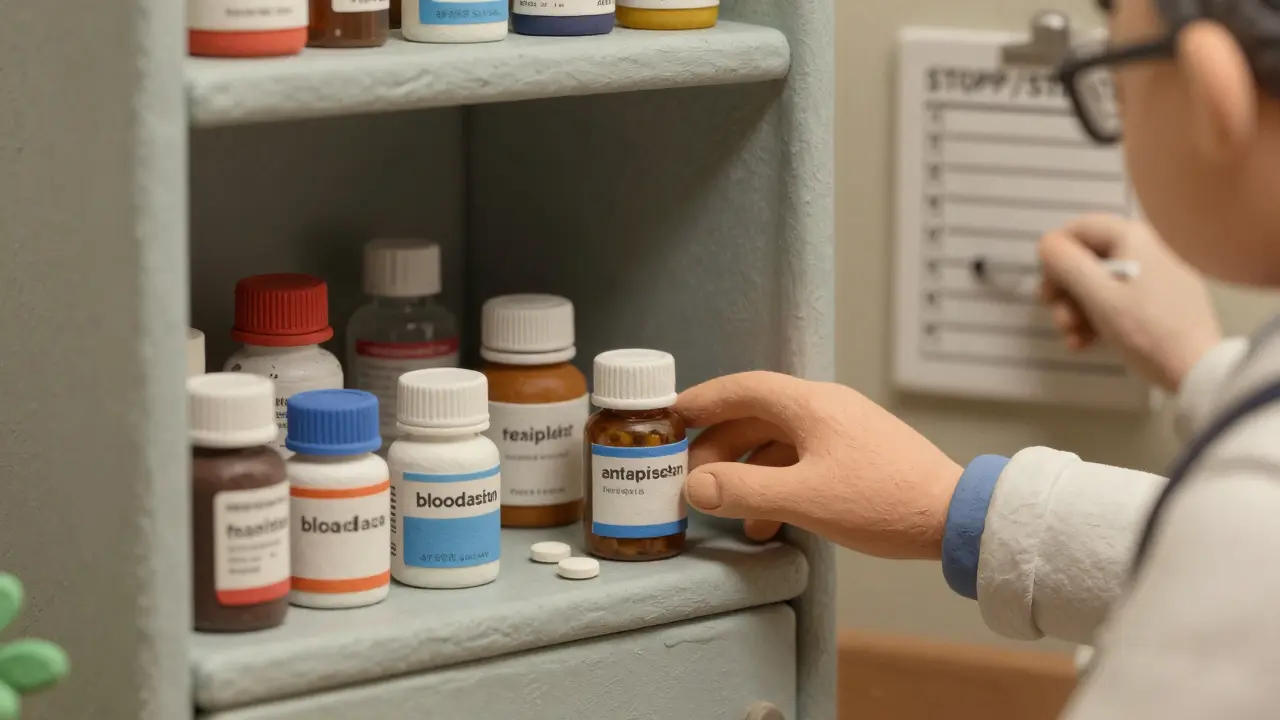
Polypharmacy Risk Assessment Tool
This tool helps identify potential medication risks in older adults based on the article's clinical guidelines. Enter details to calculate your risk level and receive personalized recommendations.
Risk factors
When an older adult takes five or more medications, it’s not just common-it’s dangerous. Polypharmacy isn’t a diagnosis. It’s a risk. And for people over 65, especially those with multiple chronic conditions, it’s one of the leading causes of hospital stays, falls, confusion, and even death. The good news? We know how to fix it. But only if we do it right.
Why Five Medications Is a Red Flag
There’s no magic number, but in clinical practice, five is the line. If someone’s on five or more prescriptions, their chance of having a serious adverse drug event jumps by 30% to 50%. That’s not a small risk. That’s life-changing. And for every extra pill added, the risk of a fall goes up by about 8%. That’s not because one of the drugs is bad-it’s because the mix becomes unpredictable. Older bodies process medications slower. Kidneys and livers don’t work like they used to. And when you stack drugs together-blood pressure pills, painkillers, sleep aids, antidepressants, heart meds-the interactions aren’t always obvious.In the U.S., 41% of adults over 65 are on five or more medications. Nearly 1 in 5 are on ten or more. That’s not because doctors are careless. It’s because each specialist sees one piece of the puzzle. The cardiologist adds a beta-blocker. The neurologist prescribes a seizure med. The rheumatologist gives a steroid. No one steps back and asks: Is this whole stack safe?
The Real Problem Isn’t Too Many Drugs-It’s the Wrong Drugs
The goal isn’t to slash prescriptions. It’s to deprescribe-to stop what doesn’t help and keep what does. Too many programs focus only on cutting numbers. That’s dangerous. About 12.8% of deprescribing attempts remove medications that should have stayed, according to STOPP/START validation studies. A 78-year-old with heart failure might lose their diuretic because someone counted pills. But without it, they end up back in the hospital with fluid overload.That’s why tools like the Beers Criteria (updated in 2023 by the American Geriatrics Society) and the STOPP/START criteria (version 3, 2021) matter. These aren’t checklists. They’re clinical guides. Beers tells you which drugs to avoid in older adults-like benzodiazepines for sleep or anticholinergics for overactive bladder. STOPP/START goes further: it says when to stop something harmful (STOPP) and when to start something missing (START). For example, an older adult with osteoporosis and a history of fracture might need a bone-building drug-but no one ever prescribed it. That’s undertreatment. And it’s just as common as overmedication.
Dr. Michael Steinman from UCSF puts it simply: “Don’t just look at the number of pills. Look at the person.” Life expectancy. Goals of care. Quality of life. A 90-year-old with advanced dementia doesn’t need a statin for cholesterol. A 72-year-old with heart disease and active goals? That statin might still be lifesaving.
What Actually Works: The Three Types of Interventions
Not all medication reviews are equal. Studies show three levels:- Type I: Just looking at the prescription list. No patient contact.
- Type II: Add a check on whether the patient is taking the meds as prescribed.
- Type III: Face-to-face or video consultation with a pharmacist or geriatrician who reviews meds AND clinical status.
Only Type III works. A 2023 JAMA Network Open study found Type III reduced hospital readmissions by 18.3%. Types I and II? No difference. Why? Because you can’t fix a medication problem without understanding the person behind it. A pill that looks unnecessary on paper might be the only thing keeping someone out of the ER. A drug you think is safe might be causing dizziness they never mentioned.
And here’s the kicker: pharmacist-led reviews under Collaborative Practice Agreements (CPAs) deprescribe 37.6% more often than physician-only approaches. Pharmacists are trained to spot interactions. They know the subtle signs of side effects. But CPAs aren’t available in 28 U.S. states. That’s a barrier.

Who Benefits Most-and Who Doesn’t
Interventions don’t work the same for everyone. The biggest wins? People aged 65 to 79. In this group, deprescribing cuts mortality by nearly 15%. For those over 80? The benefit drops to 5.2%-and it’s not even statistically significant. Why? Frailty. Complexity. Less reserve. Aggressive changes can backfire.Patients with dementia benefit far less. They’re 19.3% less likely to see improvement from polypharmacy interventions. Why? Communication. Memory. Inability to report side effects. And families often resist stopping meds “just in case.”
Even the most careful deprescribing can go wrong. Dr. Dan Berlowitz’s team found that 7.3% of patients had disease flare-ups after stopping meds too fast-like sudden high blood pressure after ditching a beta-blocker without a plan. That’s why tapering matters. Never pull a drug cold turkey. Especially not antidepressants, steroids, or blood pressure meds.
How to Do It Right: A Real-World Workflow
Here’s what a successful intervention looks like in practice:- Get the real list. Patients forget, mix up bottles, or take over-the-counter drugs. Medication reconciliation takes an average of 22.7 minutes. Don’t skip this.
- Use STOPP/START or FORTA. These tools are evidence-based. Beers is good for avoidance, but STOPP/START tells you what to add and remove.
- Review with the patient. Ask: “What are you hoping to get from this medicine?” “Have you noticed any side effects?” “Are you scared to stop something?”
- Taper, don’t quit. Give the body time. A benzodiazepine might need 6-8 weeks to come off safely.
- Follow up. Check in at 2 weeks, then 4. Watch for withdrawal, rebound symptoms, or new problems.
At Duke University, they use their “Five Tips” approach: get the list, check for duplication, eliminate low-value drugs, prioritize symptoms over labels, and involve the patient. Simple. Effective.

The Hidden Barriers
Even when you know what to do, doing it is hard. Primary care doctors report having less than five minutes per patient to review meds. Only 15% of Medicare Advantage plans pay for comprehensive medication reviews. And 78% of older adults see five or more providers a year. No one talks to each other.Electronic health records don’t help much either. Only 32.7% track medication adherence properly. And patients? 68.4% are afraid to stop meds. They think “if it’s prescribed, it must be necessary.” That’s a myth.
Success stories exist. The Veterans Health Administration cut potentially inappropriate medications by 26.8% using embedded pharmacists. Academic centers with geriatric-trained pharmacists resolve 42.6% more drug problems than regular clinics. But most community hospitals? Still flying blind.
The Future Is Here-And It’s AI
In April 2024, Epic Systems launched its “Polypharmacy Risk Score”-an AI tool that scans EHRs and flags patients at high risk of adverse events. In testing, it was 87.3% accurate. That’s not science fiction. That’s now.The American Geriatrics Society is finalizing Beers Criteria 2026, with new deprescribing algorithms. The National Institute on Aging is funding research into personalized risk calculators using genomic data. By 2030, experts predict comprehensive polypharmacy management will be standard care.
And it’s not just clinical-it’s financial. Polypharmacy costs the U.S. $30.1 billion a year. Two-thirds of that is from preventable hospitalizations. CMS started penalizing providers in 2024 if more than 30% of their Medicare patients are on ten or more meds. That’s a wake-up call.
For every dollar spent on pharmacist-led reviews, you save $1,872 in avoided hospital visits. That’s not just good medicine. It’s smart economics.
What You Can Do Today
If you’re caring for an older adult on multiple meds:- Ask for a full medication review-don’t wait for a crisis.
- Bring every pill bottle, supplement, and OTC drug to the appointment.
- Ask: “Which of these are still helping? Which might be hurting?”
- Don’t assume a drug is necessary just because it’s been taken for years.
- Insist on a plan for tapering, not stopping.
It’s not about fewer pills. It’s about better health. One less pill might mean one more fall avoided. One less hospital stay. One more day at home, with dignity.
What is considered polypharmacy in older adults?
Polypharmacy is generally defined as the regular use of five or more medications. This threshold is used by major organizations like the American Geriatrics Society and the American Academy of Family Physicians because research shows the risk of adverse drug events increases sharply at this point. It’s not about the number alone-it’s about whether each medication is still necessary, safe, and aligned with the patient’s goals.
Can deprescribing cause harm?
Yes, if done too quickly or without proper monitoring. About 7.3% of patients experience disease exacerbation after inappropriate discontinuation-like rebound hypertension after stopping a beta-blocker or withdrawal seizures from abrupt benzodiazepine removal. Safe deprescribing means tapering slowly, watching for symptoms, and having a follow-up plan. Never stop a medication cold turkey without professional guidance.
Which tools are best for identifying inappropriate medications?
The most evidence-backed tools are STOPP/START (v3, 2021) and FORTA (Fit fOR The Aged). STOPP identifies potentially inappropriate prescriptions; START identifies treatments that are missing. The Beers Criteria (2023) is useful for avoiding harmful drugs but doesn’t guide what to add. Only STOPP/START and FORTA have been shown in randomized trials to improve real-world outcomes like hospitalizations and mortality.
Who should lead polypharmacy interventions?
Pharmacists, especially those trained in geriatrics, are the most effective leads. Studies show pharmacist-led reviews under Collaborative Practice Agreements achieve 37.6% higher deprescribing rates than physician-only approaches. They’re trained to detect interactions, assess adherence, and communicate risks clearly. But they need access to patient records and authority to adjust prescriptions-something not available in all states or clinics.
Are there new technologies helping with polypharmacy?
Yes. In 2024, Epic Systems launched its Polypharmacy Risk Score, an AI tool that analyzes electronic health records to predict which patients are most likely to have adverse drug events. It was 87.3% accurate in validation studies. Other tools are being developed to incorporate genomic data and life expectancy estimates to personalize deprescribing plans. These aren’t replacements for clinical judgment-they’re force multipliers for busy providers.


