
29 November 2025

Basal-Bolus vs Premixed Insulin: Side Effects and Daily Life Impact

Basal-Bolus vs Premixed Insulin: Side Effects and Daily Life Impact

Insulin Regimen Selector

Which Insulin Regimen Fits Your Life?

This tool analyzes your daily routine to determine whether basal-bolus or premixed insulin might better suit your needs based on scientific research and real-world experience.

Your Recommendation

Why This Match

Important Note: This tool provides general guidance. Always discuss your insulin regimen with your healthcare provider.
Key Considerations:

    Choosing between basal-bolus and premixed insulin isn’t just about numbers on a glucose meter. It’s about whether you can stick with it when your schedule gets messy, when you’re tired, or when your blood sugar drops in the middle of the night. The right insulin plan doesn’t just control your blood sugar-it fits your life. And the side effects? They’re not the same for everyone.

    How Basal-Bolus Insulin Works

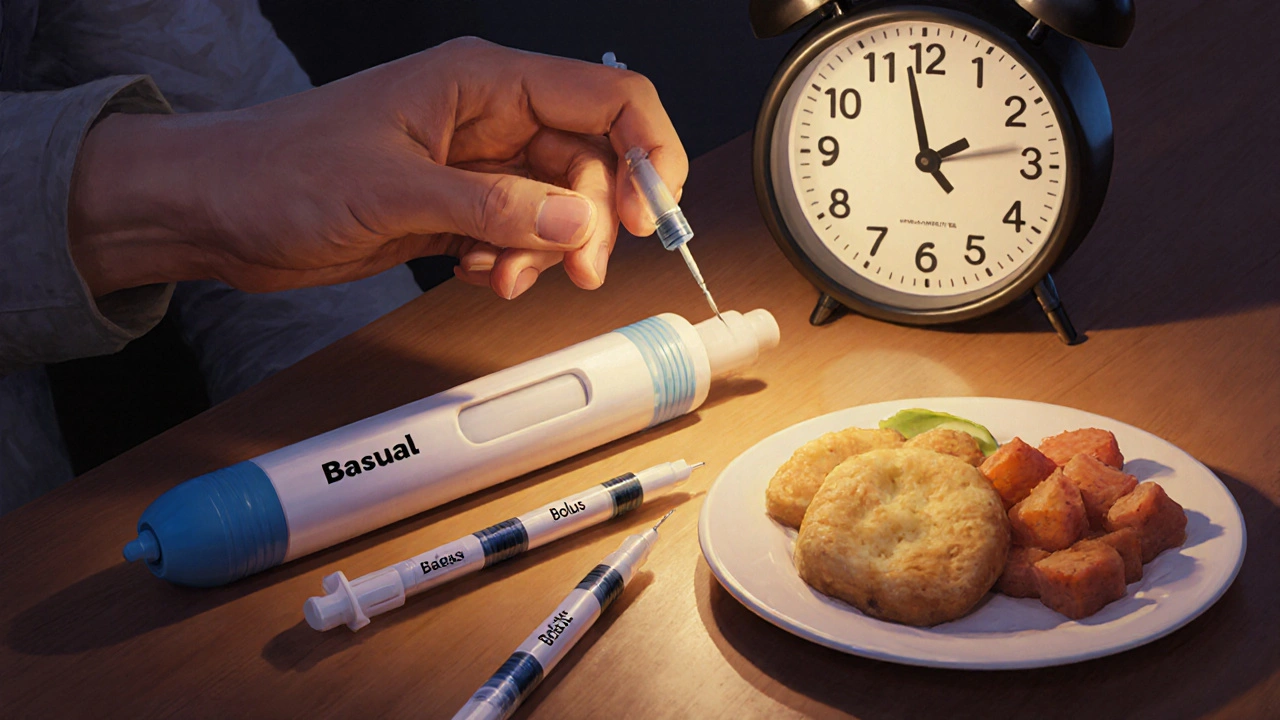
    Basal-bolus therapy means two kinds of insulin working together. One is long-acting, called basal insulin, which keeps your blood sugar steady between meals and overnight. The other is rapid-acting, called bolus insulin, taken right before meals to handle the sugar spike from food. Most people need four to five injections a day: one or two for basal, and one before each meal plus an extra correction dose if needed.

    This system gives you control. Eat a big pasta dinner? Take more bolus. Skip lunch? Skip the bolus. Got a late-night snack? You can cover it. That flexibility is why it’s the gold standard for type 1 diabetes and many with type 2 who need tight control. But it’s not simple. You need to count carbs, check your blood sugar before every meal, and adjust doses based on what you eat and how active you are. It’s a lot of math, and it takes time to get good at it.

    How Premixed Insulin Works

    Premixed insulin is a one-two punch in a single shot. It combines a fixed amount of intermediate-acting insulin (like NPH) with rapid- or short-acting insulin. Common ratios are 70/30 or 75/25-meaning 70% long-acting, 30% fast-acting. You typically take it twice a day, before breakfast and dinner. Some people take it three times a day if they eat more frequently.

    It’s simpler. No carb counting. No guessing how much to take before each meal. Just two or three shots, same time, same dose. That’s why it’s popular with older adults, people with memory issues, or those who find multiple daily injections overwhelming. But here’s the catch: you have to eat the same amount of carbs at the same time every day. Miss a meal? Your blood sugar can crash. Eat more than usual? You’re stuck with high blood sugar until your next shot.

    Side Effects: Hypoglycemia Is the Big Difference

    The biggest worry with any insulin is low blood sugar. And here’s where basal-bolus and premixed diverge sharply.

    Studies show premixed insulin carries a higher risk of hypoglycemia-especially at night and between meals. Why? Because the long-acting part doesn’t last evenly. NPH peaks around 4-8 hours after injection, which can cause a sudden drop if you haven’t eaten or if you’re active. A 2015 trial had to stop early because over half the people on premixed insulin had dangerous lows. That’s not a small risk-it’s a safety alarm.

    Basal-bolus users have lower rates of nighttime lows. Why? Their basal insulin (like glargine or degludec) releases slowly and steadily, without big peaks. They only take fast-acting insulin when they eat. So if they skip a meal, they skip the bolus. No insulin, no crash. That’s a big deal for people who work night shifts, have unpredictable schedules, or just don’t always feel hungry.

    Elderly person taking premixed insulin at a fixed mealtime with a daily schedule.

    Weight Gain: It’s Not as Big a Deal as You Think

    People often worry insulin makes them gain weight. That’s true-but not equally true for both regimens.

    Studies show basal-bolus users gain slightly more weight on average-about 1.9 kg over time-compared to 1.0 kg with premixed. Why? Because basal-bolus lets you eat more freely. You can cover higher-carb meals without fear of spikes, so you might eat more. Premixed users, on the other hand, are stuck with fixed portions. They can’t easily adjust, so they often eat less to avoid highs.

    But here’s the real story: weight gain isn’t about the insulin itself. It’s about how much you eat and how active you are. If you’re eating more because you feel better (no more glucose spikes and crashes), that’s not necessarily bad. It’s your body finally getting the fuel it needs.

    Lifestyle Fit: Flexibility vs Routine

    This is where the real battle lies-not in the lab, but in your kitchen, your car, your job, your social life.

    Basal-bolus wins for flexibility. Need to eat dinner at 9 p.m. after work? No problem. Going out for pizza on Friday? Take your bolus. Traveling across time zones? Adjust your basal dose. You’re not chained to a clock. But this freedom comes at a cost: you need to be willing to learn, track, and think about food constantly. It’s not for everyone.

    Premixed insulin demands routine. You eat breakfast at 8 a.m., lunch at 1 p.m., dinner at 6 p.m. You can’t skip. You can’t delay. You can’t change your mind. That’s fine if you’re retired, live alone, and eat the same meals every day. But if you’re a parent, a shift worker, or someone who eats on the go? You’ll feel trapped. One Reddit user wrote: “I switched from premixed to basal-bolus because missing a meal meant risking hypoglycemia-even if my sugar was normal.” That’s not a small frustration. It’s a daily stressor.

    On the flip side, many older adults say premixed saved their lives. One 78-year-old on the ADA forum said: “Two shots a day instead of four has made managing my diabetes possible since my arthritis makes multiple injections painful.” For them, simplicity isn’t a compromise-it’s survival.

    Cost and Accessibility Matter

    Let’s talk money. Basal-bolus usually costs more. You’re buying two or three separate insulin products: basal, rapid-acting, and sometimes a backup pen. Medicare data shows average monthly out-of-pocket costs of $68.20 for basal-bolus versus $45.75 for premixed.

    That gap matters. In the U.S., it’s a barrier. In parts of Asia, where premixed insulin is used in over half of cases, cost and access drive the choice. In the UK and Europe, basal-bolus adoption is rising fast-not because it’s cheaper, but because technology is making it easier.

    Person using CGM with AI suggestion icon, surrounded by various food options.

    Technology Is Changing the Game

    You don’t have to do all the math yourself anymore.

    Continuous glucose monitors (CGMs) have changed everything. A 2022 study found that CGM users on premixed insulin had hypoglycemia rates nearly cut in half-down to just 0.2 events per month. That’s because they see their glucose dropping before it becomes dangerous. They can eat a snack, pause, or adjust.

    And now there’s AI. Systems like Diabeloop’s DBLG1 can analyze your glucose trends and suggest insulin doses automatically. Early trials show patients using AI tools need 27% fewer decisions per day. That’s huge. It’s turning basal-bolus from a complex chore into a smart assistant.

    Even new insulins are helping. The FDA approved a “basal-plus” option in 2023-a single injection that gives you steady basal coverage with the option to add a quick bolus if you eat more. It’s a middle ground for people who want flexibility without five daily shots.

    Who Gets Which Regimen?

    There’s no one-size-fits-all. But guidelines give clear clues.

    Basal-bolus is best for:

    • People with type 1 diabetes
    • Those with high post-meal spikes
    • People who eat irregular meals or travel often
    • Those willing to learn carb counting and use a CGM
    • Anyone who wants the tightest possible control

    Premixed insulin is best for:

    • Older adults with arthritis or memory issues
    • People with very consistent daily routines
    • Those with limited access to diabetes education
    • Patients who fear multiple injections
    • Those in areas where insulin costs are high and CGMs aren’t available

    The American Diabetes Association says it plainly: choose based on your life, not just your numbers. Your doctor should ask: “Can you stick with this?” not just “Will it lower your HbA1c?”

    What If You’re Not Sure?

    Start with what’s easiest to manage. If you’re new to insulin, premixed might be a good first step. But don’t stay there if it’s making you anxious, hungry, or scared of lows.

    Many people start on premixed, then switch to basal-bolus when they realize they’re missing meals, gaining weight, or feeling restricted. Others start with basal-bolus and go back to premixed because the daily workload is too much.

    There’s no shame in switching. Insulin therapy isn’t a life sentence-it’s a tool. And tools should fit your hands, not force you to reshape your life for them.

    Ask your doctor for a trial. Try one regimen for 8-12 weeks. Track your lows, your energy, your meals, your stress. See what works. Then adjust. You’re not failing if you change plans. You’re being smart.

    Written by:
    William Blehm
    William Blehm

    Comments (12)

    1. Matthew Higgins
      Matthew Higgins 30 November 2025

      Man, I switched from premixed to basal-bolus last year after my night shifts started messing with my sugar. Used to wake up drenched in sweat, heart racing-classic hypoglycemia. Now? I just skip the bolus if I’m not eating. No more midnight panic attacks. Life’s weird, but my glucose is stable.

      Also, I eat pizza at 2 a.m. now. No regrets.

    2. Sullivan Lauer
      Sullivan Lauer 1 December 2025

      Let me tell you something-this isn’t just about insulin, it’s about FREEDOM. Premixed insulin is like being forced to eat oatmeal for breakfast every single day of your life, even when you crave pancakes. Basal-bolus? It’s the difference between being handcuffed to a schedule and being the CEO of your own damn metabolism.

      I used to be terrified of carb counting. Thought I’d need a PhD in math. Turns out? My phone does it for me now. CGM + app = magic. I went from 14 HbA1c to 6.1 in 8 months. Not because I’m special. Because I stopped letting my diabetes run my life.

      And yeah, I gained 2 kilos. So what? I’m not a skeleton anymore. I can hug my niece without worrying I’ll pass out. That’s not weight gain-that’s dignity restored.

      Don’t let anyone tell you ‘simplicity’ is better if it’s just another cage. You deserve to live, not just survive.

      Also-yes, the cost sucks. But if your insurance won’t cover it, ask for samples. Ask for patient assistance. Fight for your health. You’re worth it.

    3. Sohini Majumder
      Sohini Majumder 2 December 2025

      OMG I CANT BELIEVE PEOPLE STILL USE NPH??? LIKE IT’S 2005??

      Basal-bolus is the ONLY way. Premixed is for people who think ‘glucose monitor’ is a type of yoga.

      Also, I saw a guy on Reddit say he uses premixed because ‘his arthritis makes injections hard’-bro, get a pen injector. Or better yet, get a pump. Stop living in the dark ages.

      And weight gain? DUH. If you’re eating more because you’re not crashing all day, that’s not ‘fat’-that’s your body finally NOT being starved by bad insulin.

      Also, why are we still talking about this? AI dosing is here. We’re basically cyborgs now. Get with it.

    4. tushar makwana
      tushar makwana 3 December 2025

      I’m from India, and here, most people use premixed because it’s cheaper and easier to find. My uncle, 72, uses 70/30. He doesn’t count carbs. He eats roti and dal at the same time every day. He’s happy. His sugar is okay.

      Basal-bolus? Too much for him. He forgets to check. His hands shake too much to fill syringes. So we don’t push it.

      But I know friends in the US who use basal-bolus with CGMs and they say it’s life-changing. Maybe it’s not one size fits all. Maybe it’s about what fits your life.

      No shame in either. Just need support.

      Also, I love how the post said ‘tools should fit your hands.’ That’s true for everything.

    5. Jennifer Wang
      Jennifer Wang 5 December 2025

      While the narrative presented is largely accurate, it is imperative to acknowledge that the clinical superiority of basal-bolus regimens is contingent upon patient adherence, access to continuous glucose monitoring, and comprehensive diabetes education-all of which remain inequitably distributed across socioeconomic strata.

      Furthermore, the assertion that premixed insulin carries a higher risk of nocturnal hypoglycemia is corroborated by multiple randomized controlled trials, including the DIAMOND study (2017) and the EDITION program (2019), wherein NPH-containing premixes demonstrated a 2.3-fold increase in severe hypoglycemic events compared to basal analogs.

      Cost differentials, while significant, must be contextualized within national healthcare frameworks. In resource-limited settings, the marginal benefit of basal-bolus therapy may not outweigh the logistical burden.

      Therefore, the ADA’s recommendation to prioritize ‘stickability’ over glycemic targets remains clinically sound and ethically imperative.

    6. Mary Kate Powers
      Mary Kate Powers 6 December 2025

      I was on premixed for 5 years. I hated it. I felt like I was on a leash. Then I switched. First month was a mess-I messed up doses, ate too much, panicked over numbers. But then… it clicked. I stopped fearing food. Started hiking again. Went on a trip to Japan and ate ramen at 1 a.m. and didn’t crash.

      It’s not easy. But it’s worth it.

      If you’re thinking about switching? Do it. Talk to a diabetes educator. Get a CGM if you can. You’re not failing if it takes time. You’re learning.

      You got this.

    7. Bernie Terrien
      Bernie Terrien 8 December 2025

      Premixed is a Band-Aid on a bullet wound. NPH peaks? That’s not insulin-that’s a sugar rollercoaster with a blindfold on. Basal-bolus isn’t ‘complicated’-it’s honest. You want control? Then do the work. Stop pretending simplicity is a virtue when it’s just avoidance.

      And yeah, you’ll gain weight. Good. You’re not dying of starvation anymore. Your body’s finally getting fuel. That’s not a side effect-that’s a win.

      Also, AI dosing? Yeah, it’s coming. But you still gotta eat. Still gotta move. Still gotta care. No app replaces that.

    8. Sara Shumaker
      Sara Shumaker 10 December 2025

      What’s interesting is how this mirrors the larger question of autonomy in chronic illness. We’re told to optimize, to control, to perfect-but what if the goal isn’t perfection, but peace? Premixed gives peace through predictability. Basal-bolus gives peace through freedom. Both are valid. Both are human.

      I used to think ‘better control’ meant lower HbA1c. Now I think it means fewer panic attacks at 3 a.m. Fewer arguments with my partner about why I can’t eat dessert. Fewer times I canceled plans because I was too scared to leave the house.

      Maybe the real metric isn’t glucose numbers. Maybe it’s how often you feel like yourself.

      And if your insulin lets you be that person? That’s the right one.

    9. jamie sigler
      jamie sigler 10 December 2025

      Ugh. Another post pretending this is a choice. It’s not. It’s a privilege. Most people can’t afford CGMs. Can’t afford basal insulin. Can’t afford to miss work to learn carb counting.

      So yeah, basal-bolus is ‘better.’ But only if you’re rich. For the rest of us? We’re just trying not to die.

      Stop romanticizing ‘freedom.’ Not everyone gets to choose.

    10. Richard Thomas
      Richard Thomas 10 December 2025

      While the article presents a compelling anecdotal framework, it fails to adequately address the pharmacokinetic limitations of intermediate-acting insulins, particularly the inherent variability of NPH absorption, which introduces significant inter- and intra-patient heterogeneity in time-action profiles. This renders premixed regimens inherently less predictable than modern basal analogs, which exhibit near-constant release kinetics.

      Moreover, the assertion that weight gain is ‘not necessarily bad’ lacks empirical substantiation in longitudinal metabolic studies, wherein insulin-induced adipogenesis is demonstrably correlated with increased visceral adiposity and insulin resistance-a counterproductive outcome in type 2 diabetes management.

      Furthermore, the normalization of ‘eating more’ under basal-bolus therapy may inadvertently promote caloric excess, particularly in populations with limited nutritional literacy.

      Technological augmentation, while promising, does not eliminate the fundamental requirement for patient engagement, which remains the most significant predictor of therapeutic success across all regimens.

    11. stephen idiado
      stephen idiado 11 December 2025

      Basal-bolus is overrated. Premixed is the OG. Real diabetics don’t need apps. Real diabetics eat when the sun says. No CGM. No AI. Just discipline. You want flexibility? Get a job that doesn’t suck. Stop blaming insulin for your poor life choices.

      Also, NPH is fine. You’re just lazy.

    12. Latika Gupta
      Latika Gupta 12 December 2025

      I started on premixed because my mom said ‘two shots a day is enough.’ Now I’m on basal-bolus because I nearly passed out at my daughter’s school play because I skipped lunch and my sugar crashed. I didn’t want to scare her. So I changed. No big speech. Just… I did it.

      Still hate counting carbs. Still hate needles. But I don’t hate living anymore.

    Write a comment

    Please check your email
    Please check your message
    Thank you. Your message has been sent.
    Error, email not sent