

When medications fail to control seizures, epilepsy surgery becomes one of the most effective options - yet it’s still vastly underused. About 1 in 3 people with epilepsy don’t respond to drugs, and for many of them, surgery could mean the difference between daily seizures and living seizure-free. But too many patients wait years before even being evaluated. The truth is, if you’ve tried two or more appropriate anti-seizure medications and still have disabling seizures, you’re likely a candidate - not a last resort.
Who Qualifies for Epilepsy Surgery?
< p>Not everyone with epilepsy is eligible. Surgery works best when seizures start in one specific area of the brain - called a focal onset. If seizures come from everywhere at once (generalized epilepsy), surgery is rarely helpful. The key is finding where the seizures begin.The International League Against Epilepsy (ILAE) says you should be considered for surgery as soon as two medications fail. You don’t need to wait two years. That old rule is outdated. If you’re having at least one disabling seizure a month, your life is being disrupted - whether it’s driving, working, or even leaving the house. That’s the real threshold, not time.
Pediatric cases are even more urgent. Kids with conditions like tuberous sclerosis complex or infantile spasms often need surgery early. In fact, up to 90% of children with tuberous sclerosis are drug-resistant. Waiting can mean permanent brain changes. The Epilepsy Surgery Alliance now recommends referral after just two failed medications - no need to exhaust every drug first.
But here’s the catch: most people never get referred. In the U.S., only about 0.6% of people with drug-resistant epilepsy are sent to epilepsy centers each year. Meanwhile, studies show up to 40% of this group could benefit from surgery. That’s a huge gap. Many doctors still think surgery is a final option. It’s not. It’s a timely intervention.
The Evaluation Process: What to Expect
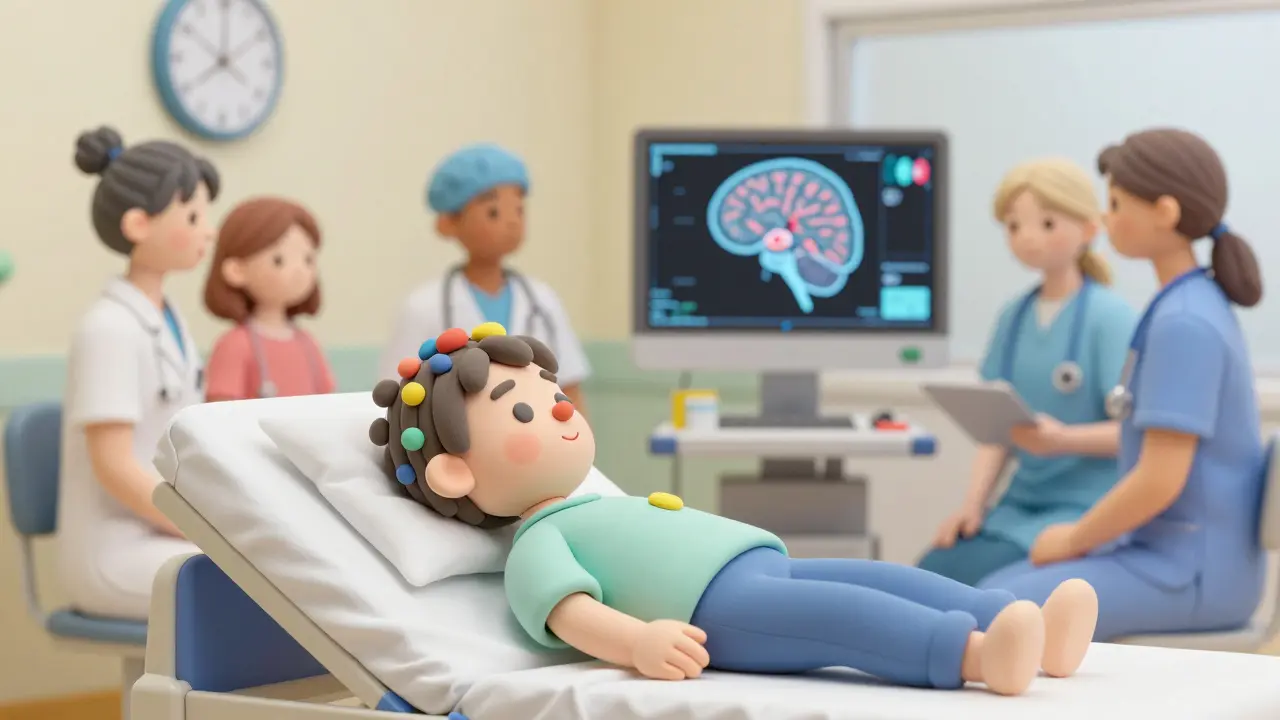
Before surgery, you go through a detailed evaluation - usually at a Level 4 epilepsy center. These are specialized hospitals with full teams: epileptologists, neurosurgeons, neuropsychologists, and EEG technicians. You’ll spend days in the hospital hooked up to video-EEG monitors, recording your seizures. This isn’t just about counting seizures - it’s about finding where they start.
High-resolution 3T MRI scans look for scars, tumors, or malformations in the brain. A PET scan shows areas with low metabolism - often the seizure focus. Neuropsychological testing checks memory, language, and thinking skills. If those tests point to one area, and it matches your seizure patterns, you’re likely a good candidate.
In some cases, doctors need to go deeper. Intracranial EEG - placing electrodes directly on or inside the brain - helps map the exact origin. This is invasive, but it’s done only when non-invasive tests aren’t clear. It’s not routine, but it’s life-changing when needed.
Insurance is another hurdle. About 42% of initial requests are denied. But 78% of appeals get approved. Keep pushing. Your care team should help you navigate this. Patient navigators - like those from the Epilepsy Surgery Alliance - have cut no-show rates by more than half. They help with paperwork, scheduling, and even travel.
Types of Surgery and What They Do
The most common surgery is a temporal lobe resection. It’s done for mesial temporal lobe epilepsy, often caused by hippocampal sclerosis. This one condition alone accounts for nearly half of all epilepsy surgeries. Success rates? Between 65% and 70% of patients become seizure-free after two years. That’s far better than the 5% chance of spontaneous remission with meds alone.
For other focal areas - like the frontal, parietal, or occipital lobes - surgeons remove the exact spot causing seizures. Accuracy matters. If the focus isn’t well-defined, surgery won’t help. That’s why evaluation is so critical.
Newer techniques are changing the game. Laser interstitial thermal therapy (LITT) uses a thin probe to heat and destroy the seizure focus through a small hole. It’s less invasive than traditional resection. One-year seizure freedom is around 55%, with complications under 3%. Recovery is faster. It’s not for everyone, but for some, it’s a better option.
For people who aren’t candidates for removal, devices like responsive neurostimulation (RNS) are growing. The device detects abnormal brain activity and delivers a tiny pulse to stop seizures before they start. The FDA expanded its use in 2022 to include some generalized epilepsies. It doesn’t cure, but it cuts seizures by half in many.
Risks: What Can Go Wrong?
Surgery isn’t risk-free. The biggest fear? Losing memory, language, or movement. But modern mapping makes this rare. For a left temporal resection - often linked to verbal memory - about 10-15% of patients have temporary memory issues. Permanent problems? Less than 2%.
Other risks include infection (3-5%), bleeding (1-2%), or stroke (under 1%). Temporary swelling can cause weakness or speech trouble, but it usually clears in weeks. Death from surgery is extremely rare - under 0.1% in major centers.
One of the most common complications is visual field loss. After a temporal resection, about 15-20% of people lose a small part of their side vision. It’s not disabling, but it’s permanent. You’ll know before surgery if you’re at risk.
And yes - some people still have seizures after surgery. About 20-30% don’t become completely seizure-free. But many of them see a 70-90% drop in frequency. That’s still life-changing. One man in Bristol told his neurologist: “I went from 20 seizures a week to one every three months. I got my job back. I started driving again.” That’s the goal.
Outcomes: What Real People Experience
Studies show 60-80% of people with temporal lobe epilepsy become seizure-free. For other focal epilepsies, it’s 50-60%. These numbers hold up over 5, 10, even 20 years. Once you’re seizure-free for two years, the chance of relapse drops below 10%.
But outcomes aren’t just about seizures. Quality of life improves dramatically. A 2021 study found 79% of patients could drive again. 72% returned to work or school. 65% said they felt less anxious. 81% reported better sleep.
One major benefit? Reduced risk of SUDEP - sudden unexpected death in epilepsy. It affects 1 in 1,000 people with epilepsy each year. Surgery cuts that risk by more than half in those who become seizure-free.
On Reddit’s epilepsy community, 68% of those who had surgery said their life improved. One woman wrote: “I had 15-20 seizures a day. After surgery, zero. I held my baby for the first time without fearing I’d drop her.”
But not everyone wins. About 15-20% of people who go through evaluation are told surgery won’t help. Their seizures start in too many places. Or the focus can’t be pinpointed. That’s why the evaluation is so thorough. It’s not about pushing surgery - it’s about finding the right path.
Why So Few People Get It?
Even with strong data, only 5,000 epilepsy surgeries happen each year in the U.S. - less than 2% of those who could benefit. Why?
- Fear: Half of patients who are referred decline evaluation. They’re scared of brain surgery.
- Delayed referrals: 63% wait over five years after becoming drug-resistant. Some wait a decade.
- Doctor knowledge gaps: Nearly half of neurologists can’t correctly define drug-resistant epilepsy.
- Access: 85% of top-tier centers are in big cities. Rural patients often can’t get there.
- Insurance delays: Authorization takes an average of 27 days. Some families give up.
But change is coming. The ILAE’s Global Surgery Initiative aims to raise referral rates to 5% by 2025. More neurologists are learning to refer earlier. More centers are offering LITT. More insurance companies are approving appeals.
What You Should Do Next
If you or someone you know has drug-resistant epilepsy:
- Confirm you’ve tried two appropriate medications - not just any drugs, but ones chosen for your seizure type.
- Track your seizures. Keep a diary: date, time, duration, what happened before and after.
- Ask your neurologist: “Am I a candidate for epilepsy surgery?” Don’t wait for them to bring it up.
- If they say no, ask for a referral to a Level 4 epilepsy center. You have the right to be evaluated.
- Use resources like the Epilepsy Surgery Alliance’s patient navigator program. They help with insurance, travel, and questions.
There’s no magic age. People in their 60s and 70s have had successful surgery. There’s no “too late.” If seizures are still happening, surgery can still help.
Remember: surgery isn’t about fixing your brain. It’s about removing the trigger. And for many, it’s the first step back to a normal life.
Can epilepsy surgery completely cure epilepsy?
For some people, yes. About 60-80% of those with temporal lobe epilepsy become completely seizure-free after surgery. For others, seizures are greatly reduced - by 70% or more. Surgery doesn’t guarantee zero seizures, but it offers the best chance for long-term freedom. The key is having seizures that start in one clear area of the brain.
Is epilepsy surgery only for adults?
No. Children are often excellent candidates - sometimes even more than adults. Conditions like infantile spasms, Rasmussen’s encephalitis, or tuberous sclerosis often require early surgery to prevent brain damage. Guidelines now recommend referral after just two failed medications, regardless of age. Early intervention can protect cognitive development.
How long does recovery take after epilepsy surgery?
Most people stay in the hospital for 3-7 days. Full recovery takes 4-8 weeks. You’ll need to avoid heavy lifting and strenuous activity during that time. Return to work or school usually happens within 6 weeks. LITT patients often return in 2-3 weeks. Seizure freedom may take months to become clear - doctors monitor EEGs and seizure logs over time.
What if I’m not a candidate for surgery?
If your seizures start in multiple brain areas or can’t be localized, traditional resection won’t help. But other options exist. Devices like responsive neurostimulation (RNS) or vagus nerve stimulation (VNS) can reduce seizure frequency. Newer treatments like dietary therapies (ketogenic diet) or experimental gene therapies are being studied. The goal is still to reduce seizures - even if complete freedom isn’t possible.
Can I stop taking seizure medication after surgery?
Most people continue medication for at least one to two years after surgery. If seizures don’t return, doctors slowly reduce the dose. Many eventually stop all drugs - especially if they’ve been seizure-free for over a year. But stopping too soon increases the risk of seizures returning. Never adjust medication without your neurologist’s guidance.
Does epilepsy surgery affect memory or intelligence?
In most cases, no. Memory changes are possible, especially with left temporal surgery, which can affect verbal memory. But these are often temporary. Pre-surgery testing maps brain function so surgeons avoid critical areas. Studies show that most patients maintain or even improve cognitive function over time - likely because fewer seizures mean less brain stress. The bigger risk is not having surgery: ongoing seizures can slowly damage memory and thinking.


