

Vancomycin Infusion Rate Calculator
Safe Infusion Calculator
Calculate the safe infusion time and rate for vancomycin to prevent flushing syndrome. The recommended rate is ≤10 mg/min.
Infusion Results
Calculations based on recommended rate of ≤10 mg/min
The recommended infusion rate is ≤10 mg/min. This calculator shows the minimum safe infusion time based on your dose.
This tool is for educational purposes only. Always follow your institution's specific guidelines for vancomycin administration.
When you hear the word vancomycin, you might think of it as a powerful antibiotic used to fight serious infections like MRSA. But for many patients, especially those getting it through an IV, vancomycin can trigger a reaction that’s startling - and entirely preventable. This isn’t an allergy in the traditional sense. It’s not caused by your immune system remembering the drug from a past dose. It’s a direct chemical reaction, and it happens fast.
What Exactly Is Vancomycin Flushing Syndrome?
For decades, this reaction was called ‘red man syndrome.’ But that name is outdated, misleading, and offensive. Today, medical professionals use terms like vancomycin flushing syndrome or vancomycin infusion reaction (VIR). The shift isn’t just about political correctness - it’s about accuracy. This reaction has nothing to do with race. It’s about how vancomycin interacts with your body’s mast cells.
When vancomycin is infused too quickly, it causes mast cells and basophils to dump histamine into your bloodstream. Histamine is the same chemical released during allergic reactions - it’s what makes your skin flush, itch, and swell. But here’s the key difference: you don’t need to have been exposed to vancomycin before. This isn’t an allergy. It’s an anaphylactoid reaction - meaning it looks like an allergic reaction, but it’s triggered directly by the drug, not by your immune system.
What Does It Feel Like?
The symptoms come on quickly - usually within 15 to 45 minutes after starting the IV. You might feel a warm flush spreading across your face, neck, and upper chest. Your skin turns red, sometimes with a blotchy appearance. Itching follows, often intense. Some people describe it as a burning or tingling sensation.
In more severe cases, you might notice:
- Low blood pressure (hypotension)
- Rapid heartbeat (tachycardia)
- Chest or back pain
- Muscle spasms
- Difficulty breathing
These symptoms can be scary, but they’re rarely life-threatening - if caught early. The good news? They usually fade within 30 minutes after stopping the infusion. And if you’ve had the reaction once, it often gets less severe with future doses. That’s because your body may develop a kind of tolerance - a phenomenon called tachyphylaxis.
Why Does Speed Matter So Much?
The single biggest factor that triggers this reaction is how fast the vancomycin goes into your vein. Infusing 1 gram of vancomycin over just one hour - that’s 16.7 mg per minute - is a recipe for trouble. A landmark 1988 study in The Journal of Infectious Diseases showed that 9 out of 11 healthy adults developed this reaction under those conditions. But when the same dose was given over four hours (about 7 mg per minute), none of them had symptoms.
Today, the standard safe rate is 10 mg per minute or slower. That means a 1-gram dose should take at least 100 minutes to infuse. Many hospitals now use 90-minute infusions as the default. Slowing the rate doesn’t just prevent reactions - it also reduces the risk of kidney damage, which can happen with too-fast infusions.

How Is It Different From a True Allergy?
This is where confusion creeps in. Many patients are labeled as ‘allergic to vancomycin’ after having a flushing reaction. But that’s a mistake. True vancomycin allergies - the kind involving IgE antibodies - are extremely rare. According to UCSF’s 2022 guidelines, only about 3% of patients with reported vancomycin ‘allergies’ actually had a true IgE-mediated reaction.
Real vancomycin allergies might cause:
- Swelling of the throat or tongue (angioedema)
- Wheezing or trouble breathing
- Loss of consciousness
- Severe skin reactions like Stevens-Johnson Syndrome or DRESS
These are medical emergencies. But they’re not what most people experience. The vast majority of so-called ‘vancomycin allergies’ are just infusion reactions - and they’re completely avoidable.
What About Other Drugs That Cause Similar Reactions?
Vancomycin isn’t alone. Other antibiotics and medications can trigger histamine release too:
- Amphotericin B: Used for fungal infections, it causes reactions by activating the complement system.
- Rifampin: Can trigger hypersensitivity by forming reactive metabolites that stick to proteins in your body.
- Ciprofloxacin: Rarely, it causes flushing and itching similar to vancomycin.
And here’s something else to watch for: combining vancomycin with other drugs that release histamine - like opioids (morphine, fentanyl) or muscle relaxants - can make the reaction worse. That’s why many hospitals avoid giving these together, especially during the first infusion.
How Do You Prevent It?
The best treatment? Prevention. You don’t need to give antihistamines to every patient before vancomycin. In fact, according to the Journal of Hospital Medicine (2018), premedication isn’t necessary for people who’ve never had a reaction before. The only thing you need is time.
Here’s what works:
- Infuse vancomycin at ≤10 mg per minute (1 gram over 100 minutes minimum).
- Use a dedicated IV line - don’t mix it with other drugs.
- Avoid giving opioids or muscle relaxants right before or during the infusion.
- Monitor the patient closely during the first 15-20 minutes.
If a reaction does happen, stop the infusion immediately. Most patients recover fully within 30 minutes. If symptoms are severe - like low blood pressure or breathing trouble - give oxygen, fluids, and consider antihistamines like diphenhydramine (25-50 mg IV) or ranitidine (50 mg IV). But again: these are backups. Slowing the infusion is the real solution.
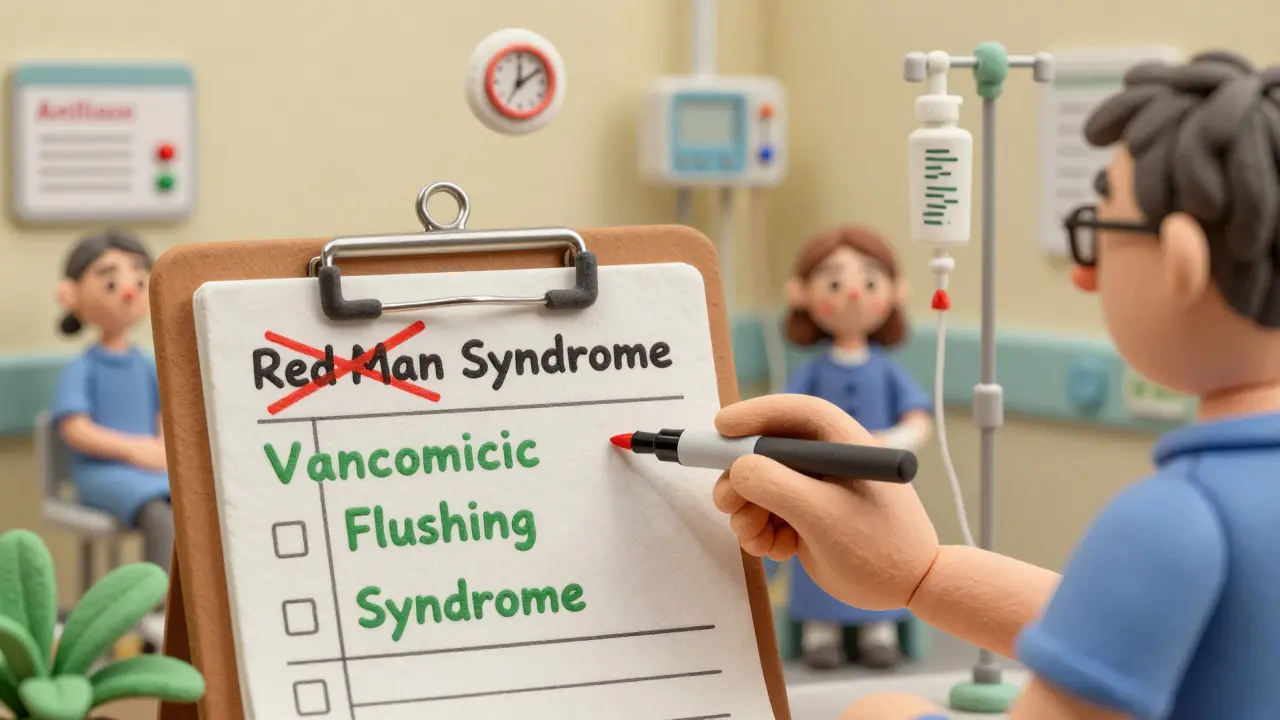
Why the Name Change Matters
The term ‘red man syndrome’ wasn’t just inaccurate - it was harmful. A 2021 study in Hospital Pediatrics reviewed over 21,000 patient records and found that 61.6% of vancomycin ‘allergy’ entries used the term ‘red man syndrome.’ That’s not just outdated - it’s offensive. It implies the reaction is tied to skin color, which it isn’t.
After hospitals switched to using ‘vancomycin flushing syndrome’ in electronic records, the use of the old term dropped by 17% in just three months. That’s not just a win for language - it’s a win for equity. Terms like this contribute to bias in medical care. When patients are mislabeled as ‘allergic’ because of a misnamed reaction, they might be denied life-saving antibiotics in the future.
Major organizations like the Infectious Diseases Society of America and the American Academy of Allergy, Asthma & Immunology now require the use of accurate terminology. Harvard’s FXB Center for Health and Human Rights calls these outdated terms ‘reinforcements of harmful stereotypes.’
What If You’ve Had a Reaction Before?
If you’ve had vancomycin flushing syndrome once, you’re at higher risk for it again. But that doesn’t mean you can’t get vancomycin in the future. It just means you need to be more careful.
Your care team might:
- Slow the infusion even further - maybe over 2 hours instead of 100 minutes.
- Give you an antihistamine before the infusion (diphenhydramine or ranitidine).
- Use a different antibiotic if possible - like linezolid or daptomycin.
- Consider a desensitization protocol if vancomycin is absolutely necessary.
Desensitization is a slow, controlled process where you get tiny, increasing doses of vancomycin over several hours under close supervision. It’s not routine, but it’s an option when no other antibiotic will work.
Bottom Line
Vancomycin is a lifesaver for serious bacterial infections. But its infusion reaction - once called ‘red man syndrome’ - is one of the most preventable drug reactions in modern medicine. It’s not an allergy. It’s not rare. And it’s not your fault.
It’s a simple matter of speed. Slow down the drip, and the reaction disappears. That’s it. No fancy tests. No expensive meds. Just time and attention.
If you’re scheduled for vancomycin, ask: ‘How fast will this be given?’ If they say ‘over an hour,’ speak up. Push for a longer infusion. Your skin - and your care - will thank you.


