
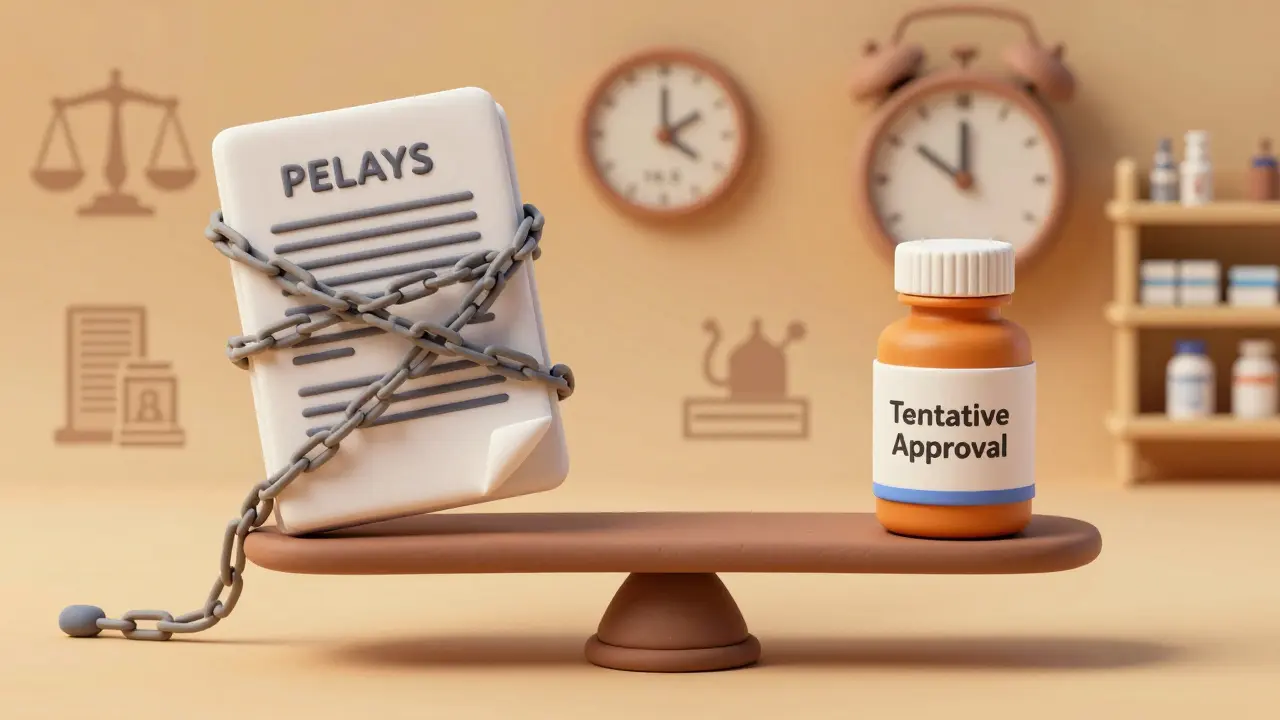
When a generic drug gets tentative approval from the FDA, it doesn’t mean it’s ready to hit pharmacy shelves. It means the agency has confirmed the drug is safe, effective, and made to the right standards - but something is still blocking its release. That something is often not the science. It’s the system.
What Tentative Approval Really Means
Tentative approval isn’t a half-step. It’s a full pass on science. The FDA has checked every batch, every test, every bioequivalence study, and found no flaws. The drug works just like the brand-name version. The problem? Someone else still holds the legal rights to sell it.
This status was created under the Hatch-Waxman Act of 1984 to help generic makers get ahead of the game. Instead of waiting until a patent expires to start the review process, companies can submit their applications years in advance. The FDA reviews them early. If everything checks out, they get tentative approval. But they can’t sell the drug until the patent or exclusivity period ends.
As of 2023, over 2,500 generic applications have received tentative approval. That’s more than half of all pending generic applications. But only about 60% of them ever become actual products on the market. Why? Because the road from tentative to final approval is full of roadblocks - many of them legal, not scientific.
Patent Games and Legal Delays
The biggest reason a tentatively approved generic never launches? Patent litigation.
When a generic company files an application and claims the brand’s patent is invalid or won’t be infringed (called a Paragraph IV certification), the brand-name company can sue. That triggers a 30-month automatic stay. The FDA can’t give final approval during that time - even if the generic has been tentatively approved for three years.
A 2017 Commonwealth Fund analysis found that 68% of tentatively approved generics were held up by these lawsuits. Some of these suits are legitimate. Many aren’t. Brand companies have learned to file them strategically - often just before a patent expires - to squeeze out every last month of exclusivity.
Then there are citizen petitions. These are formal requests filed with the FDA asking them to delay approval on technical grounds. Between 2013 and 2015, 67 petitions were filed by brand companies. Only three were granted. Yet each petition added months to the timeline. One petition, filed just 10 days before a patent expired, delayed a generic launch by seven months.
Even worse are “pay-for-delay” deals. In these cases, the brand company pays the generic maker to hold off on launching. Between 2009 and 2014, over 980 such deals were recorded. The FTC called them “anti-competitive.” Courts have since cracked down, but they still happen.
Manufacturing Problems That Hold Up Approval
It’s not just patents. Many generics sit in limbo because their factories don’t meet FDA standards.
In 2022, 41% of complete response letters (CRLs) - the FDA’s official “you didn’t pass” notices - cited manufacturing issues. The top three? Inadequate quality control systems, failed environmental monitoring, and unqualified equipment. These aren’t minor glitches. They’re systemic failures.
Take a simple tablet. The FDA expects every step - from mixing powder to pressing pills - to be tightly controlled. If a machine isn’t properly calibrated, or if humidity levels in the production room aren’t logged correctly, the whole batch is suspect. And if the facility has been flagged before? The FDA will delay approval until they’re confident it won’t happen again.
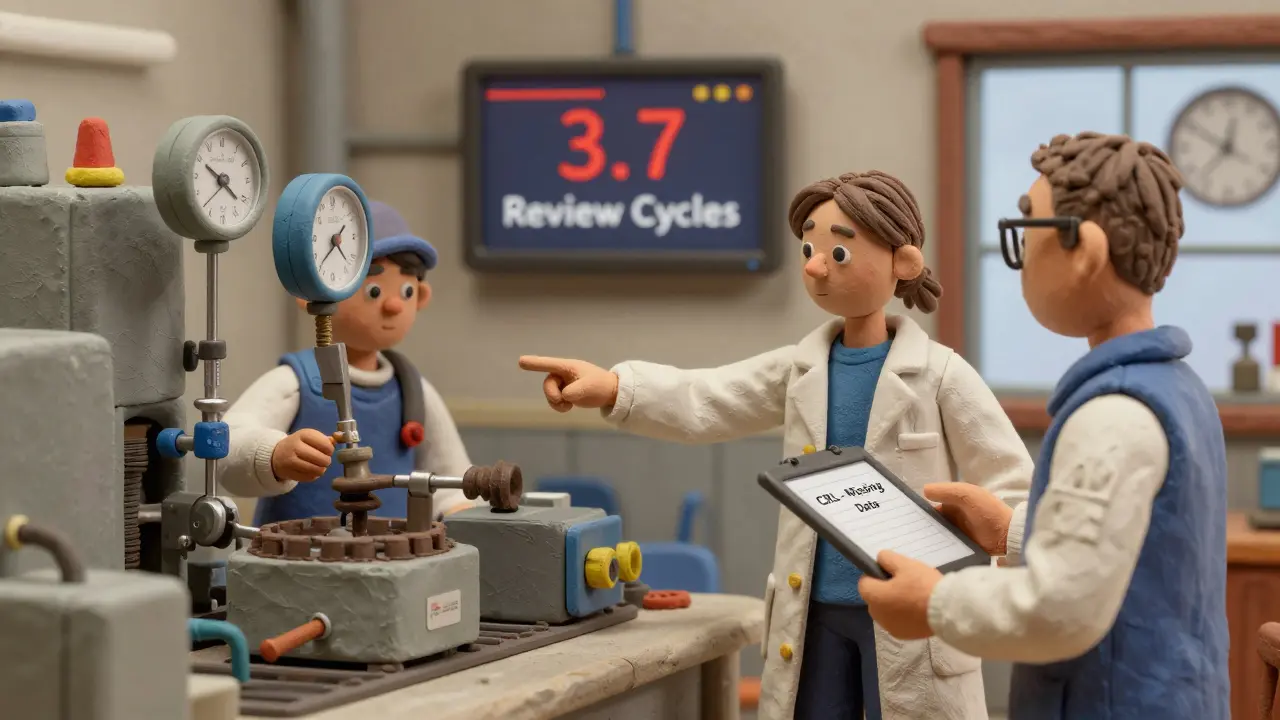
Complex drugs make this worse. Inhalers, injectables, topical creams - these aren’t just pills you swallow. They require advanced manufacturing. A 2020 FDA report found that complex generics go through 3.7 review cycles on average, compared to 2.9 for simple tablets. That’s an extra 14 months of back-and-forth.
Applicants Are Slow to Respond
Even when the FDA points out a problem, the applicant doesn’t always fix it fast.
In 2022, the average time to respond to a CRL was 9.2 months. The FDA recommends six. That’s a 50% delay right there. Why? Some companies don’t have the resources. Others wait to see if the patent will expire soon anyway. Others just don’t prioritize the application.
Missing data is another big issue. Nearly 30% of initial applications lack critical information - stability data, container closure details, or proper labeling. The FDA doesn’t reject them outright. They send a letter asking for more. If the applicant doesn’t reply quickly, the clock keeps ticking.
One company submitted an ANDA for a generic version of a popular cholesterol drug. The FDA asked for additional bioequivalence data. The company waited six months to respond. By then, the brand had filed a new patent. The generic never launched.
Market Economics Don’t Always Add Up
Even if a generic clears every legal and regulatory hurdle, it might still never reach the market.
Why? Because it’s not profitable.
A 2022 DrugPatentWatch analysis found that 30% of tentatively approved generics never launch. That number jumps to 47% for drugs with annual U.S. sales under $50 million. If the market is too small, or if the manufacturing cost is too high, companies walk away.
And even when they do launch, they don’t always rush. Many wait to see how many competitors enter. If only one generic comes out, prices stay high. The brand may still make 80% of its original revenue. So why should another company risk investing in a low-margin product? The result? A single generic sits on the shelf for 12 to 18 months after patent expiry, while patients keep paying brand prices.
What’s Being Done to Fix This?
The FDA knows the system is broken. They’ve tried to fix it.
The Generic Drug User Fee Amendments (GDUFA) program, first launched in 2012 and renewed in 2023, gives the FDA more money to hire reviewers and cut review times. Under GDUFA II, they aimed to reduce the average number of review cycles from 3.9 to 2.5. They got it down to 3.2. Progress, but not enough.
The Competitive Generic Therapy (CGT) pathway, created in 2017, gives priority review to drugs with little or no generic competition. Of the 78 CGT-designated drugs reviewed, 78% got tentative approval in under eight months - half the normal time.
In 2022, the FDA launched a special initiative to fast-track 102 high-priority tentative approvals. Of those, 67% got final approval within a year. The control group? Only 34% did. That’s a real win.
Legislation like the CREATES Act (2019) and the Affordable Drug Manufacturing Act (2023) aim to stop brand companies from blocking sample access or abusing patents. But enforcement is slow. And the FDA still lacks the staff to review complex applications quickly.
What’s the Real Timeline?
Let’s put this in perspective.
From the moment a generic company files an ANDA, it takes about 18 months to get tentative approval - if everything goes smoothly. Then, if there’s a patent lawsuit, they wait 30 months or more. Once the patent expires, the FDA can give final approval. But the company might still wait another 12 to 18 months to launch.
The median time from tentative approval to market launch? 16.5 months in 2022. That’s over a year and a half after the FDA said, “You’re good to go.”
And in 22% of cases, the drug never launches at all.
Why This Matters to You
This isn’t just a bureaucratic headache. It’s a public health issue.
Every month a generic is delayed, patients pay more. Every patent lawsuit that drags on adds billions to the U.S. drug bill. The Congressional Budget Office estimated patent delays cost $9.8 billion in 2018. By 2027, that number could hit $12.4 billion.
There are 517 brand drugs with no generic version at all. Over 300 of them have tentative approvals stuck in legal limbo. That means real people are paying hundreds or even thousands of dollars more than they should for medicines that could cost a fraction of the price.
Tentative approval was meant to speed up access to affordable drugs. Instead, it’s become a waiting game - one where patients, not corporations, pay the price.
What’s the difference between tentative approval and final approval for generics?
Tentative approval means the FDA has confirmed the generic drug meets all scientific and manufacturing standards - it’s safe, effective, and properly made. But final approval means the drug can legally be sold. Tentative approval is granted when patent or exclusivity rights on the brand drug are still active. Final approval only happens after those rights expire and any legal barriers are cleared.
Can a generic drug be sold after tentative approval?
No. Tentative approval does not allow marketing or sale. The drug remains legally restricted until the FDA grants final approval, which only occurs after all patent protections and exclusivity periods have expired. Selling a tentatively approved drug before final approval is illegal.
Why do some tentatively approved generics never reach the market?
Several reasons: patent litigation can drag on indefinitely, manufacturing facilities may fail inspections, companies may decide the market is too small to be profitable, or they may wait for competitors to enter before launching. About 30% of tentatively approved generics never make it to shelves, and that number rises to nearly 50% for low-sales drugs.
How long does it take to get tentative approval?
Under normal conditions, it takes about 18 months from application submission to tentative approval. For complex drugs like inhalers or topical creams, it can take longer. The FDA’s GDUFA III program aims to reduce this to 12 months by 2027, but current timelines still average 16-18 months.
Do citizen petitions really delay generic approvals?
Yes. Brand-name companies often file citizen petitions asking the FDA to delay approval, claiming safety or scientific concerns. While most petitions are denied, they still trigger a review process that can delay approval by 6-12 months. Between 2013 and 2015, 67 petitions were filed, and 72% came from brand manufacturers seeking to block competition.
What is the Competitive Generic Therapy (CGT) pathway?
The CGT pathway is a fast-track option for generic drugs that have little or no competition. Drugs designated as CGT receive priority review, meaning the FDA aims to approve them in under 10 months - compared to the standard 18 months. Since its launch in 2017, 78% of CGT-designated drugs received tentative approval within 8 months.
What Comes Next?
The system is slowly improving. First-cycle approval rates are rising. The FDA is getting better at handling complex drugs. The CGT pathway is working. But the core problems - patent abuse, slow responses, and weak incentives - remain.
Until lawmakers and regulators tackle the financial incentives behind delays - like pay-for-delay deals and patent evergreening - tentative approval will keep being a promise, not a path to affordable medicine.


