
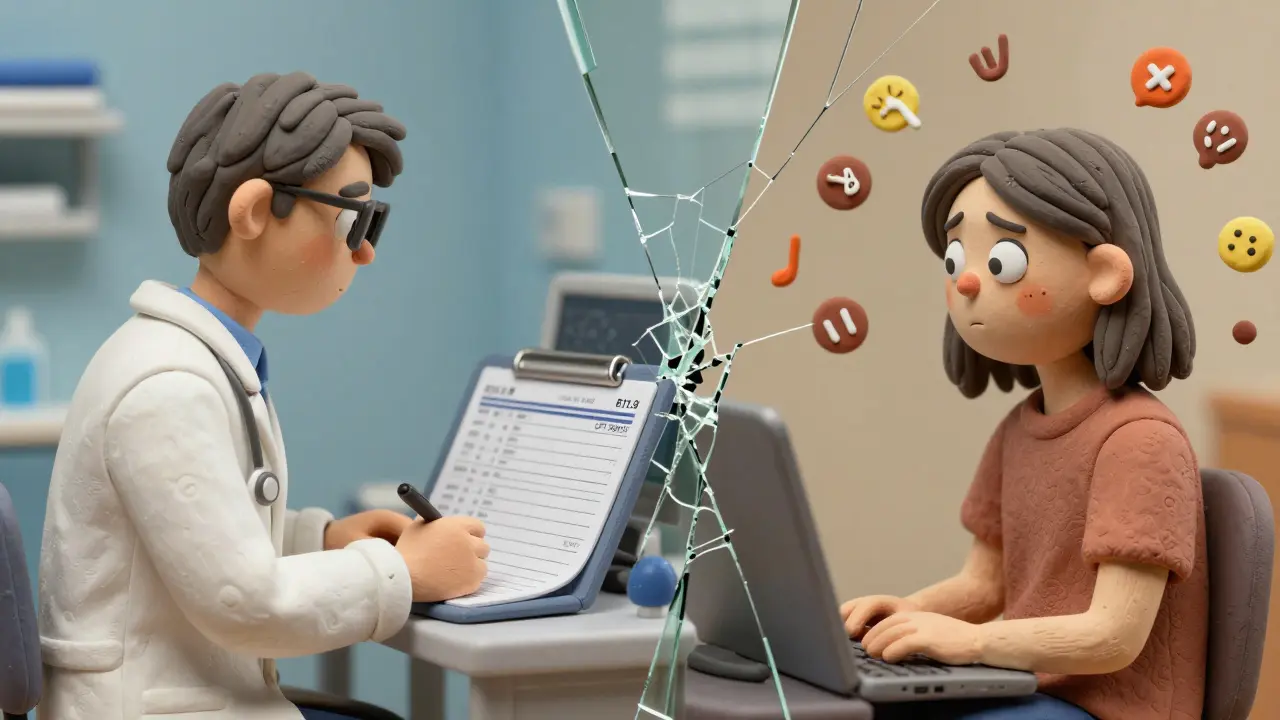
Ever read your medical record and felt like you were reading a foreign language? You’re not alone. What your doctor writes as "Type 2 Diabetes Mellitus, E11.9" might mean "I’m always tired and thirsty" to you. This gap isn’t just confusing-it’s dangerous. Over 68% of patients misunderstand common medical terms, and nearly a third skip follow-up care because they don’t get what their chart says. The problem isn’t that providers are hiding anything. It’s that two completely different systems are labeling the same health experience-and they’re not talking to each other.
How Providers Label Health: Codes, Charts, and Compliance
Healthcare providers don’t write notes for patients. They write them for systems. Every diagnosis, test, and medication is turned into a code so it can be billed, tracked, and shared across hospitals. The main tools? ICD-10 for diagnoses and CPT for procedures. There are over 70,000 ICD-10 codes and 10,000+ CPT codes. These aren’t suggestions-they’re requirements. Medicare and Medicaid won’t pay unless they’re used correctly. Electronic Health Records (EHRs) like Epic and Cerner are built around these codes. They’re designed to speed up billing, reduce errors in insurance claims, and help hospitals meet federal rules. But that means the language inside them is optimized for computers and auditors, not for people. A patient’s pain, fear, or confusion doesn’t fit neatly into a box labeled "E11.9." So it gets left out. Providers are trained to use this language. Medical school teaches them to say "hypertension," not "high blood pressure." They learn to write "metformin 500mg BID," not "the white pill I take with breakfast." It’s efficient. It’s precise. But it’s also alienating.How Patients Experience Health: Stories, Feelings, and Confusion
Patients don’t think in codes. They think in symptoms. "I can’t sleep." "My legs ache all day." "I feel like I’m drowning after walking up the stairs." These aren’t vague complaints-they’re vital clues. But when patients see their records, these stories disappear. In their place: sterile labels. A 2019 study found that 42% of patients didn’t know "hypertension" meant high blood pressure. 61% didn’t recognize "colitis" as an inflamed colon. One patient on PatientsLikeMe wrote that seeing "poorly controlled DM" in her chart made her feel like a failure-not that her blood sugar was too high. That’s not just a misunderstanding. That’s shame. The American Medical Association’s 2022 survey showed 57% of patients felt confused by terms in their records. And it’s not just about words. It’s about meaning. When a provider says "non-compliant," they mean the patient didn’t take their meds. But the patient hears "I’m bad at this." The label sticks. The trust cracks.The Bridge: Health Information Management Professionals
Someone has to connect these two worlds. That’s where Health Information Management (HIM) professionals come in. These are the people trained to translate between medical jargon and human experience. They’re certified by AHIMA, spend over 1,200 hours learning ICD-10 coding, and are the ones ensuring your records are accurate, complete, and protected under HIPAA. But their job isn’t just about coding. It’s about clarity. They’re the ones who push hospitals to use plain language in patient-facing documents. They train staff to use the "teach-back" method-asking patients to repeat back what they heard in their own words. That simple trick cuts communication errors by 45%, according to a JAMA study. HIM professionals don’t change the clinical record. They create a parallel version-for you. That’s why some hospitals now have dual EHR templates: one for providers, one for patients. "Myocardial infarction" becomes "heart attack." "Hyperlipidemia" becomes "high cholesterol." At Mayo Clinic, this change reduced patient confusion by 38% in just one pilot program.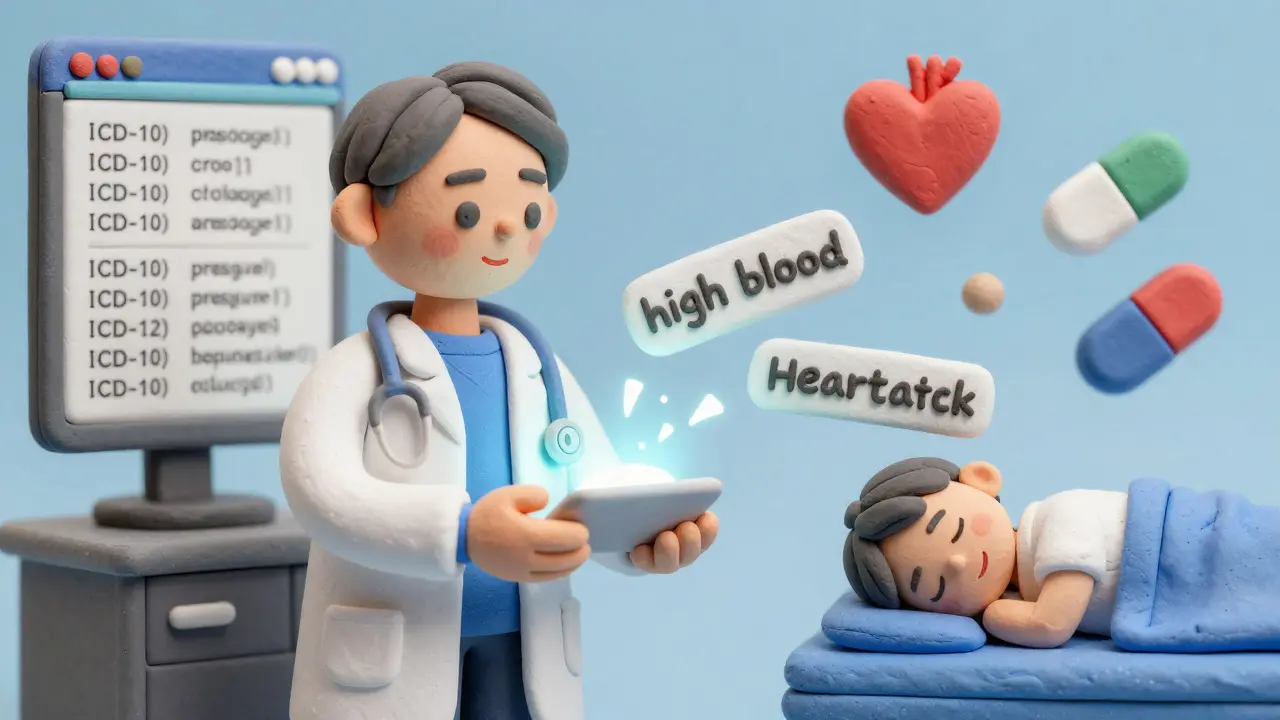
What’s Changing: Open Notes, FHIR, and AI
The biggest shift? Patients can now see their own records. Thanks to the 21st Century Cures Act, providers have been required since April 2021 to give patients full access to their clinical notes without editing. Before that, only 15% of patients could see them. Now, 89% can. That’s forced change. Hospitals can’t keep writing in code and expect patients to understand. So they’re adapting. Kaiser Permanente’s Open Notes program, running since 2010, saw a 27% drop in patient confusion and a 19% increase in people taking their meds correctly. More than 55 million patients across 350+ organizations now get this access. New tech is helping too. The HL7 FHIR standard lets systems show both clinical and patient-friendly terms side by side. The WHO’s ICD-11, rolled out in 2022, includes plain-language descriptions alongside codes for the first time. And AI is stepping in. Google’s Med-PaLM 2 can convert clinical notes into simpler language with 72.3% accuracy. It’s not perfect yet-but it’s getting closer.Why This Matters for You
This isn’t just about words. It’s about safety. Dr. Thomas Bodenheimer of UCSF says language gaps cause 30-40% of medication errors. Think about that. Someone gets prescribed insulin because their chart says "hyperglycemia." But they think it means "I’m just stressed." They don’t take it. They end up in the ER. The Institute of Medicine found communication failures contribute to 80% of serious medical errors. That’s not just bad luck. It’s a system design flaw. But there’s hope. When providers use plain language, patients are more likely to ask questions. They’re more likely to follow treatment plans. They’re more likely to trust their care team. That’s not just good for you. It’s good for the whole system.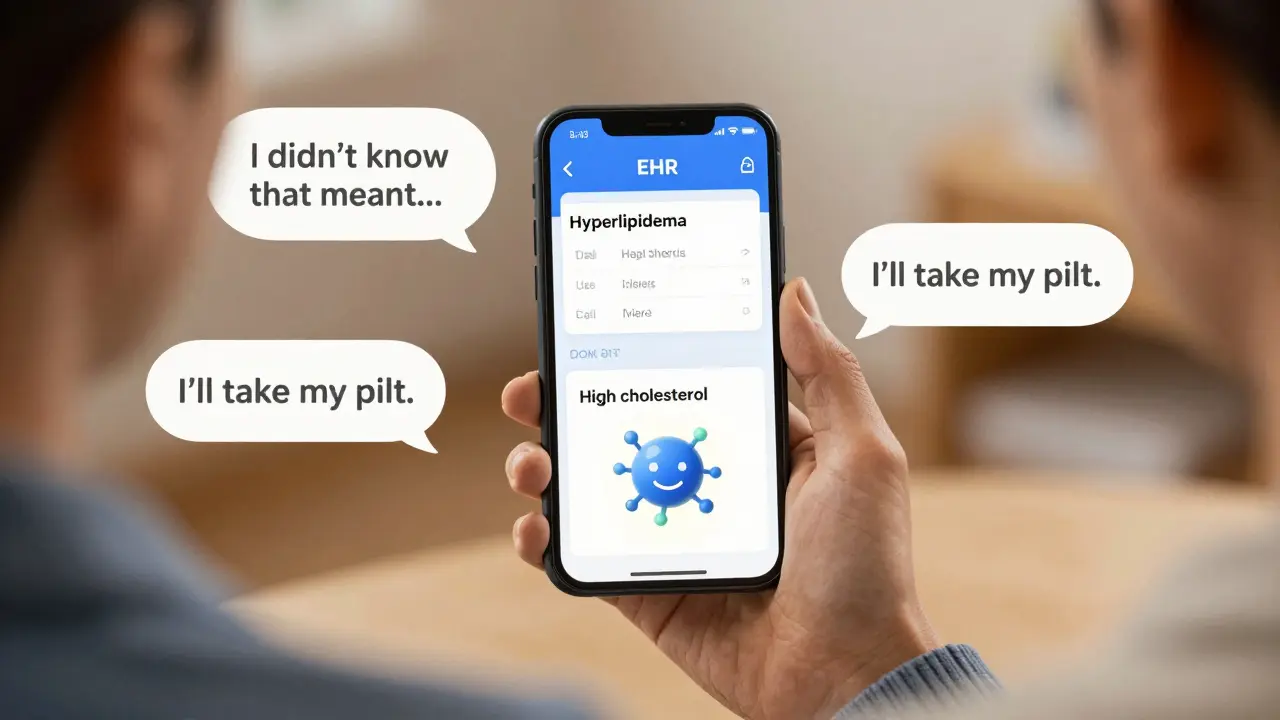
What You Can Do Today
You don’t have to wait for your provider to change. Here’s what you can do right now:- Ask: "Can you explain that in simpler terms?" No shame in it. Most providers expect it.
- Use the teach-back method: After they explain something, say, "So what I hear you saying is…" Then repeat it back.
- Request a plain-language version of your notes. Many hospitals now offer this.
- Check your portal regularly. If something doesn’t make sense, call and ask for clarification.
- Write down your symptoms in your own words before your visit. Bring it with you. It helps your provider understand what matters to you.


