

FDA vs EMA Drug Label Comparison Tool
Compare Drug Labeling Differences
This tool helps you understand how the same drug might have different labeling requirements between the U.S. and Europe. Select a drug or condition to see key differences in FDA vs EMA labeling.
Indications
FDA:
FDA typically requires stronger evidence of clinical benefit before approval.
Pregnancy Warnings
FDA:
FDA often uses cautionary language even when evidence is reassuring.
Patient-Reported Outcomes
FDA:
FDA requires stricter validation of patient-reported benefits.
Risk Management
FDA:
FDA often implements REMS programs with strict requirements.
Language Requirements
FDA:
FDA labels are only in English.
Indications
EMA:
EMA is often more flexible with evidence requirements.
Pregnancy Warnings
EMA:
EMA prefers direct statements based on available human data.
Patient-Reported Outcomes
EMA:
EMA more commonly includes patient-reported outcomes in labels.
Risk Management
EMA:
EMA uses RMPs with more flexible guidelines.
Language Requirements
EMA:
EMA requires all labels in 24 official EU languages.
When a new drug hits the market in the U.S. or the EU, the label you see on the box or in the patient leaflet didn’t just appear out of nowhere. It was shaped by two of the most powerful drug regulators in the world: the U.S. Food and Drug Administration (FDA) and the European Medicines Agency (EMA). Even though they often review the same clinical data, their labeling rules can be wildly different. And those differences? They affect how doctors prescribe, how patients understand risks, and how quickly a drug reaches people who need it.
Why the Same Drug Has Different Labels
The FDA and EMA don’t just have different rules-they operate under completely different legal systems. The FDA answers to U.S. federal law, primarily the Federal Food, Drug, and Cosmetic Act. The EMA works under European Union Regulation (EC) No 726/2004, which gives it a decentralized structure tied to national agencies across 27 EU countries. That means the EMA doesn’t just make one decision-it coordinates dozens of national regulators. The FDA makes its own call, directly. This structural gap leads to real-world differences. For example, when reviewing the same clinical trial data on a cancer drug, the EMA might approve a broader use based on early signs of benefit, while the FDA waits for clearer proof of survival improvement. A 2019 study found that in over half the cases where the two agencies disagreed on what a drug could be used for, the reason wasn’t different data-it was different interpretations of the same data. The EMA was more willing to accept smaller studies or surrogate endpoints. The FDA leaned harder on large, long-term outcomes.Patient-Reported Outcomes: What Gets Listed
One of the clearest examples of how these agencies think differently shows up in how they handle patient-reported outcomes (PROs). These are things like ‘I felt less pain,’ ‘I could walk farther,’ or ‘I slept better.’ The EMA is far more open to including these claims on labels. Between 2006 and 2010, 47% of drugs approved by both agencies had at least one PRO claim on their EMA label. Only 19% had the same claim on the FDA label. And only four drugs had identical PRO claims on both. Why? The EMA sees patient experience as part of the medicine’s value. The FDA, historically, has been more cautious, requiring strict validation and statistical proof that the patient’s report directly links to clinical benefit. That doesn’t mean the FDA ignores patient input-it just demands more evidence before putting it on the label. For patients, this means a drug might say ‘improves fatigue’ in Europe but only say ‘reduces tumor size’ in the U.S.Pregnancy and Breastfeeding Warnings: A Tale of Two Approaches
When it comes to pregnancy and breastfeeding, the labeling gap is even starker. In one case studied in 2023, a drug that had human data showing no harm during pregnancy got a warning label from the FDA saying ‘use only if clearly needed.’ The EMA, using its standard template, simply stated ‘no adverse effects observed in humans.’ The FDA tends to err on the side of caution, often using vague language like ‘potential risk’ or ‘insufficient data’ even when evidence is reassuring. The EMA prefers clear, direct statements based on available human data. This isn’t just about wording-it affects how women and their doctors make decisions. A woman in the U.S. might avoid a life-changing medication because the label sounds scary. The same woman in Germany might be told it’s safe to use.Language and Translation: The Hidden Cost
If you’re a pharmaceutical company trying to sell a drug in Europe, you’re not just translating one label-you’re translating 24. The EMA requires all product information to be available in every official EU language. That means 24 versions of the Summary of Product Characteristics (SmPC), 24 patient leaflets, 24 pack inserts. The FDA? Only English. Period. This isn’t just a paperwork headache. It adds 15-20% to the cost of bringing a drug to market in Europe. It slows down timelines. It increases the chance of errors. One company told regulators they spent over $2 million just on translation and review for a single drug. And if you miss a detail in one language? You could face a recall across the entire EU.
Risk Management: REMS vs RMPs
Both agencies want to manage drug risks. But they do it in opposite ways. The FDA uses Risk Evaluation and Mitigation Strategies (REMS). These are strict, legally enforceable programs. For some drugs, that means only one pharmacy can dispense it. Or doctors must complete special training. Or patients must sign a form every time they get a refill. Think of REMS as a locked door with a key card. The EMA uses Risk Management Plans (RMPs). These are more like guidelines. Companies must identify risks and describe how they’ll monitor them, but they get to choose how to do it. No single distributor requirement. No mandatory training. Just a plan, submitted and updated regularly. This difference matters for patients. A drug with a REMS might be harder to get in rural areas of the U.S. because few pharmacies are certified. The same drug in France? Available at any pharmacy. The EMA trusts companies to act responsibly. The FDA builds enforcement into the system.Approval Speed and Post-Marketing Rules
The EMA approves drugs faster-on average, 92% of applications get approved on the first try. The FDA’s first-cycle approval rate is around 85%. Why? The FDA often requests more data upfront, especially for drugs meant to treat common conditions. The EMA is more willing to approve drugs for rare diseases under ‘exceptional circumstances,’ even if long-term data isn’t complete. But here’s the catch: EMA approval often comes with strings attached. Companies must keep collecting data after the drug is on the market. The FDA, by contrast, usually asks for all the data before approval-but then lets the drug stay on the market with fewer ongoing requirements. For patients, this means a drug might be available in Europe six months before the U.S. But if the FDA later finds a safety issue, it can act faster because it has full control. The EMA must coordinate with 27 countries, which can delay action.Vaccines: The Biggest Gap
Vaccine labeling is where the differences become impossible to ignore. A 2020 study looked at 12 vaccines approved by both agencies between 2006 and 2018. The result? No pattern of alignment over time. None. Not even a trend toward more similarity. The EMA includes detailed information on dosing schedules, storage conditions, and interactions with other vaccines. The FDA often omits these, assuming healthcare providers already know them. The EMA also includes more information on use in specific populations-like pregnant women or people with autoimmune conditions. The FDA tends to keep it simple: ‘use as directed by healthcare provider.’ This isn’t just about information overload. It’s about trust. European regulators assume patients and providers want full transparency. The FDA assumes providers are experts and patients get details from their doctors-not the label.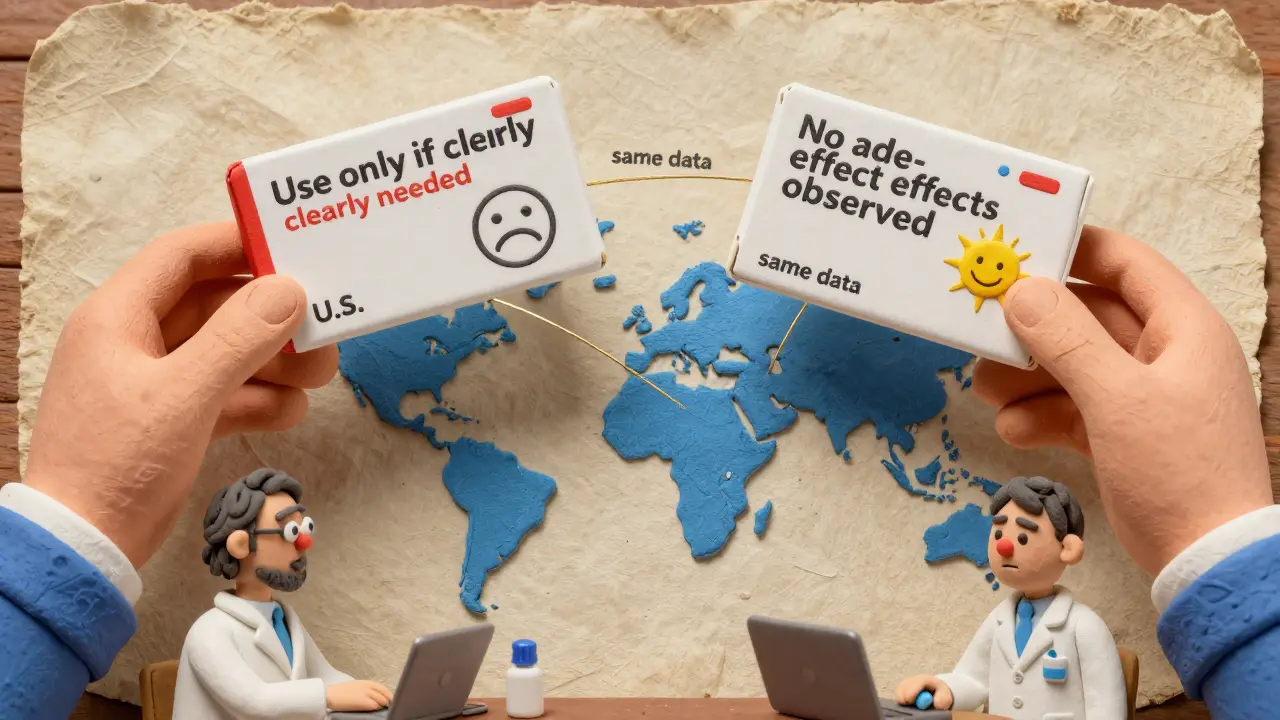
What This Means for Patients and Doctors
If you’re a patient in the U.S. and your doctor prescribes a drug you saw advertised in Europe, don’t assume the label means the same thing. The benefits, risks, and usage instructions might be described differently-or not at all. Doctors need to be aware too. A patient might come in with a European leaflet saying the drug is ‘safe during breastfeeding.’ The U.S. label might say ‘not recommended.’ Both could be technically correct, based on how each agency interprets the data. For people traveling or living abroad, this can be dangerous. A drug approved in Germany might be unavailable in the U.S. because the FDA didn’t accept the same evidence. Or a drug approved in the U.S. might be restricted in France because the EMA required more safety data.The Future: More Cooperation, But Not Full Alignment
The good news? The FDA and EMA talk more than ever. They share data, hold joint reviews, and have a confidentiality agreement to exchange information. Their collaboration has grown 47% since 2018. The ICH guidelines have helped standardize some parts of drug development. But complete harmonization? Unlikely. The legal systems are too different. Cultural attitudes toward risk aren’t the same. Europeans are more comfortable with shared responsibility. Americans prefer clear rules and enforcement. The future won’t be one label for all. It’ll be two-but with fewer gaps. Companies are already adapting. Nearly two-thirds now have teams dedicated to tracking both agencies’ requirements. They’re designing trials to meet both standards from the start. They’re building multilingual labeling systems early. It’s expensive. It’s complex. But it’s necessary.What You Can Do
If you’re a patient: Always check the label that came with your prescription-and ask your doctor if there’s a version from another country that might have different information. If you’re a healthcare provider: Don’t assume labels are interchangeable. Know which agency approved your drug. Check for differences in dosing, warnings, or contraindications. If you’re in the industry: Start thinking globally from day one. Don’t wait until approval to worry about language, risk management, or patient claims. Build flexibility into your development plan. The world is connected. Drugs cross borders every day. But the rules that govern them? They still speak different languages.Why do the same drugs have different labels in the U.S. and Europe?
The FDA and EMA operate under different legal systems and have different philosophies on what constitutes sufficient evidence. The EMA often accepts earlier or smaller data sets and includes more patient-reported outcomes. The FDA requires stronger proof of long-term benefit and is more cautious with risk communication. Even with the same clinical trials, they interpret the data differently.
Is one agency’s labeling safer than the other?
Neither is inherently safer. The FDA’s stricter rules can delay access to effective drugs, but its enforcement tools like REMS help control known risks. The EMA’s more flexible approach allows faster access but relies on companies to monitor safety after approval. Both systems have prevented harm and improved care-just in different ways.
Can a drug approved in the EU be sold in the U.S. without FDA approval?
No. The FDA has exclusive authority over drug sales in the U.S. Even if a drug is approved by the EMA, it cannot be legally sold in the U.S. without FDA approval. The same applies in reverse-U.S.-approved drugs can’t be sold in the EU without EMA approval.
Why does the EMA require 24 language versions of drug labels?
The European Union has 24 official languages. To ensure all citizens can understand how to use medications safely, the EMA requires every product’s labeling to be translated into all 24 languages. This is a legal requirement under EU law. The FDA, as a U.S. agency, only needs to provide labels in English.
Do these labeling differences affect drug prices?
Yes. The extra time, translation costs, and need for additional studies to satisfy both agencies can increase development costs by up to 20%. These costs are often passed on to patients and healthcare systems. In some cases, companies delay launching in one region to avoid the burden, which can limit access and drive up prices due to reduced competition.
Are there any drugs that have identical labels in both regions?
Very few. Even when the same clinical data is used, differences in how the agencies interpret evidence, prioritize patient outcomes, or handle risk communication usually lead to variations. Some generic drugs or older medications may have closer alignment, but for most new drugs-especially in oncology, vaccines, or rare diseases-the labels differ in wording, scope, or warnings.


