
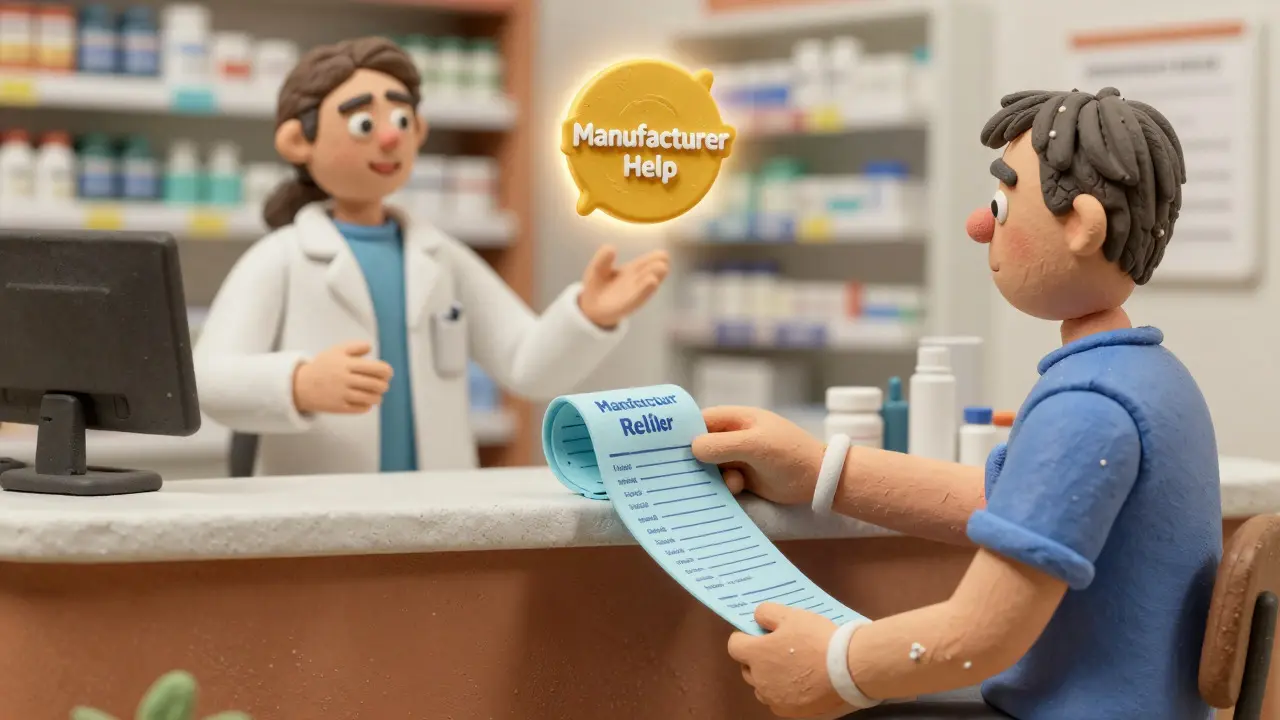
You stand at the pharmacy counter, staring at a bill that looks more like a mortgage payment than a prescription receipt. You have insurance, but your deductible is high, or your plan puts this specific brand-name drug on a steep tier. It feels like you’re stuck between a rock and a hard place. But there is often a third option sitting right in front of you, usually overlooked until it’s too late: direct help from the pharmaceutical manufacturer.
Pharmaceutical companies don’t just sell drugs; they also run massive financial safety nets to ensure people can actually afford them. These are known as Prescription Assistance Programs, which are direct support initiatives established by pharmaceutical companies to help patients afford medications through copay cards or free drug distribution. In 2022 alone, these programs distributed $24.5 billion in aid, helping over 12.7 million Americans stay on their treatment plans. The problem? They are fragmented, confusing, and heavily regulated. Knowing exactly which program fits your situation-and how to use it without messing up your insurance status-is the difference between staying healthy and going broke.
The Two Main Types of Manufacturer Help
Not all assistance is created equal. When you hear about "manufacturer help," it usually refers to one of two distinct systems. Confusing them is the most common mistake patients make, leading to rejected applications or unexpected bills later.
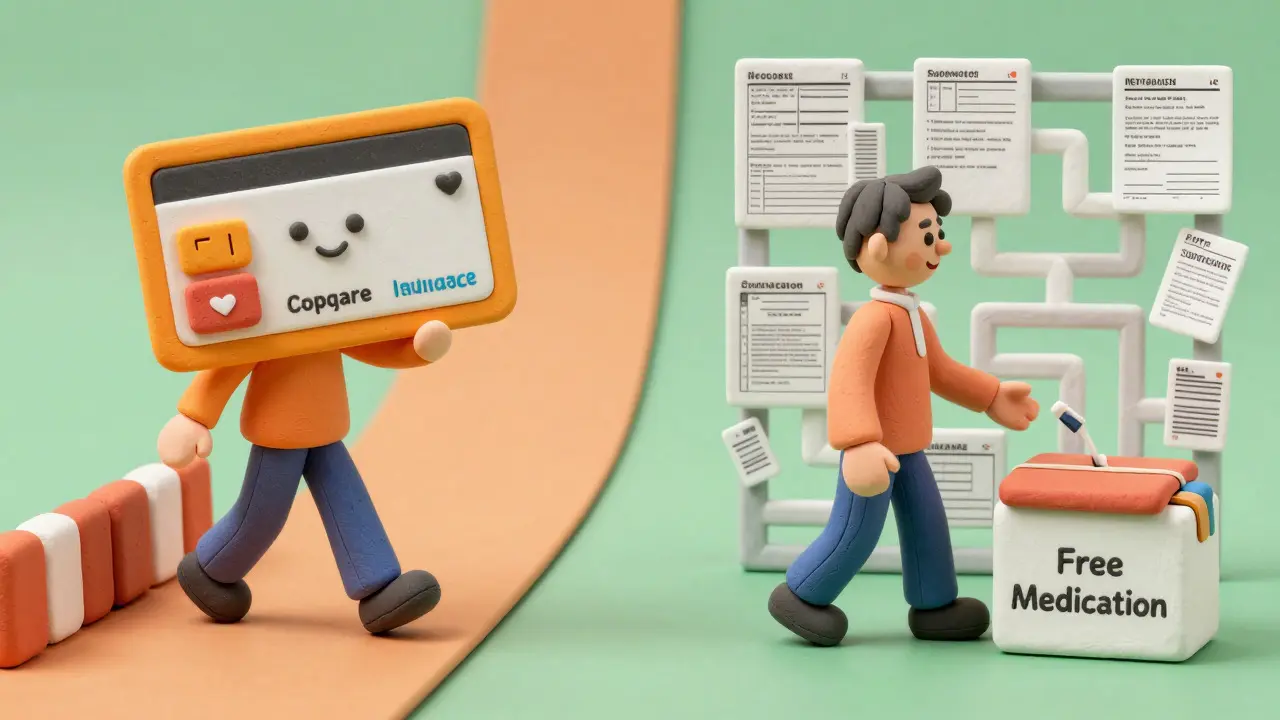
The first type is Copay Assistance. Think of this as a discount card or coupon. If you have commercial private insurance (like a plan through your employer), this program pays the difference between what your insurance requires you to pay and the full cost of the drug. For example, if your copay is set at $100, but the drug costs $300, the manufacturer might cover that extra $200. Some programs even reduce your copay to a nominal fee, like $10 or $15 per prescription. These are designed for insured patients who still face high out-of-pocket costs due to deductibles or coinsurance.
The second type is the Patient Assistance Program (PAP), which is a program providing medications at no cost or significantly reduced cost to uninsured or underinsured patients who meet specific income criteria. PAPs are older, dating back to the HIV/AIDS crisis of the 1980s. They are strictly for people who are uninsured or underinsured and fall below certain income thresholds-typically 200% to 400% of the Federal Poverty Level. Unlike copay cards, PAPs often provide the medication entirely for free. However, the application process is rigorous, requiring proof of income, residency, and medical necessity.
Who Qualifies? Insurance Status Is Everything
Your eligibility hinges almost entirely on the type of insurance you hold. This is where the system gets tricky because government programs and private insurance play by different rules.
If you have private commercial insurance, you are likely eligible for copay assistance. Major manufacturers like Pfizer, Merck, and Eli Lilly offer these for many of their brand-name and specialty drugs. As of 2023, 85% of specialty drugs offered some form of manufacturer copay support. You simply register online, get a digital or physical card, and present it at the pharmacy.
If you are uninsured, you look toward PAPs. About 92% of major pharmaceutical manufacturers operate a PAP. You will need to gather documents like recent tax returns or pay stubs. The income limit varies by company, but generally, if a family of four makes less than $60,000 annually (based on 2023 CMS guidelines), they might qualify.
If you have Medicaid or Medicare, things get complicated. Most copay assistance programs explicitly exclude government insurance. Why? Because states worry that manufacturer discounts inflate the base price of drugs, making them look more expensive to the government than they should be. In fact, 78% of state Medicaid programs prohibit the use of manufacturer copay assistance. For Medicare patients, the rules are equally strict, particularly regarding how these payments interact with your deductible progress.
The Medicare Part D Trap: Watch Your TrOOP
For seniors on Medicare Part D, using manufacturer assistance requires careful navigation. There is a critical concept called True Out-of-Pocket cost, or TrOOP. This is the amount you must spend before Medicare kicks in to cover nearly 100% of your drug costs in the catastrophic phase.
Here is the catch: Money paid by a manufacturer via a copay card does not count toward your TrOOP. If you use a copay card to save $200 on a prescription, you saved cash today, but you haven't moved closer to reaching the catastrophic coverage threshold. This can keep you stuck in the "coverage gap" (often called the doughnut hole) longer than necessary.
Furthermore, many health plans now use "copay accumulator" programs. Instead of counting the manufacturer's contribution toward your deductible, the insurer ignores it completely. So, you might pay $0 at the counter thanks to the card, but your deductible remains untouched. Always check with your plan administrator to see if they use an accumulator model. If they do, paying a small portion out-of-pocket might actually be smarter financially in the long run, as it helps you hit your deductible faster.
How to Apply: Navigating the Bureaucracy
Finding the right program shouldn't require a degree in healthcare administration, but it often feels like it. The good news is that centralized tools exist to cut through the noise.
The primary resource is the Medicine Assistance Tool (MAT), which is a centralized search engine maintained by PhRMA providing access to more than 900 public and private assistance programs. MAT is free, confidential, and allows you to search by drug name or condition. It tells you instantly if a manufacturer offers a copay card or a PAP for your specific medication.
For copay cards, the process is usually quick. You create an account, verify your insurance details, and download the card. The manufacturer then pays the pharmacy directly when you present the code. Limits vary: some programs cap annual savings at $1,000, while others go up to $25,000 for high-cost specialty drugs. Monthly caps are also common, typically ranging from $50 to $200.
PAP applications are heavier lifting. Expect to spend 45 to 60 minutes filling out forms. You’ll need:
- Proof of income (tax returns or pay stubs)
- Proof of residency
- A signed statement from your doctor confirming medical necessity
Once approved, PAPs can provide continuous coverage as long as you remain eligible, though many require annual re-enrollment. Keep copies of everything. If your income changes or your insurance lapses, you need to update your status immediately to avoid interruptions in medication.

The Hidden Costs and Controversies
While these programs save individuals money, they aren't without systemic flaws. Critics argue that copay assistance distorts the market. A 2022 study in JAMA Internal Medicine found that these programs encourage patients to stick with expensive brand-name drugs even when cheaper generics are available, potentially increasing total healthcare spending by $1.4 billion annually.
Regulators are taking notice. By early 2024, 22 states had enacted laws restricting or regulating manufacturer copay assistance. California, for instance, passed SB 1424, requiring manufacturers to disclose exactly how much they spend on these programs. The Department of Health and Human Services has also proposed rules for greater transparency.
There is also the issue of awareness. Despite the billions distributed, a 2022 survey found that only 37% of eligible patients knew these programs existed. Many suffer through non-adherence-skipping doses or stopping medication entirely-because they assume they simply can't afford the drug. Don't let assumption dictate your health. Check the resources.
| Feature | Copay Assistance | Patient Assistance Program (PAP) |
|---|---|---|
| Target Audience | Commercially insured patients | Uninsured or underinsured patients |
| Income Requirement | Usually none | Yes (typically <200-400% FPL) |
| Government Insurance | Rarely accepted (Medicaid/Medicare excluded) | Sometimes accepted, but complex |
| Application Speed | Minutes (online) | Weeks (paperwork required) |
| Cost to Patient | Reduced copay (e.g., $10-$20) | Often $0 (free medication) |
| Impact on Deductible | May not count (accumulator risk) | N/A (no insurance involved) |
Practical Steps to Secure Your Savings
Don't wait until your wallet is empty. Start this process when you first receive a new prescription, especially for chronic conditions or specialty drugs. Here is your action plan:
- Check the Drug Box: Manufacturers often include a QR code or website link on the packaging directing you to savings programs. This is the fastest route.
- Use MAT: Go to the Medicine Assistance Tool website and search your drug. It will list all available options instantly.
- Verify Plan Compatibility: Call your insurance provider and ask two questions: "Do you accept manufacturer copay cards?" and "Do you use a copay accumulator program?" Their answers will determine if the card actually helps your deductible.
- Gather Documents Early: If you think you might need a PAP, keep your tax returns and pay stubs organized. The application delay is real; starting early prevents gaps in therapy.
- Talk to Your Pharmacist: Pharmacists see these transactions daily. Ask them if they know of any local or manufacturer-specific discounts for your specific drug.
These programs are not charity; they are a built-in feature of the modern pharmaceutical ecosystem. Whether you need a simple copay card to lower a monthly bill or a full PAP to secure life-saving medication, the help is there. You just have to know where to look and how to navigate the rules.
Can I use a manufacturer copay card if I have Medicare?
Generally, no. Most manufacturer copay assistance programs exclude patients with government-sponsored insurance, including Medicare and Medicaid. However, some manufacturers offer specific Patient Assistance Programs (PAPs) for Medicare beneficiaries, but these are rare and come with strict rules. Always check the eligibility criteria on the manufacturer's website or consult a pharmacist.
Does manufacturer assistance count toward my deductible?
It depends on your insurance plan. Many plans now use "copay accumulator" technology, which means the amount the manufacturer pays does not count toward your annual deductible. If your plan uses accumulators, you might pay less at the counter but take longer to reach catastrophic coverage. Call your insurer to confirm their policy.
What is the income limit for Patient Assistance Programs (PAPs)?
Income limits vary by manufacturer, but most PAPs require applicants to earn between 200% and 400% of the Federal Poverty Level (FPL). For a family of four, this typically translates to an annual income between $30,000 and $60,000, based on recent CMS guidelines. You will need to provide proof of income, such as tax returns or pay stubs.
Where can I find a list of all available assistance programs?
The best resource is the Medicine Assistance Tool (MAT), maintained by the Pharmaceutical Research and Manufacturers of America (PhRMA). It is a free, searchable database that lists over 900 public and private assistance programs, allowing you to search by drug name or medical condition.
Why do some states restrict manufacturer copay cards?
States restrict these programs because they believe copay cards artificially inflate the list price of drugs. When manufacturers offer large rebates via copay cards, they may raise the base price of the drug, which affects reimbursement rates for government programs like Medicaid. As of 2024, 22 states have enacted laws to regulate or limit these practices to control overall healthcare costs.


