
Imagine trying to breathe through a straw that’s clogged with thick mucus. Now imagine trying to blow up a balloon made of worn-out rubber that won’t hold air. These two scenarios describe the daily reality for millions of people living with Chronic Obstructive Pulmonary Disease (COPD), a progressive lung disease characterized by persistent respiratory symptoms and airflow limitations. But here’s the catch: COPD isn’t just one thing. It is primarily made up of two distinct conditions-chronic bronchitis and emphysema. While they often travel together and share the same root causes, they damage your lungs in completely different ways.
Understanding the difference between these two components is not just academic trivia; it changes how you treat the disease. A 2022 study published in the New England Journal of Medicine found that patients who received treatment tailored to their specific condition had 27% fewer hospitalizations than those treated with a generic "one-size-fits-all" approach. If you or a loved one has been diagnosed with COPD, knowing which component is dominant can help you manage symptoms more effectively and advocate for better care.
The Core Difference: Mucus vs. Air Sacs
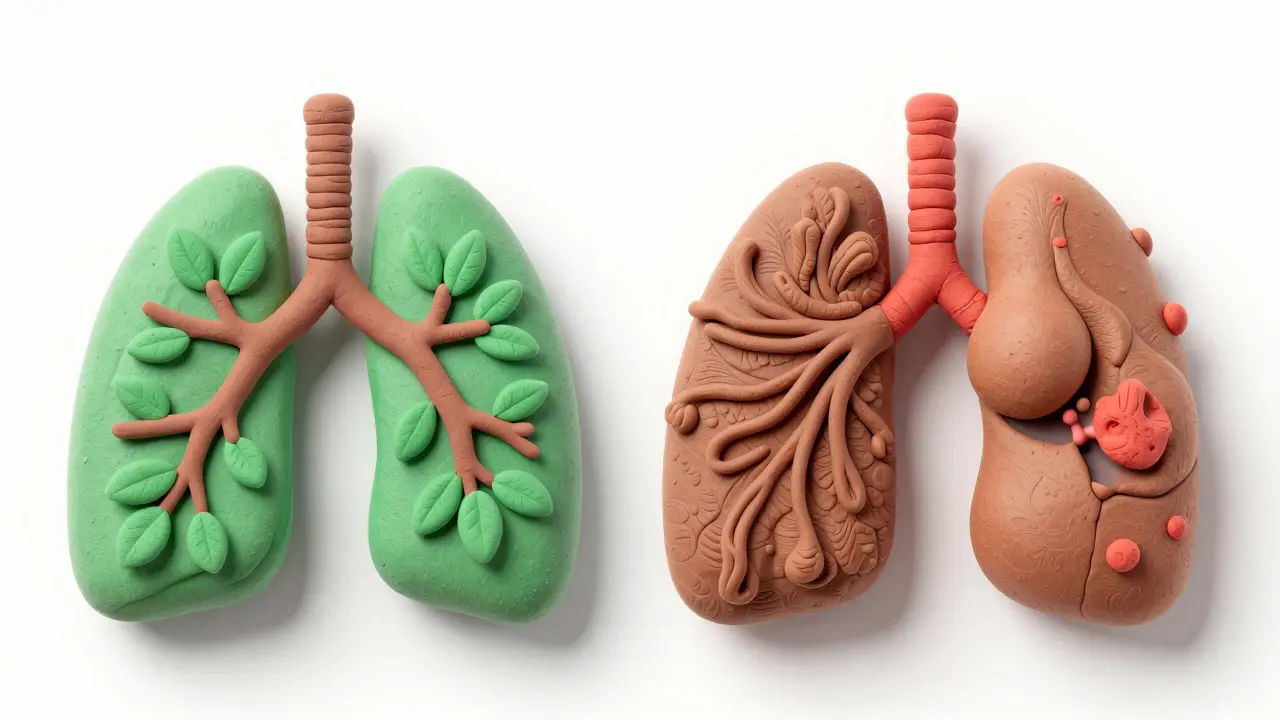
To understand why these conditions feel so different, we need to look at what is happening inside your chest. Think of your lungs like a tree. The branches are your airways (bronchi), and the leaves are tiny air sacs called alveoli where oxygen enters your blood.
Chronic bronchitis attacks the branches. It is defined clinically as a productive cough that lasts for at least three months a year for two consecutive years. In this condition, the lining of your airways becomes inflamed and swollen. Your body overproduces mucus glands-in fact, histological studies show a 300-500% increase in goblet cells. This leads to excessive mucus production, ranging from 100 to 200 milliliters daily compared to the normal 10-100 milliliters. The result? Your airways get clogged, making it hard to push air out.
Emphysema, on the other hand, destroys the leaves. It involves the irreversible breakdown of the elastic fibers in the alveolar walls. Imagine popping thousands of tiny balloons until they merge into large, inefficient spaces. This loss of elasticity means your lungs lose their ability to snap back after breathing out. You lose 30-50% of your lung's elastic recoil, which reduces the surface area available for gas exchange by up to 60% in advanced cases. Instead of getting stuck behind mucus, the air gets trapped because the lungs have no strength to expel it.
| Feature | Chronic Bronchitis | Emphysema |
|---|---|---|
| Primary Damage | Airway inflammation and mucus overproduction | Destruction of alveolar walls and elastic tissue |
| Main Symptom | Productive cough with sputum | Shortness of breath (dyspnea) and air hunger |
| Oxygen Levels | Often low (hypoxemia); may show cyanosis | Usually normal until late stages |
| Lung Sound | Rales, rhonchi, wheezing | Decreased breath sounds, prolonged expiration |
| DLCO Test Result | Normal or near-normal | Significantly reduced (below 60% predicted) |
Recognizing the Symptoms: Pink Puffers vs. Blue Bloaters
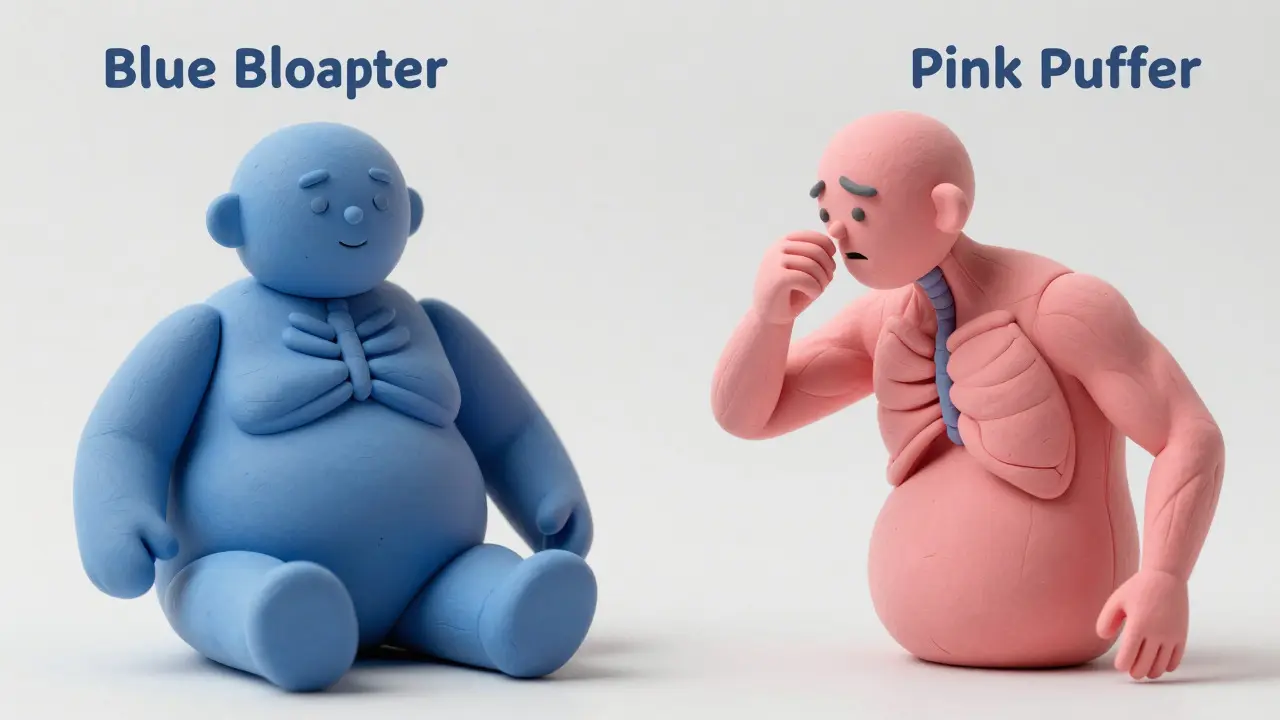
Doctors used to rely on visual cues to distinguish these conditions, labeling them "pink puffers" and "blue bloaters." While modern medicine recognizes that most patients have a mix of both, these descriptions still help illustrate the classic presentations.
The "Blue Bloater" typically represents chronic bronchitis dominance. Because the airways are blocked by mucus, oxygen doesn't get into the blood efficiently. This leads to chronic hypoxemia (low oxygen levels), causing the skin and lips to take on a bluish tint (cyanosis). These patients often retain fluid, leading to swelling in the legs (peripheral edema) due to strain on the heart, a condition known as cor pulmonale. They tend to be overweight or have normal weight, and their primary complaint is the relentless cough and difficulty clearing phlegm.
The "Pink Puffer" describes emphysema dominance. These patients work incredibly hard to breathe, often using accessory muscles in their neck and chest. They hyperventilate to keep oxygen levels up, which keeps their skin color pinker than expected despite severe breathlessness. Because they burn so many calories just trying to breathe, they are often thin and may experience significant muscle wasting. Their chest may become barrel-shaped as the lungs hyperinflate, pushing against the rib cage. For them, the terror isn't the cough-it's the "air hunger," the feeling that no matter how deep they breathe, they never get enough air.
How Doctors Diagnose Which One You Have
You can’t tell the difference just by looking at someone anymore, especially since 85% of severe COPD patients exhibit features of both conditions, according to the 2022 SPIROMICS study. Diagnosis requires specific tests that measure how your lungs function.
Pulmonary Function Tests (PFTs) are the gold standard. Everyone with COPD will have a forced expiratory volume in 1 second (FEV1) to forced vital capacity (FVC) ratio below 70%, indicating airflow obstruction. However, the key differentiator is the diffusing capacity for carbon monoxide (DLCO) test. In emphysema, the DLCO is significantly reduced (often below 60% of predicted values) because the surface area for gas exchange is destroyed. In chronic bronchitis, the DLCO is usually normal because the alveoli themselves are intact; the problem is just getting air to them.
Imaging also plays a crucial role. High-resolution CT scans can visualize the structural damage. In emphysema, doctors look for heterogeneous low-attenuation areas covering more than 15% of lung volume (quantified by the Goddard score). In chronic bronchitis, the scan might show thickened airway walls, but the lung tissue itself looks relatively preserved.
Treatment Strategies: Tailoring Care to the Component
This is where understanding the distinction saves lives. Treating emphysema like bronchitis-or vice versa-can lead to unnecessary side effects and poor outcomes.
For chronic bronchitis, the focus is on clearing mucus and reducing inflammation. Patients benefit significantly from mucolytics like carbocisteine, which reduce exacerbation frequency by 22% according to a 2023 Cochrane Review. If you have frequent exacerbations (more than two per year), medications like roflumilast can reduce flare-ups by 17.3%. Chest physiotherapy is also vital; many patients report spending 20-30 minutes daily performing techniques to loosen and clear the thick secretions that clog their airways.
For emphysema, the goal is to improve airflow and reduce lung hyperinflation. Since there is no mucus to clear, antibiotics during non-infectious exacerbations are often unnecessary and should be avoided to prevent resistance. Advanced emphysema patients may qualify for Lung Volume Reduction Surgery (LVRS) or endobronchial valve placement. The 2021 IMPACT trial showed that endobronchial valves could improve 6-minute walk distance by 35% by collapsing the most damaged parts of the lung, allowing the healthier tissue to work more efficiently.
Inhaled therapies are the backbone of treatment for both. Long-acting muscarinic antagonists (LAMAs) and long-acting beta-agonists (LABAs) are first-line treatments. However, caution is needed: Dr. MeiLan Han notes that chronic bronchitis patients have a 40% higher risk of pneumonia when using inhaled corticosteroids, making LAMA/LABA combinations safer for this group.

Living with COPD: Daily Management Tips
Whether you lean more toward bronchitis or emphysema, lifestyle adjustments are critical. Here is how to adapt your daily routine based on your dominant symptoms:
- If you have chronic bronchitis: Stay hydrated. Water thins mucus, making it easier to cough up. Use a humidifier in dry climates. Practice controlled coughing techniques taught by respiratory therapists to clear airways without exhausting yourself.
- If you have emphysema: Focus on energy conservation. Pace yourself throughout the day. Learn pursed-lip breathing-inhaling through your nose and exhaling slowly through puckered lips-to keep airways open longer and reduce air trapping.
- For both: Quit smoking immediately. It is the number one cause of both conditions. Avoid secondhand smoke and air pollutants. Get vaccinated against flu and pneumonia to prevent infections that can trigger severe exacerbations.
Nutrition matters too. Emphysema patients often need high-calorie, high-protein diets to combat muscle wasting, while chronic bronchitis patients should monitor salt intake if they have fluid retention issues.
The Future of COPD Care
Medical science is moving away from treating COPD as a single disease. The 2023 GOLD guidelines emphasize phenotype-directed management. New treatments are emerging specifically for these components. For example, inhaled alpha-1 antitrypsin was approved in 2023 for genetic emphysema, showing a 20% improvement in lung function. Meanwhile, new acoustic devices launched in Europe in 2024 help chronic bronchitis patients clear mucus mechanically, reducing exacerbations by 32%.
Researchers are also investigating biomarkers, such as blood eosinophil counts, to predict who will respond best to biologic therapies. The NIH’s SPIROMICS-2 study is currently enrolling thousands of patients to refine these targeted approaches. The message is clear: the future of COPD care is personalized, precise, and increasingly effective.
Can you have both chronic bronchitis and emphysema?
Yes, most people with COPD have elements of both conditions. Studies suggest that only about 15% of patients have a pure phenotype of either chronic bronchitis or emphysema alone. The majority exhibit mixed features, which is why comprehensive testing is essential to determine which component is driving your symptoms more strongly.
Is chronic bronchitis curable?
There is no cure for chronic bronchitis, as the damage to the airways is permanent. However, it is manageable. By quitting smoking, using prescribed inhalers, and practicing airway clearance techniques, you can significantly reduce symptoms and slow the progression of the disease.
What is the life expectancy for someone with emphysema?
Life expectancy varies widely depending on the severity of the disease, age, and whether the person smokes. With proper management, including pulmonary rehabilitation and medication adherence, many people live for decades after diagnosis. Early intervention and avoiding exacerbations are key to extending lifespan.
How do I know if my shortness of breath is from bronchitis or emphysema?
If your shortness of breath is accompanied by a heavy, productive cough and wheezing, it may lean toward chronic bronchitis. If you feel like you can't get enough air regardless of coughing, and you struggle with physical exertion due to air trapping, it may be emphysema. Only a doctor can confirm this through pulmonary function tests, specifically the DLCO test.
Are there surgeries for emphysema?
Yes, for select patients with severe upper-lobe predominant emphysema, Lung Volume Reduction Surgery (LVRS) or endobronchial valve placement can be highly effective. These procedures remove or collapse the most damaged parts of the lung, allowing the healthier lung tissue to expand and function better.
