

Renal Artery Stenosis Risk Calculator
This tool helps assess the risk of kidney function decline when taking ACE inhibitors based on your renal artery stenosis status and current creatinine level. The data is based on clinical studies showing significant risks for certain patient groups.
Input Your Information
When your kidneys don’t get enough blood, your body tries to compensate by turning on a powerful hormone system called the renin-angiotensin-aldosterone system (RAAS). This system raises blood pressure to force more blood through the narrowed arteries. But if you’re taking an ACE inhibitor - a common blood pressure drug - you’re accidentally shutting down that lifesaving mechanism. That’s why ACE inhibitors are dangerous in people with renal artery stenosis.
What Happens When Blood Flow to the Kidneys Is Reduced
Renal artery stenosis means one or both arteries leading to your kidneys are narrowed, usually by plaque buildup (atherosclerosis) or fibromuscular dysplasia. When this happens, the kidney thinks your whole body is low on blood. So it releases renin, which triggers a chain reaction: angiotensin I turns into angiotensin II, a potent vasoconstrictor.
Angiotensin II does two key things in a stenotic kidney: it squeezes the efferent arteriole (the tiny blood vessel leaving the filtering unit of the kidney) and keeps pressure high inside the glomerulus - the part that actually filters waste. Without that squeeze, the kidney’s filtering ability drops fast. That’s why people with renal artery stenosis can still make urine even when their kidneys are starved for blood.
How ACE Inhibitors Break This Balance
ACE inhibitors block the enzyme that turns angiotensin I into angiotensin II. That sounds good for lowering blood pressure - and it is, in healthy people. But in someone with renal artery stenosis, removing angiotensin II causes the efferent arteriole to relax. Suddenly, the pressure inside the glomerulus plummets by 25-30%. Glomerular filtration rate (GFR) crashes.
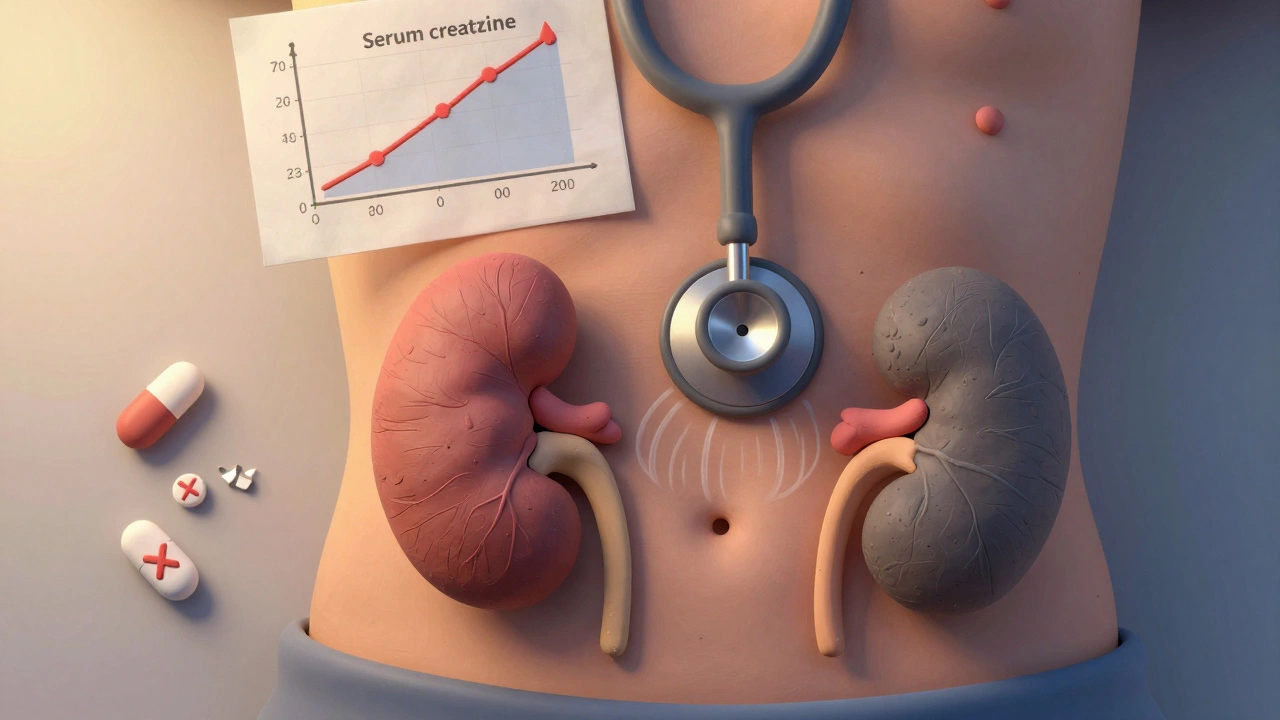
This isn’t a slow decline. It happens within days. Serum creatinine - a marker of kidney function - can jump more than 30% in just 7 to 10 days after starting the drug. In some cases, it’s even faster. A 2018 study of over 1,200 patients found that nearly 19% of those with undiagnosed bilateral renal artery stenosis developed acute kidney injury after starting an ACE inhibitor. That’s almost 1 in 5 people.
Bilateral vs. Unilateral: Why It Matters
Not all renal artery stenosis is the same. If only one kidney is affected and the other one is healthy, your body can usually compensate. The good kidney picks up the slack. In those cases, ACE inhibitors can often be used safely - with close monitoring.
But if both kidneys are narrowed - or if you have only one working kidney - you have no backup. That’s when ACE inhibitors become dangerous. The 2017 ASTRAL trial follow-up showed that patients with bilateral stenosis who took ACE inhibitors lost an average of 18.7 mL/min/1.73m² of kidney function over time. Those without the drug lost only 3.2. That’s a six-fold difference.
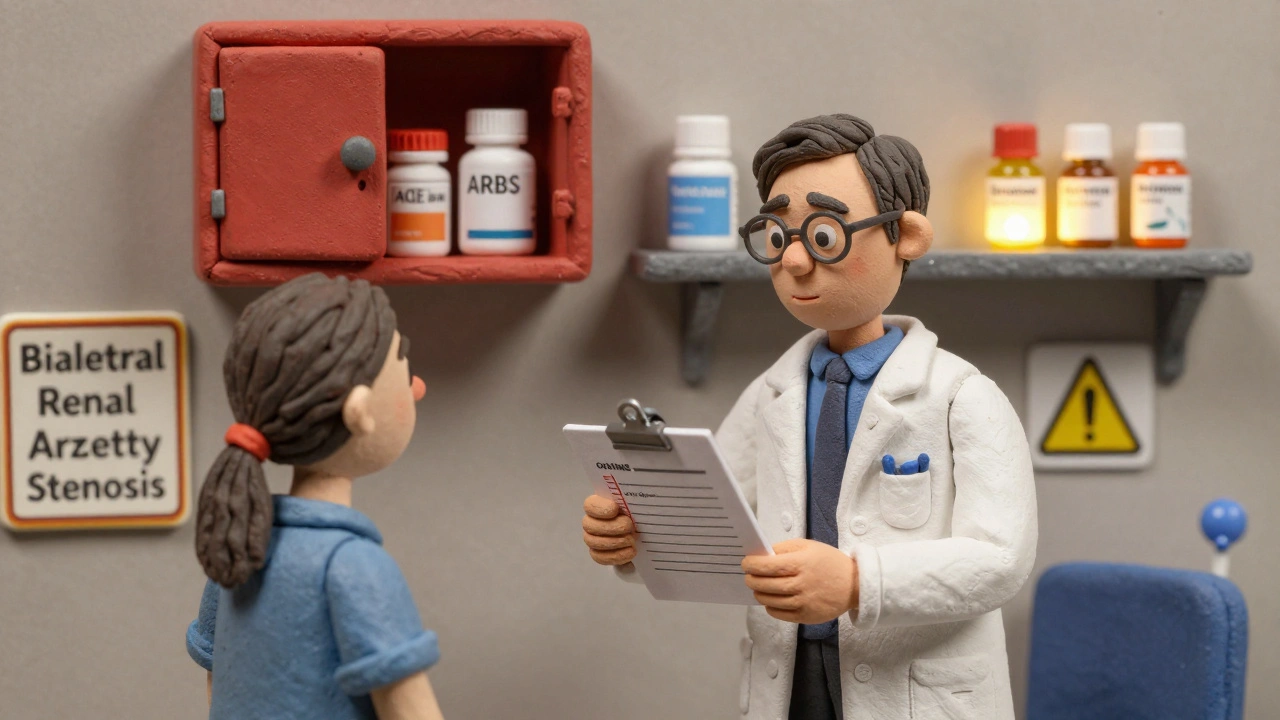
The FDA and major guidelines - including the American Heart Association, NICE, and KDIGO - all list bilateral renal artery stenosis or stenosis in a solitary kidney as a hard contraindication. This isn’t a suggestion. It’s a warning written in blood.
What Happens If You Don’t Stop the Drug
Most of the kidney damage from ACE inhibitors in this setting is reversible - if you catch it early. Stopping the drug usually brings creatinine levels back down within a week or two. But if the low blood flow lasts more than 72 hours, the kidney tissue can start dying. Permanent scarring, chronic kidney disease, or even the need for dialysis can follow.
A 2019 case series documented patients who developed irreversible kidney failure after continuing ACE inhibitors for over three days despite rising creatinine. These weren’t rare cases. They were preventable.
ARBs Are Not Safer Alternatives
Some doctors think switching from an ACE inhibitor to an ARB (like losartan or valsartan) solves the problem. It doesn’t. ARBs block angiotensin II at the receptor level - same end result. The same mechanism that harms the kidney with ACE inhibitors also harms it with ARBs. The 2002 American Heart Association statement and the 2019 KDIGO guidelines both say ARBs are equally contraindicated in bilateral renal artery stenosis.
There’s no magic bullet here. If your kidneys are already struggling from narrowed arteries, neither class of drug is safe.
Who Should Be Screened Before Starting ACE Inhibitors?
You don’t need to test everyone. But if you fall into one of these high-risk groups, a simple ultrasound should be done before starting an ACE inhibitor:
- High blood pressure that suddenly got worse after age 50
- Unexplained kidney function decline (especially if creatinine is above 150 µmol/L)
- Abdominal bruit - a whooshing sound heard with a stethoscope over the belly
- History of peripheral artery disease or coronary artery disease
- Worsening heart failure despite optimal treatment
Studies show that about 7% of older patients with high blood pressure and kidney problems actually have significant renal artery stenosis. That’s not rare. It’s common enough that skipping screening is a mistake.
Monitoring After Starting ACE Inhibitors
Even if you’re not in a high-risk group, guidelines from NICE and others require blood tests after starting ACE inhibitors. You need to check:
- Serum creatinine
- Estimated GFR
- Potassium levels
These should be done before starting the drug, and then again 10 days after the first dose. If creatinine rises more than 30% from baseline, stop the drug immediately and investigate for renal artery stenosis.
Many primary care doctors miss this. A 2020 study found that over 22% of patients with known bilateral renal artery stenosis were still being prescribed ACE inhibitors. That’s not just a gap in knowledge - it’s a safety failure.
What to Do Instead
If you have bilateral renal artery stenosis, your blood pressure still needs control. But ACE inhibitors and ARBs are off the table. Here’s what works:
- Calcium channel blockers (like amlodipine or diltiazem) - often first choice
- Diuretics (like hydrochlorothiazide) - helpful if fluid overload is an issue
- Beta-blockers (like metoprolol) - especially if you also have heart disease
In some cases, opening the narrowed artery with a stent may be considered - but recent trials show that stenting alone doesn’t improve kidney function or survival better than medication in most patients. So medication management remains the cornerstone of treatment.
The Bottom Line
ACE inhibitors are powerful, life-saving drugs for millions. But they’re not safe for everyone. In renal artery stenosis, especially when both kidneys are involved, they don’t just lower blood pressure - they can shut down kidney function. The science behind this has been clear since the 1980s. The guidelines haven’t changed. The risk hasn’t changed.
If you’re prescribed an ACE inhibitor and you have high blood pressure plus kidney problems, ask: Could my kidneys be narrowed? Get tested. Check your creatinine 10 days after starting. Don’t assume it’s fine. This isn’t a theoretical risk. It’s a real, preventable danger that still catches doctors off guard.
Knowing this could keep your kidneys working - and keep you off dialysis.


