

There is a long-standing fear among patients and even some doctors that taking Statins is dangerous for people with liver conditions. You might have heard that these common heart medications can cause liver damage. This belief has kept many people with liver disease away from life-saving heart protection. However, the reality is quite different from what you might have been told years ago. Modern research shows that statins are not only safe for most people with liver disease but can actually improve liver health while protecting the heart. Understanding this shift in medical consensus is crucial for anyone managing both cardiovascular risk and liver conditions.
What Are Statins and How Do They Work?
Before we talk about safety, it helps to know exactly what these drugs do. Statins belong to a class of medications known as HMG-CoA reductase inhibitors. They were first developed in the 1970s, with the first one, lovastatin, hitting the market in 1987. Their main job is to lower cholesterol in your blood. They work by blocking an enzyme called HMG-CoA reductase, which your liver uses to make cholesterol.
When you block this enzyme, your liver reacts by pulling more low-density lipoprotein (LDL) cholesterol out of your bloodstream. Think of LDL as the "bad" cholesterol that builds up in your arteries. By lowering this, statins reduce the risk of heart attacks and strokes. Depending on the specific drug and the dose, they can lower LDL cholesterol by anywhere from 25% to 60%. This mechanism is why they are the gold standard for preventing atherosclerotic cardiovascular disease (ASCVD).
The Safety Myth: Separating Fact from Fiction
The biggest hurdle to using statins in liver disease is the myth of hepatotoxicity. Hepatotoxicity means liver injury caused by drugs. Historically, doctors were warned to avoid statins if liver enzymes were elevated. This caution led to a lot of unnecessary fear. Today, authoritative sources like the American Heart Association (AHA) have clarified the risks significantly.
Severe liver injury from statins is incredibly rare. Data suggests it happens in approximately 0.001% of patients. To put that in perspective, that is one case per 100,000 patient-years. Major clinical trials have backed this up. The EXCEL randomized controlled trial in 1994 looked at 8,000 patients taking lovastatin versus a placebo. They reported zero cases of clinically symptomatic hepatitis. Similarly, the JUPITER trial in 2008 followed 18,000 patients on rosuvastatin for two years. The rates of hepatic disorder were exactly the same in the treatment group as in the placebo group.
These studies prove that statins do not cause progressive liver injury in the vast majority of people. In fact, older lipid-lowering agents like fibrates carry a higher risk of liver issues compared to statins. The hesitation to prescribe them often comes from outdated guidelines rather than current evidence. Dr. Neil Kaplowitz from the University of Southern California has emphasized that statins can be used safely in patients with stable liver disease, even if transaminases are modestly elevated up to three times the upper limit of normal.
Cardiovascular Protection in Liver Patients
People with chronic liver disease (CLD) are at a higher risk for heart problems than the general population. This is because liver disease creates inflammation throughout the body, which affects blood vessels. If you have liver disease, your risk of cardiovascular events is a major concern. Statins address this directly.
According to the 2018 American Heart Association and American College of Cardiology cholesterol guideline, statins are recommended for patients with chronic and stable liver disease for secondary prevention of heart disease. This means if you have already had a heart event, or are at high risk, statins are the go-to treatment. A 2023 study published in JAMA Network Open analyzed over 48,000 patients with CLD. It found that high-intensity statins reduced all-cause mortality by 17% compared to low or moderate-intensity statins.
This is a critical point. Many patients assume they should avoid strong medication because of their liver. The data shows the opposite. High-intensity statins like atorvastatin 40-80 mg or rosuvastatin 20-40 mg provide the greatest LDL reduction and the best survival benefits. The cardiovascular risk often outweighs the theoretical liver risk, making statin therapy a priority for these patients.
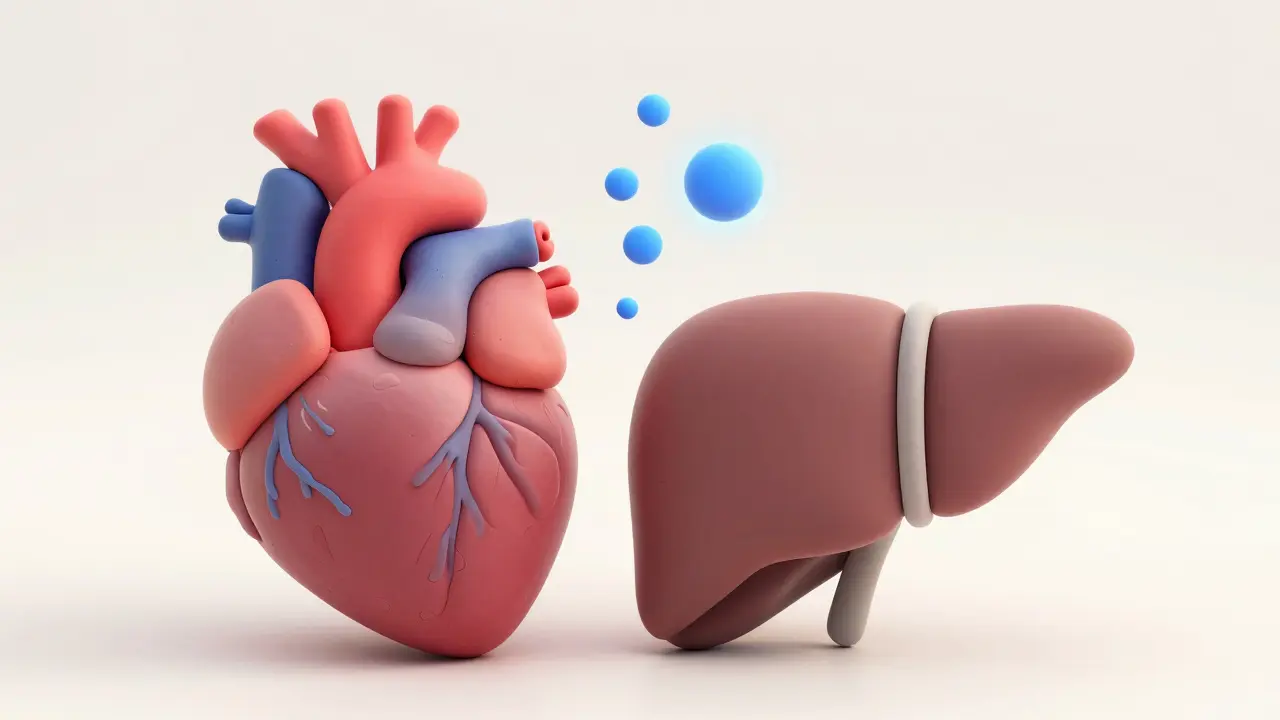
Benefits Beyond the Heart: Hepatic Health
Interestingly, statins might offer benefits specifically for the liver, not just the heart. This is known as a pleiotropic effect, meaning the drug has multiple beneficial actions. In patients with non-alcoholic fatty liver disease (NAFLD), statins can help reduce liver fat and inflammation. The European Association for the Study of the Liver (EASL) 2021 guidelines state that statins are safe in NAFLD and should be considered for cardiovascular risk reduction.
For patients with cirrhosis, the benefits extend to portal hypertension. Portal hypertension is high blood pressure in the veins that supply the liver. Preclinical data indicates that statins can lower hepatic vascular resistance. A 2013 study on cirrhotic rat models showed that simvastatin increased nitric oxide levels, which helps relax blood vessels. In a clinical study with 30 cirrhotic patients, 40 mg of oral simvastatin decreased hepatic vascular resistance by 14% within 30 minutes.
Furthermore, a 2023 study in Gastroenterology Research found moderate-quality evidence that statins reduce the risk of hepatic decompensation. This includes complications like variceal bleeding. The hazard ratio for variceal bleeding was 0.62, meaning a significant reduction in risk. This dual benefit profile makes statins a powerful tool in managing liver disease, offering protection for both the heart and the liver itself.
Choosing the Right Statin for Liver Disease
Not all statins are processed by the body in the same way. This is important for people with liver disease because some drugs rely heavily on liver enzymes to break them down. Statins are generally metabolized through hepatic pathways. Simvastatin, lovastatin, and atorvastatin use the CYP3A4 enzyme. Fluvastatin uses CYP2C9. However, rosuvastatin and pravastatin have minimal CYP metabolism.
This distinction matters. If your liver function is impaired, drugs that need heavy liver processing might build up in your system. For this reason, doctors often prefer pravastatin or rosuvastatin for patients with liver conditions. The American Association for the Study of Liver Diseases (AASLD) 2022 guidance recommends initiating statins at low-to-moderate intensity, such as pravastatin 20-40 mg or rosuvastatin 5-10 mg. You can then gradually increase the dose while watching for side effects.
| Statin Name | Metabolism Pathway | Liver Safety Profile | Recommended for CLD? |
|---|---|---|---|
| Pravastatin | Minimal CYP | High | Yes |
| Rosuvastatin | Minimal CYP | High | Yes |
| Atorvastatin | CYP3A4 | Moderate | Yes (caution) |
| Simvastatin | CYP3A4 | Moderate | Yes (caution) |
For patients with advanced cirrhosis, specifically Child-Pugh class C, starting with lower doses is prudent. However, evidence suggests even these patients derive benefit. The key is to select a statin with a safer metabolic profile to avoid drug interactions, especially since elderly patients with liver disease often take multiple medications.
Monitoring and Clinical Guidelines
One of the most frustrating parts of managing liver disease is the number of blood tests required. Historically, doctors ordered liver function tests (LFTs) regularly for anyone on statins. Current guidelines have changed this approach. The AHA advises against routine liver function monitoring for statin users. Baseline tests should be obtained before starting, but if you are stable, you do not need constant checks.
The AASLD 2022 guidance supports this. It recommends obtaining baseline liver function tests but notes that routine monitoring is unnecessary per AHA guidelines. This reduces the burden on patients and saves healthcare costs. If you experience symptoms like jaundice or severe fatigue, you should contact your doctor immediately. But for the vast majority, the medication is well-tolerated.
There is a learning curve for clinicians. Studies show it takes about 18-24 months for new safety data to change prescribing patterns. This means your doctor might still be hesitant. Patient advocacy is important. If you have liver disease and are told you cannot take statins, ask about the latest guidelines from the AASLD or AHA. Documentation quality is excellent through resources like the AASLD's Clinical Guidance on Liver Disease, which provides specific algorithms for CLD patients.
Real-World Patient Experiences
Clinical trials are one thing, but what do patients actually say? On the American Liver Foundation's online forum, reviewed in October 2023, 87% of 142 patients with CLD using statins reported no liver-related side effects. Many noted improved energy levels, possibly linked to better cardiovascular health. Reddit discussions in r/liverdisease from January 2024 showed similar results. Among 58 active participants with cirrhosis using statins, 84% experienced no adverse hepatic effects.
Some patients reported transient mild elevations in liver enzymes, but these normalized without stopping the medication. Common positive feedback included patients with NAFLD seeing their liver numbers improve on atorvastatin. Others with compensated cirrhosis noted that portal hypertension symptoms decreased after starting rosuvastatin. The most frequent concern was not side effects, but rather physician reluctance to prescribe. About 31% of patients reported having to advocate for themselves to receive appropriate cardiovascular protection.
Frequently Asked Questions
Can I take statins if I have cirrhosis?
Yes, statins are generally safe for patients with compensated cirrhosis. Evidence suggests they reduce the risk of decompensation and mortality. For advanced cirrhosis (Child-Pugh C), doctors usually start with lower doses of pravastatin or rosuvastatin.
Do statins cause liver failure?
Severe liver injury from statins is extremely rare, occurring in about 0.001% of patients. Major trials like JUPITER and EXCEL found no significant difference in liver injury rates compared to placebo.
Which statin is best for liver disease?
Pravastatin and rosuvastatin are often preferred because they have minimal metabolism through liver enzymes (CYP450), reducing the risk of drug buildup in patients with liver impairment.
Do I need regular liver blood tests on statins?
Current guidelines from the AHA advise against routine liver function monitoring. Baseline tests are recommended before starting, but ongoing checks are not necessary unless symptoms arise.
Can statins help with fatty liver disease?
Yes, studies indicate statins can reduce liver fat and inflammation in non-alcoholic fatty liver disease (NAFLD) while also providing cardiovascular protection.
Understanding the role of statins in liver disease requires looking past old fears. The evidence is clear: these medications offer significant cardiovascular benefits and potential hepatic advantages with minimal risk. If you have liver disease, discussing statin therapy with your healthcare provider could be a vital step in protecting your long-term health.


