

When a life-saving medication has no generic version, the price can be crushing. Some drugs cost more than $15,000 a month. For many patients, that’s not just expensive-it’s impossible. But there’s a lifeline: Patient Assistance Programs (PAPs). These aren’t charity handouts. They’re structured, official programs run by drugmakers, nonprofits, and sometimes states to help people get the medicine they need when no cheaper alternative exists.
Why PAPs Matter When There’s No Generic
Generic drugs cut prices by 80% or more. But for many conditions-rare diseases, advanced cancers, autoimmune disorders-there simply isn’t a generic. Drugs like Soliris, Tasigna, or HIV treatments like Truvada have no copycat versions. Their list prices? Often over $500,000 a year. Without help, patients choose between their health and their home.That’s where PAPs step in. In 2022, these programs gave out $4.7 billion in aid to over 1.2 million people. Most of that went to brand-name drugs with no generics. For eligible patients, that means $0 out-of-pocket costs. Not a discount. Not a coupon. Full coverage.
Who Qualifies for PAPs?
You don’t need to be broke. But you do need to meet income rules. Most programs use the Federal Poverty Level (FPL) as their benchmark. In 2023, that meant:- Individuals earning under $60,000 a year could qualify
- Families of four making under $123,000 were often eligible
Some programs are stricter-only accepting those below 200% FPL. Others go as high as 400%. The key? Your income must be documented. That means tax returns, pay stubs, or W-2 forms. If you’re uninsured, you’ll likely qualify. If you have insurance, it’s trickier.
How PAPs Actually Work
There are three main types of assistance:- Full coverage (55%) - You pay nothing. The program sends the drug directly to your pharmacy or home.
- Tiered assistance (30%) - You pay a portion based on income. For example, $25/month if you earn under $30,000, $50 if you earn $40,000.
- Fixed-dollar help (15%) - You get a set amount, like $100 per prescription, regardless of income.
Most manufacturer PAPs require:
- A prescription from your doctor
- Proof of income (tax return, pay stub, or government aid letter)
- Proof of U.S. residency
- A signed form from your doctor confirming you need the drug
Processing time? Manufacturer programs take 7-10 business days. Foundation-run programs (like the Patient Access Network Foundation) can take 2-3 weeks because they check more paperwork.
The Big Catch: Accumulator Programs
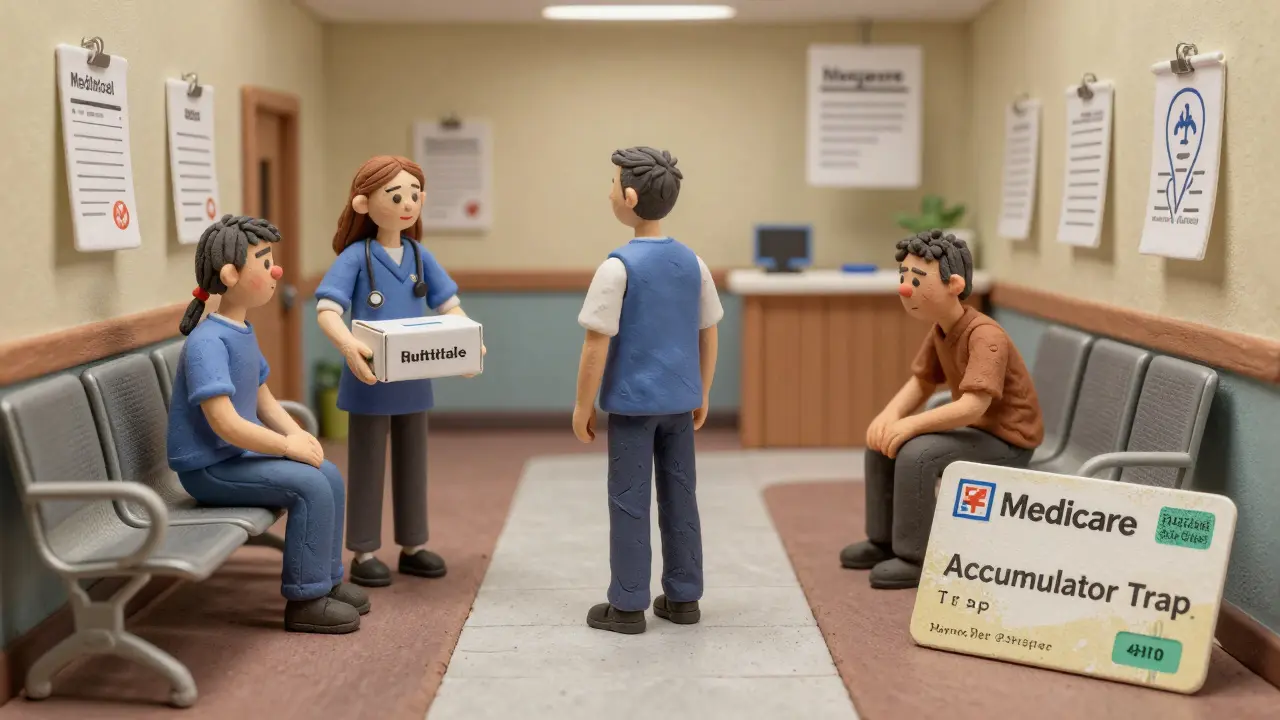
Here’s where things get ugly. If you have private insurance, your drug plan might have an accumulator adjustment policy. That means: even if PAPs cover your entire drug cost, your insurer won’t count that help toward your deductible or out-of-pocket maximum.So here’s the trap:
- You get PAP assistance → your drug costs $0
- But your insurance still treats you as if you paid full price
- You keep hitting your deductible
- You end up paying thousands more just to reach your out-of-pocket max
Over 78% of major pharmacy benefit managers (PBMs) like Express Scripts and Optum use this trick. It turns a lifesaving program into a financial trap. You’re getting the drug for free-but you’re still drowning in medical bills.
What About Medicare?
If you’re on Medicare Part D, you can’t use manufacturer copay assistance anymore. A rule that took effect in 2020 blocks it. That’s why Medicare patients rely on nonprofit PAPs-like the Chronic Disease Fund or the Patient Advocate Foundation-that aren’t tied to drugmakers.These foundation programs have different rules. They might help even if you have Medicare. But they’re often underfunded and have long waitlists. Don’t wait until you’re out of pills to apply.
Real Stories: Success and Struggle
One patient on Reddit shared: “My HIV med cost $15,000 a month. Without the Gilead PAP, I’d have lost my apartment. With it? $0. I kept my job, my home, my life.” Another, on a patient forum, wrote: “My cancer drug was covered by PAP-but my insurer refused to count it toward my deductible. I paid $20,700 out-of-pocket in six months. I had to sell my car.” These aren’t rare. A 2023 survey found 68% of PAP users struggled with application complexity. Nearly half needed help from a nurse or social worker just to fill out the forms.How to Apply: A Step-by-Step Guide
1. Find the right program - Use free tools like RxHope or NeedyMeds. They list over 90% of manufacturer PAPs. Search by drug name. 2. Check eligibility - Enter your income, insurance status, and prescription details. The tool will tell you which programs you qualify for. 3. Gather documents - Tax return or pay stubs, your prescription, ID, and your doctor’s contact info. Most programs require a signed form from your provider. 4. Submit the application - Some can be done online. Others need mailed forms. Keep copies of everything. 5. Follow up - If you don’t hear back in 10 days, call. Denials happen. 41% of applications need an appeal. Don’t give up. 6. Check for accumulator traps - Call your insurer. Ask: “Do you use accumulator adjustment for this drug?” If yes, ask if they’ll waive it for PAP recipients.
Who Can Help You?
You don’t have to do this alone. Many hospitals now have medication access specialists-trained staff who handle PAP applications full-time. Ask your doctor’s office. If they don’t have one, contact:- Patient Advocate Foundation - Free case managers who help with paperwork and appeals
- Chronic Disease Fund - Helps with rare disease and high-cost drugs
- NeedyMeds - Free database of PAPs and discount cards
These groups don’t just help you apply-they fight for you if you’re denied.
PAPs vs. Other Options
Some people turn to GoodRx or pharmacy discount cards. But here’s the truth:- GoodRx - Saves about 8% on brand-name drugs with no generic. Not enough.
- State programs (SPAPs) - Like Pennsylvania’s PACE. They cap help at $400/month. PAPs cover the full cost.
- PAPs - Cover 100% for eligible patients. Only option that makes high-cost drugs truly affordable.
PAPs are the only tool that can turn a $500,000-a-year drug into a $0 cost. Everything else is a Band-Aid.
The Bigger Problem
PAPs are a necessary fix-but they’re not a solution. Drugmakers set high list prices because they know PAPs will cover the gap. Experts call it a “perverse incentive.” The system works, but it’s built on a lie: that patients should have to beg for the medicine they’re prescribed.Still, until laws change, PAPs are the only shield against financial ruin. For 89% of uninsured patients needing brand-name drugs, they’re the only option.
What’s Changing in 2026?
New tools are emerging. Eli Lilly’s “Simple Bridge” cuts application time from 45 minutes to 10. Epic’s electronic health record system now auto-suggests PAPs when a doctor prescribes a high-cost drug. CMS now requires insurers to disclose accumulator policies in plan documents.But the core problem remains: no generic means no price drop. And without PAPs, many patients simply stop taking their medicine.
Don’t wait. If you’re on a brand-name drug with no generic, start applying now. The process is hard. But the alternative-going without your medicine-is worse.
Can I use a Patient Assistance Program if I have insurance?
Yes-but only if your insurance doesn’t block it. Many insurers use "accumulator adjustment" policies that prevent PAP assistance from counting toward your deductible or out-of-pocket maximum. This means you might get the drug for free, but still pay thousands in other medical costs. Always ask your insurer if they use accumulator rules for your specific drug.
Do I need to be uninsured to qualify for a PAP?
No. Many PAPs help people with insurance, especially if your plan has high copays or doesn’t cover the drug well. The main requirement is income-you must earn below a certain threshold (usually 200-400% of the Federal Poverty Level). Some programs even help people with Medicare, though not with manufacturer-provided copay assistance.
How long does it take to get approved for a PAP?
Manufacturer-sponsored PAPs usually approve applications in 7-10 business days. Foundation-sponsored programs (like the Patient Access Network Foundation) can take 14-21 days because they review more documents. If you’re denied, you can appeal. About 41% of initial applications need an appeal-don’t give up after the first rejection.
What documents do I need to apply for a PAP?
You’ll typically need: 1) Proof of income (tax return, W-2, or pay stub), 2) A signed prescription from your doctor, 3) Proof of U.S. residency (like a driver’s license or utility bill), and 4) A completed physician attestation form. Most programs require these four items. If you’re on Medicaid or Medicare, you may need additional paperwork.
Can I use PAPs for any brand-name drug?
Almost all major pharmaceutical companies offer PAPs for their brand-name drugs, especially those without generics. This includes drugs for cancer, HIV, rare diseases, and autoimmune conditions. However, not every drug is covered by every program. Use free tools like RxHope or NeedyMeds to search by drug name and find active programs. If a drug has no listed PAP, contact the manufacturer directly-they may still have an unlisted program.


