
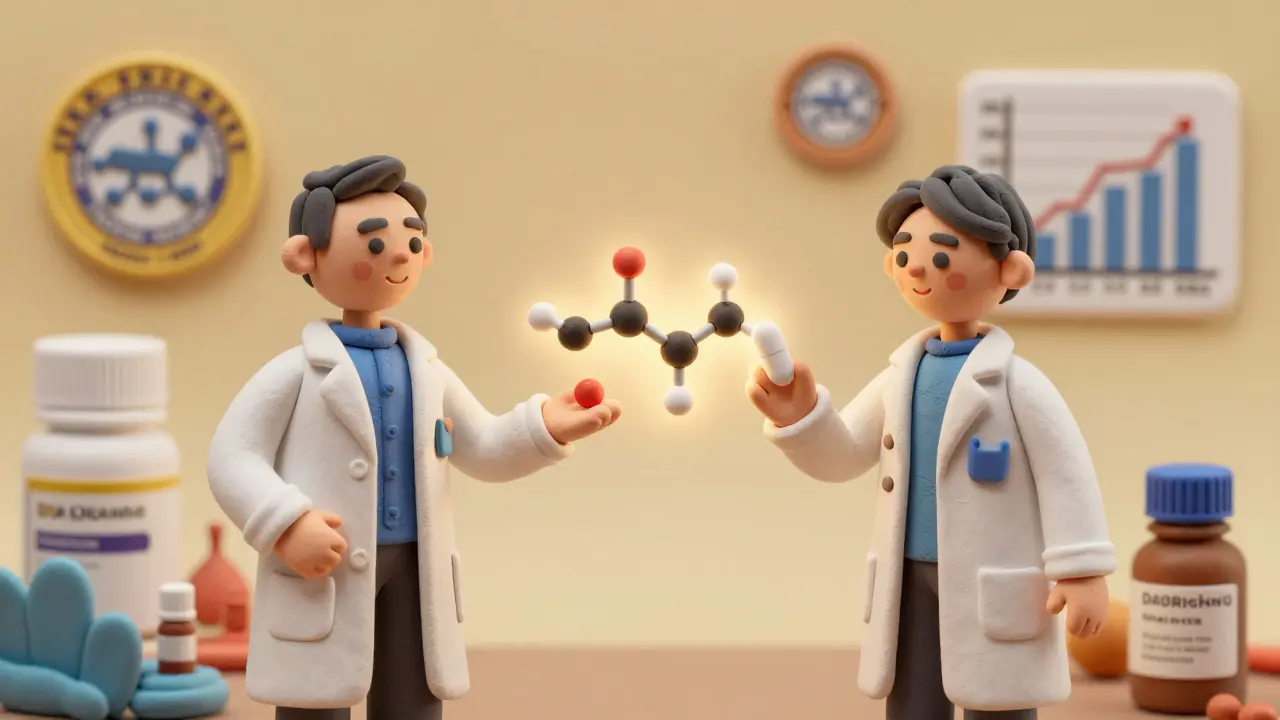
What Makes a Generic Drug Approved by the FDA?
When you pick up a generic pill at the pharmacy, you might wonder: is this really the same as the brand-name version? The answer isn’t just yes-it’s rigorously proven. The U.S. Food and Drug Administration (FDA) doesn’t approve generic drugs because they’re cheaper. They approve them because they must meet the exact same standards for safety, quality, and strength as the original brand-name drug. There’s no shortcut to this. Every generic must deliver the same therapeutic effect, in the same way, to the same patients.
The Legal Backbone: Hatch-Waxman Act of 1984
The system we use today didn’t appear by accident. It was built by law. In 1984, Congress passed the Drug Price Competition and Patent Term Restoration Act-better known as the Hatch-Waxman Act. This law created the Abbreviated New Drug Application (ANDA) pathway. Instead of forcing generic manufacturers to repeat every clinical trial done for the original drug, they could prove their version worked just as well by showing bioequivalence. That’s the core idea: same active ingredient, same dose, same route, same effect. The law also gave brand-name companies limited patent protection to recoup R&D costs, while ensuring generics could enter the market once those patents expired. This balance created competition without compromising safety.
How Bioequivalence Is Proven: The 80%-125% Rule
The most critical test for a generic drug is bioequivalence. This means the body absorbs the drug at the same rate and to the same extent as the brand-name version. It’s not guesswork-it’s science measured in blood samples. In a typical study, 24 to 36 healthy volunteers take both the generic and the brand-name drug, in random order, with a washout period in between. Researchers then measure how much of the drug enters the bloodstream over time using two key metrics: Cmax (peak concentration) and AUC (total exposure over time).
For the drug to be approved, both values must fall within 80% to 125% of the brand-name drug’s results. That’s a 20% range on either side. Sounds wide? It’s not. For most drugs, this range ensures no clinically meaningful difference in how the drug works. But for drugs with a narrow therapeutic index-like warfarin, lithium, or levothyroxine-the FDA tightens the rules. For levothyroxine, the acceptable range is 95% to 105%. That’s a much smaller window because even small changes can affect thyroid function. The FDA doesn’t treat all drugs the same. The stricter the drug, the stricter the test.
Manufacturing Must Be Perfect: cGMP and CQAs
A generic drug isn’t just about what’s inside the pill-it’s about how it’s made. Every facility that produces generic drugs must follow Current Good Manufacturing Practices (cGMP), outlined in 21 CFR Parts 210 and 211. These aren’t suggestions. They’re legal requirements covering everything from raw material testing to employee hygiene to equipment calibration.
Manufacturers must also identify and control Critical Quality Attributes (CQAs)-the physical and chemical properties that directly affect safety and performance. For a tablet, that might be hardness, disintegration time, or dissolution rate. For an inhaler, it’s particle size and spray pattern. The FDA uses a system called Question-Based Review (QbR), introduced in 2005, to dig into these details. During inspections, inspectors don’t just check paperwork. They look at process validation data. Teva and other major manufacturers say the biggest surprise for new applicants is that the FDA expects proof of consistent quality across three full commercial batches-not just pilot runs. One company, Hetero Labs, got a Complete Response Letter in 2021 because their generic version of Jardiance had inconsistent tablet hardness across batches. That’s not a minor flaw. It’s a deal-breaker.
Complex Generics: Why Some Drugs Take Years to Copy
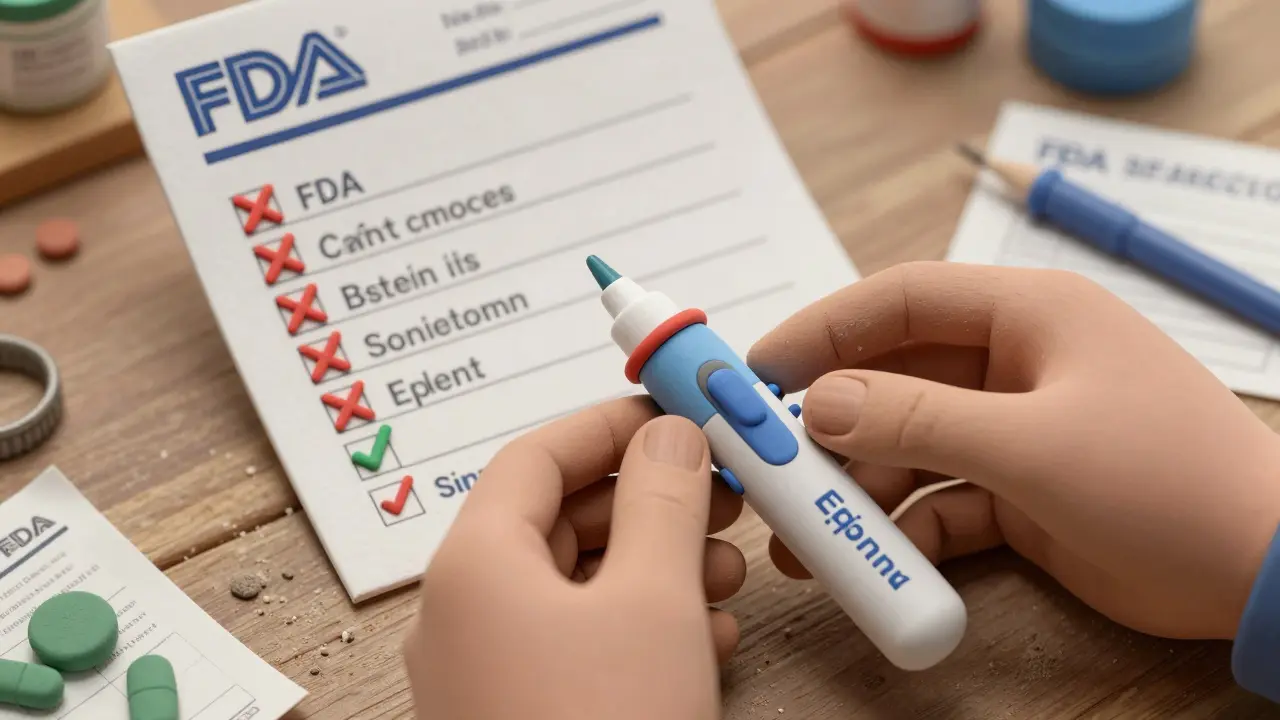
Not all drugs are created equal. A simple tablet of amoxicillin is easy to replicate. An epinephrine auto-injector like EpiPen? Not so much. Complex generics include inhalers, topical creams, injectables, and extended-release formulations. These require not just chemical matching, but device matching. The FDA approved only 3 out of 27 applications for generic EpiPens between 2015 and 2020-not because the active ingredient was hard to copy, but because the needle mechanism, pressure system, and user interface had to be identical. The same goes for drugs like Humira, which took nearly a decade after patent expiry for a generic to be approved due to its complex biologic structure.
According to DrugPatentWatch, only 58% of complex generic applications are approved within three review cycles, compared to 76% for simple oral tablets. The average approval time for complex generics is 47.2 months-almost four years. That’s why companies investing in these products spend up to $25 million per application, compared to $1.3 million for a standard pill. The FDA has set a goal to approve 50% of complex generics within two review cycles by 2027. Right now, it’s only 28%.
Why So Many Rejections? It’s Not About Science-It’s About Details
You’d think that if the science is clear, approvals would be straightforward. But here’s the reality: less than 10% of generic applications are approved on the first try. That’s not because the drug doesn’t work. It’s because of missing data, unclear labeling, or sloppy documentation. A typical ANDA submission runs 5,000 to 10,000 pages. One misplaced chart, one unvalidated test method, or an unclear stability protocol can trigger a rejection. The FDA conducts about 1,200 pre-approval inspections every year. If a facility has a major cGMP violation, the application is paused until the issue is fixed and re-inspected. Many companies fail because they underestimate the depth of documentation required. Successful applicants often use the FDA’s Pre-ANDA program-where they meet with regulators early to clarify expectations. About 78% of those who do this get approved faster.
Cost, Savings, and Market Impact
Generic drugs make healthcare affordable. In 2023, they made up 90% of all prescriptions filled in the U.S. but only 23% of total drug spending. That’s $373 billion in savings in one year alone. The average cost to develop a generic drug is $1.3 million. Compare that to $2.6 billion for a new brand-name drug. That’s why generics exist-to bring down prices without sacrificing quality. The top 10 generic manufacturers control nearly half the U.S. market. But adoption varies. Cardiovascular drugs? Almost all are generic. Oncology drugs? Only 62% are, because many are complex, patented, or tied to proprietary delivery systems. The FDA approved 90 new generic drugs in 2023, including the first version of Humira, which is expected to save patients billions over the next few years.
What Experts Say: Are Generics Really the Same?
Some patients worry that generics aren’t as good. That’s a myth. Dr. Janet Woodcock, former director of the FDA’s Center for Drug Evaluation and Research, said it plainly: "Every approved generic meets the same rigorous standards as the brand-name drug, with no clinically meaningful differences in performance." The American Medical Association reviewed 15 years of post-market data and found that 98.7% of therapeutic categories showed no difference in outcomes between generics and brands. Even critics, like Dr. Randall Uppal, acknowledge the science is sound-but warn that the 80%-125% range might be too loose for some drugs. That’s why the FDA already adjusted the range for levothyroxine and warfarin. The system isn’t perfect, but it’s adaptive. It responds to evidence.
What’s Next for Generic Drug Approval?
The FDA is pushing harder into complex generics. With $52 billion in annual brand sales tied to drugs still without generic competition, there’s a strong incentive to clear the path. New guidance is coming for topical products, inhalers, and injectables. The European Medicines Agency is aligning its rules with the FDA’s, creating global consistency. The industry is responding with better technology-3D printing of pills, advanced dissolution testing, and AI-driven process control. But the biggest hurdle isn’t science anymore. It’s patent litigation. Even after a generic is approved, companies can delay market entry for years with lawsuits. The FTC found an average delay of 2.4 years between approval and launch. That’s where policy needs to catch up with science.
Bottom Line: Generics Are Safe, Effective, and Heavily Regulated
If you’re taking a generic drug, you’re not getting a second-rate product. You’re getting a drug that passed the same tests as the brand-name version, under the same strict rules. The FDA doesn’t cut corners. It just doesn’t need to repeat what’s already been proven. The system works. It saves billions. It’s backed by decades of real-world data. And it’s constantly improving. The next time you fill a prescription for a generic, remember: behind that bottle is a mountain of data, inspections, and scientific proof.
Are generic drugs as safe as brand-name drugs?
Yes. Every generic drug approved by the FDA must contain the same active ingredient, strength, dosage form, and route of administration as the brand-name version. It must also meet identical standards for purity, stability, and performance. The FDA requires bioequivalence testing to prove it works the same way in the body. Post-market surveillance over 15 years shows no meaningful difference in safety or effectiveness for 98.7% of therapeutic categories.
Why do some generic drugs look different from the brand name?
Generic drugs can look different because U.S. law requires them to have a different shape, color, or marking than the brand-name version to avoid trademark infringement. But the active ingredient, dose, and how it works are identical. The differences are only in inactive ingredients like dyes or fillers, which don’t affect how the drug performs. If you notice a change in how you feel after switching, talk to your doctor-but it’s rarely due to the generic itself.
How long does it take to get a generic drug approved?
For a standard oral tablet, the FDA aims to complete its review within 10 months of submission. But the entire process-from developing the product to submitting the application-takes 18 to 24 months on average. For complex generics like inhalers or extended-release formulations, the process can take 47 months or more. Many applications are rejected on the first try, and fixes can add another year or two.
What’s the difference between a generic and a biosimilar?
Generics are copies of small-molecule drugs made through chemical synthesis. Biosimilars are copies of large, complex biologic drugs made from living cells. Because biologics are harder to replicate exactly, biosimilars require more clinical testing than generics. The FDA treats them as separate pathways. A generic for aspirin is straightforward. A biosimilar for Humira requires extensive studies to prove it works the same way in patients.
Why are some drugs still without generic versions after their patent expires?
Even after a patent expires, generic entry can be delayed by legal tactics like "evergreening"-where brand companies file new patents on minor changes to extend exclusivity. Complex formulations are also hard to copy. For example, the EpiPen’s auto-injector device took years to replicate. The FDA approved only 3 out of 27 generic EpiPen applications between 2015 and 2020. Some drugs simply aren’t profitable enough for manufacturers to invest in the expensive approval process.


