
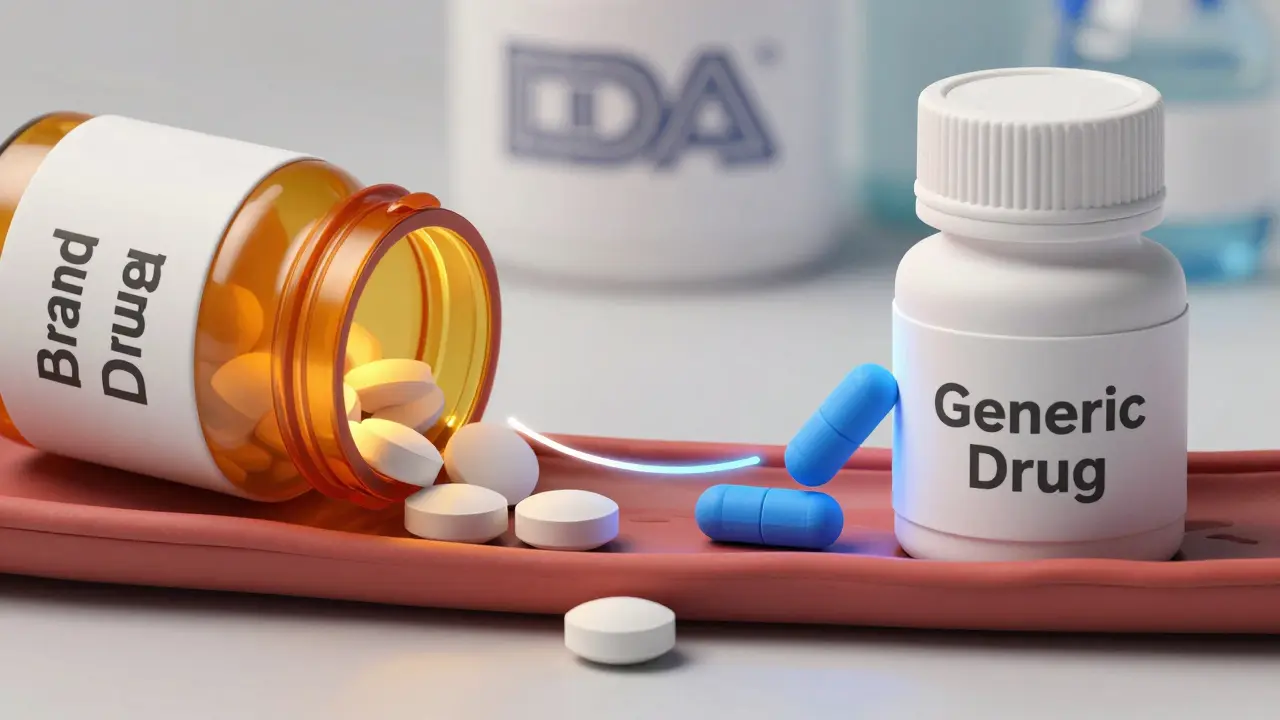
When you pick up a prescription, do you ever wonder if the generic version is truly the same as the brand-name drug you’ve been taking for years? It’s a fair question. Millions of people switch to generics every year to save money - and for good reason. In the U.S., generics make up 92% of all prescriptions filled, yet cost only about 23% of what brand drugs do. But cost savings shouldn’t come at the cost of safety. So, what does the long-term data actually show? Are generics just as safe over time? Or are there hidden risks that only show up after months or years of use?
What does "bioequivalent" really mean?
The FDA says generics are bioequivalent to brand drugs. That sounds official - but what does it actually mean? It means the generic version must deliver the same active ingredient at the same strength and in the same form. More importantly, it must be absorbed into the bloodstream at a rate and amount that falls within 80% to 125% of the brand drug. That’s a 45% range. For most drugs, that’s fine. But for drugs with a narrow therapeutic index - like warfarin, levothyroxine, or seizure meds - even small differences in absorption can mean the difference between control and crisis.A 2017 study comparing generic levothyroxine to Synthroid found that patients on generics had a 12.3% higher rate of thyroid-stimulating hormone (TSH) fluctuations. That might not sound like much, but for someone with hypothyroidism, a slight shift in TSH can mean fatigue, weight gain, or worse - heart rhythm problems. The FDA’s 80-125% window was designed for drugs like antibiotics or painkillers, not for medications where the body is finely tuned to a specific dose.
Real-world data: Austria’s massive study
One of the most comprehensive long-term studies ever done came out of Austria. Researchers tracked nearly the entire insured population - over 1.7 million people - between 2007 and 2012. They compared outcomes for 17 different medications, including blood pressure pills, statins, and diabetes drugs. The results were surprising.For antihypertensive drugs, the death rate among brand users was 53.8 per 1,000 patient-years. For generic users? 30.2 per 1,000. That’s nearly half. Major cardiac events - heart attacks, strokes - were also significantly lower in the generic group: 83.6 vs. 51.3 events per 1,000 patient-years. Even after adjusting for age, sex, and other health conditions, the advantage for generics held strong. Five-year survival rates? 77.8% for brand, 85.9% for generics. This wasn’t a fluke. The study used advanced statistical methods to rule out bias. The conclusion? For chronic conditions, generics weren’t just as safe - they were safer.
Why? One theory: brand drugs are often more expensive, so patients on them may be more likely to skip doses or stop taking them entirely. Generics, being cheaper, improve adherence. Better adherence means better outcomes. It’s not that the drug itself is safer - it’s that more people are taking it as prescribed.
The flip side: When switching back helps
But not all stories end well. There are documented cases where patients deteriorated after switching from brand to generic - and improved when switched back.One patient on generic ciprofloxacin (Mylan) kept getting infections that wouldn’t clear. Switching back to Ciproxin (Bayer) - the brand - solved the problem overnight. Another took generic levofloxacin and developed a persistent fever. Only after switching to Tavanic did their temperature drop and symptoms vanish. These aren’t rare anecdotes. A 2013 analysis found that 30% of patients saw no change after switching, 30% had worse symptoms or side effects, and 30% actually improved. That leaves a full 60% of people affected in some way.
What’s going on? It’s not always the active ingredient. It’s the fillers, coatings, and manufacturing processes. A generic drug might use a different binder or lubricant. These inactive ingredients don’t have to be identical. But for some people - especially those with sensitive digestive systems or allergies - even tiny changes can throw off absorption or trigger inflammation.
Manufacturer matters more than brand vs. generic
Here’s a twist: the real difference might not be brand versus generic - it might be who made it.A 2018 analysis looked at adverse event reports for amlodipine (a blood pressure drug). Brand-name versions made up 29.5% of reports. Authorized generics - same company, same formula, just sold under a generic label - made up 14.3%. But generic versions from other manufacturers? 56.2% of reports. For losartan, the pattern was similar: brand at 56%, authorized generic at 1.5%, generics from other companies at 42%.
This suggests that the issue isn’t generic vs. brand - it’s manufacturer quality. A study from Ohio State University found that generic drugs made in India had a 54% higher rate of severe adverse events - including hospitalizations and deaths - compared to those made in the U.S. For ciprofloxacin, Indian-made generics showed a 62% higher rate of severe reactions. The FDA’s own database (FAERS) confirmed this pattern. It’s not that all Indian-made drugs are unsafe. But the supply chain is longer, oversight is patchier, and quality control varies.
What about the elderly?
Older adults are especially vulnerable. A 2021 Harvard study looked at 136,177 people over 66 who were on three common blood pressure drugs: losartan, valsartan, and candesartan. Researchers compared ER visits and hospitalizations 24 months before and 12 months after generics entered the market. No statistically significant rise in adverse events. On the surface, that sounds reassuring.But here’s the catch: the study only tracked hospitalizations. What about mild dizziness, fatigue, or kidney changes that don’t land you in the ER? Or a gradual drop in blood pressure control that leads to a stroke six months later? These events aren’t captured in emergency data. And for older patients on multiple medications, even small changes can cascade.

The narrow therapeutic index problem
Some drugs are just more finicky. Warfarin (a blood thinner) requires precise dosing. A 10% change in absorption can mean a dangerous clot or a life-threatening bleed. Levothyroxine? Even a 5% shift can throw off thyroid function. Anti-seizure drugs? A small dip in blood levels can trigger a seizure.Reddit threads are full of these stories. One user, u/MedicalMystery123, reported their seizure frequency jumped from 1-2 per month to 8-10 after switching from brand Lamictal to generic lamotrigine. They switched back - and the seizures stopped. Another user on PatientsLikeMe said their asthma worsened after switching from Advair to a generic inhaler. The inhaler’s delivery mechanism was slightly different - enough to change how much medicine reached the lungs.
The FDA admits this. In January 2022, they released new guidance for "complex generics" - drugs like inhalers, injectables, and topical creams where traditional bioequivalence testing doesn’t cut it. But these rules are still new. Many older generics were approved under outdated standards.
What should you do?
If you’re on a medication with a narrow therapeutic index - or if you’ve noticed a change in how you feel after switching - talk to your pharmacist and doctor. Don’t assume all generics are the same. Ask:- Is this generic made by the same company as the brand?
- Where is it manufactured?
- Has anyone else in my clinic had issues with this version?
For chronic conditions, stick with the same generic manufacturer if you’re doing well. If you’re switching and feel worse, don’t wait. Go back to your original drug - or ask for a different generic. Your body may be telling you something.
And if you’re a patient with no choice - because your insurance only covers one version - speak up. Demand transparency. Ask for records of which manufacturer your pharmacy is using. You have a right to know.
Generics are a vital part of affordable healthcare. But they’re not magic bullets. The science shows they’re safe for most people, most of the time. But for some - especially those on critical medications - the differences matter. Long-term safety isn’t just about what’s in the pill. It’s about who made it, how it’s made, and whether your body can handle it - over years, not just weeks.
Are generic drugs always as safe as brand-name drugs over the long term?
For most people and most medications, yes. But not always. Studies show that for drugs with a narrow therapeutic index - like warfarin, levothyroxine, or anti-seizure meds - small differences in absorption can lead to serious side effects. Some long-term studies even found generics had better safety outcomes, likely because patients took them more consistently. But individual reactions vary. If you notice changes in how you feel after switching, talk to your doctor.
Can switching from brand to generic cause side effects?
Yes, and it’s more common than you might think. Case reports and patient surveys show that 30% of people experience worsened symptoms or side effects after switching. These aren’t always due to the active ingredient - they can come from differences in fillers, coatings, or how the drug is absorbed. If you feel worse after a switch, don’t assume it’s "in your head." Go back to your original version and document the change with your provider.
Why do some generic drugs have more adverse event reports than brands?
It’s not because generics are inherently riskier - it’s because far more people take them. For example, 92% of prescriptions are for generics, so naturally, more reports come from that group. But when you look at reports per prescription, some generics from certain manufacturers show higher rates of severe events. A study found Indian-made generics had 54% more hospitalizations than U.S.-made ones. The issue isn’t generic vs. brand - it’s manufacturer quality and oversight.
Are authorized generics safer than regular generics?
Often, yes. Authorized generics are made by the same company that produces the brand-name drug, just sold under a generic label. That means the formula, manufacturing process, and quality controls are identical. Studies show authorized generics have adverse event rates much closer to the brand than other generics. If you’re on a critical medication, asking for an authorized generic can reduce risk.
How can I find out where my generic drug is made?
You can’t always find this info on the label, but you can ask your pharmacist. Many pharmacies can tell you the manufacturer. You can also check the FDA’s Drug Registration and Listing System online or call the manufacturer directly. If your pharmacy won’t tell you, ask for a different generic - you have the right to request it. Some states require disclosure of manufacturer origin upon request.


