
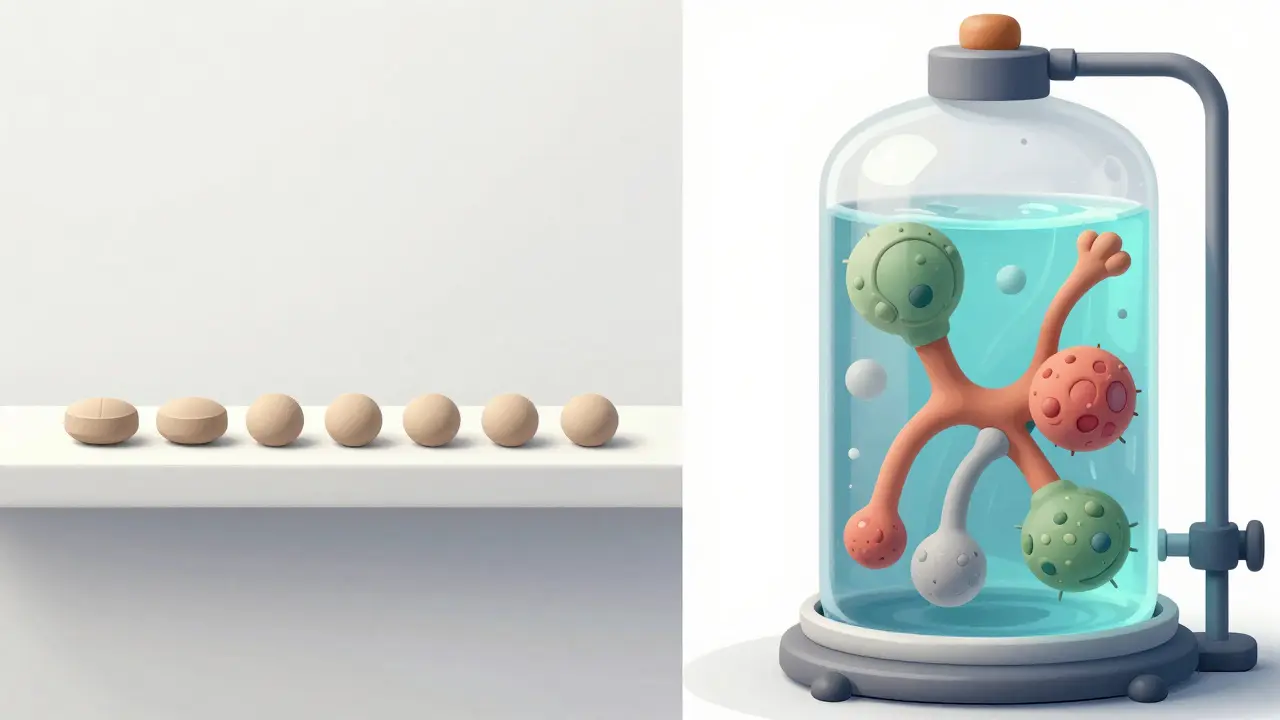
Have you ever wondered why your doctor can swap a brand-name blood pressure pill for a cheaper generic without blinking, but refuses to do the same for cancer treatments or diabetes injections? The answer isn't just about price; it’s about biology. While small-molecule drugs like aspirin are chemical copies that look identical under a microscope, biologic drugs are living entities grown in cells, making them inherently unique and impossible to copy exactly. This fundamental difference changes everything-from how they are made to how regulators approve cheaper versions called biosimilars.
If you’re navigating treatment options or insurance forms, understanding this distinction is crucial. You might be asking why a "generic" biologic (a biosimilar) costs so much more than a generic pill, or why switching between brands requires careful medical oversight. Let’s break down the science, the manufacturing headaches, and what this means for your healthcare choices.
The Core Difference: Chemistry vs. Biology
To understand why biologics can’t be copied, we first need to look at what they actually are. Traditional pharmaceuticals, known as small-molecule drugs, are created through chemical synthesis. Think of baking cookies from a box mix. If you follow the recipe precisely-same flour, same sugar, same oven temperature-you get the exact same cookie every time. These molecules are small, simple, and stable. When the patent expires, another company can make an identical copy, which we call a generic drug.
Biologics are different. They are large, complex proteins produced by living organisms-bacteria, yeast, or mammalian cells. Imagine trying to replicate a vintage wine. Even if you use the same grapes, the same soil, and the same barrel, the weather, the fermentation process, and even the mood of the winemaker introduce subtle variations. You get a very similar product, but never an exact clone.
| Feature | Small-Molecule Drugs (Generics) | Biologic Drugs (Biosimilars) |
|---|---|---|
| Production Method | Chemical synthesis | Grown in living cells (bioreactors) |
| Molecular Size | Small (<900 Daltons) | Large (up to 1,000x larger) |
| Copyability | Exact molecular copy possible | No exact copies; only "highly similar" |
| Regulatory Pathway | Abbreviated New Drug Application (ANDA) | Biological License Application (BLA) |
| Interchangeability | Automatic pharmacy substitution | Requires specific state laws & prescriber approval |
This biological origin is the root of the complexity. Because these drugs are alive during production, they undergo natural variations. The FDA notes that slight modifications to the protein structure are expected as a natural part of the manufacturing process. This means no two batches of a biologic are perfectly identical, even from the same manufacturer.
The Manufacturing Maze: Why It Takes Years
If you think making medicine is hard, try making medicine with living cells. The manufacturing process for biologics is a high-stakes balancing act that spans three to six months per batch-roughly ten times longer than producing small-molecule drugs. According to industry data from BioPlan Associates, failure rates during this process sit around 10-15%, often due to contamination or cell line instability.
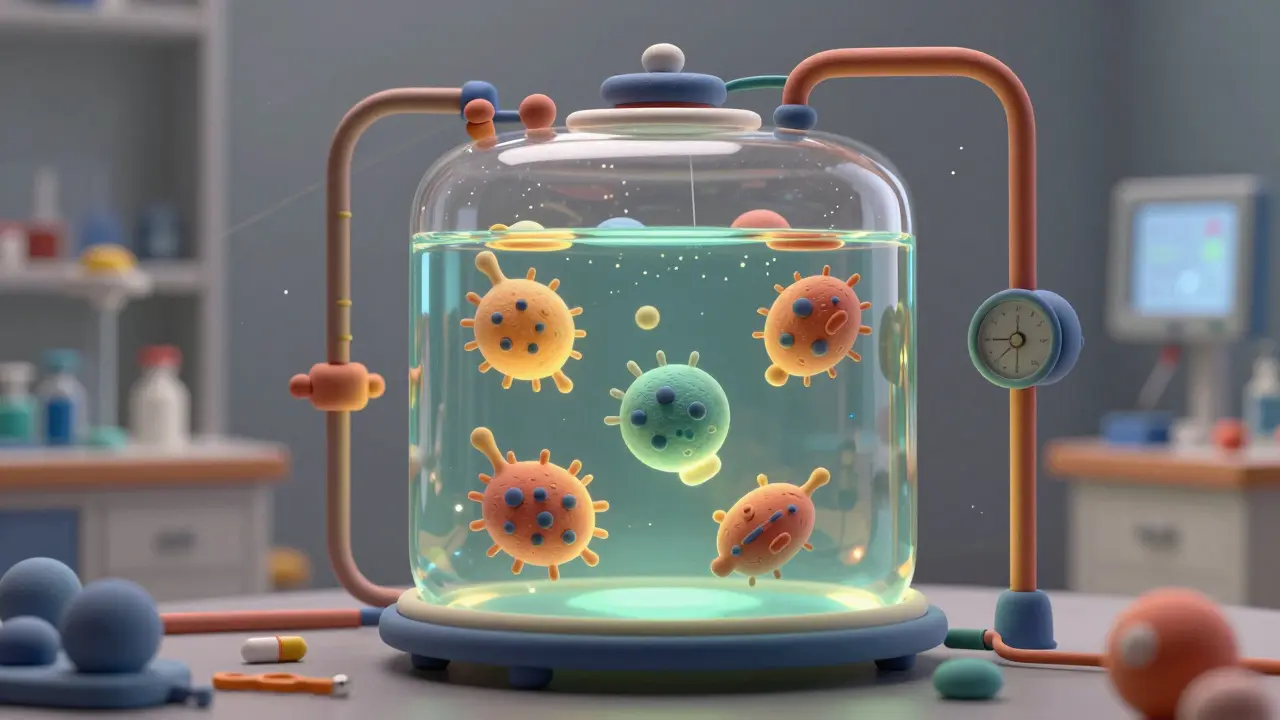
The journey starts with cell line development. Scientists genetically engineer host cells to produce the therapeutic protein. Then comes upstream processing, where these cells are fed in massive bioreactors. Conditions must be perfect: temperature stays at 36-37°C, pH is locked between 7.0 and 7.4, and oxygen levels are meticulously monitored. Mammalian cell cultures alone take 10-14 days just to reach enough biomass to harvest.
Once harvested, downstream processing begins. This involves purifying the protein using techniques like Protein A chromatography, which aims for 95-98% purity. Viral filtration removes potential pathogens, and ultrafiltration concentrates the drug. Finally, the drug is formulated into its final buffer system. Every step introduces potential variability. As Dr. Susan Dana Jones, CEO of Biologics Consulting Group, points out, "the manufacturing process itself becomes part of the product definition." Change the process slightly, and you change the drug.
Biosimilars: The "Highly Similar" Alternative
Since exact copies are impossible, what happens when a biologic’s patent expires? Companies develop biosimilars. A biosimilar is not a generic; it is a highly similar biological product to an already approved reference product. There are no clinically meaningful differences between the biosimilar and the reference in terms of safety, purity, and potency.
Proving this similarity is expensive and time-consuming. Unlike generics, which only need to prove bioequivalence (that they dissolve and absorb the same way), biosimilars require extensive analytical testing, animal studies, and often clinical trials. The FDA requires manufacturers to demonstrate that any minor structural differences do not affect how the drug works in the body.
Why does this matter to you? Biosimilars offer significant cost savings. In 2023, the global biosimilars market reached $10.5 billion, projected to hit $30 billion by 2028. However, because they are not identical, regulations around their use are stricter. In many jurisdictions, pharmacists cannot automatically substitute a biosimilar for the original brand unless it has been designated as "interchangeable" and state laws permit it. This protects patients from unexpected switches that could theoretically impact treatment outcomes, even if the risk is low.
Real-World Challenges and Risks
The complexity of biologics manufacturing creates real-world hurdles. Contamination is the biggest enemy, accounting for roughly 35% of batch failures. A single contaminant can ruin millions of dollars worth of product. Reddit discussions among pharmaceutical professionals highlight "nightmare scenarios" where minor deviations in cell culture conditions led to total batch losses valued over $500,000 each.
Scale-up is another major challenge. Moving from a lab-scale 2,000-liter bioreactor to a commercial 15,000-liter unit isn’t just about turning up the volume. Fluid dynamics, heat transfer, and oxygen mixing change drastically. One senior engineer at Amgen noted that scaling up required 17 months of re-optimization and cost $22 million in delayed revenue. This fragility keeps prices high and supply chains tight.
Furthermore, analytical limitations persist. Dr. R. Lou Sherman of the Alliance for Advanced Biologics notes that current methods can characterize only 60-70% of a monoclonal antibody’s structural attributes. We simply don’t have the tools to see every tiny detail, which adds a layer of uncertainty that regulators must manage through strict oversight.
What This Means for Patients
For patients, the key takeaway is vigilance and communication. If you are prescribed a biologic, ask your doctor about the specific brand. Do not assume that a biosimilar is a drop-in replacement without discussion. While biosimilars are safe and effective, individual responses can vary. Switching from one biologic to another (even within the same class) should be done under medical supervision.
Also, be aware of insurance policies. Many insurers push for biosimilars to reduce costs. Understanding the difference between a biosimilar and a generic helps you advocate for your care. You aren’t just buying a molecule; you’re investing in a complex biological therapy that demands precision.
Can I switch from a brand-name biologic to a biosimilar on my own?
No, you should not switch on your own. Always consult your healthcare provider. While biosimilars are highly similar, regulatory rules vary by location. Some biosimilars are "interchangeable," meaning pharmacists may substitute them, but others require a new prescription from your doctor. Your provider needs to monitor your response to ensure efficacy and safety.
Why are biosimilars still expensive compared to generic pills?
Biosimilars are costly because their development and manufacturing are incredibly complex. Unlike generic pills, which require minimal testing, biosimilars need extensive clinical trials and rigorous quality control to prove similarity. Additionally, the manufacturing process uses living cells in sterile environments, leading to higher failure rates and infrastructure costs.
Is there a risk of side effects when switching to a biosimilar?
The risk is generally low, as biosimilars must meet strict safety standards. However, because they are not identical copies, there is a theoretical possibility of different immune responses. Most patients tolerate the switch well, but close monitoring by your doctor is essential to catch any adverse reactions early.
How long does it take to manufacture a batch of biologic drugs?
Manufacturing a single batch of biologic drugs typically takes 3 to 6 months. This includes cell culture growth (10-14 days), purification, formulation, and extensive quality testing. This timeline is significantly longer than the days or weeks required for small-molecule drug production.
What is the main difference between a generic and a biosimilar?
A generic drug is an exact molecular copy of a small-molecule brand-name drug. A biosimilar is a highly similar version of a biologic drug, which is too complex to copy exactly. Generics are approved based on chemical equivalence, while biosimilars are approved based on comprehensive comparative studies showing no clinically meaningful differences.
