
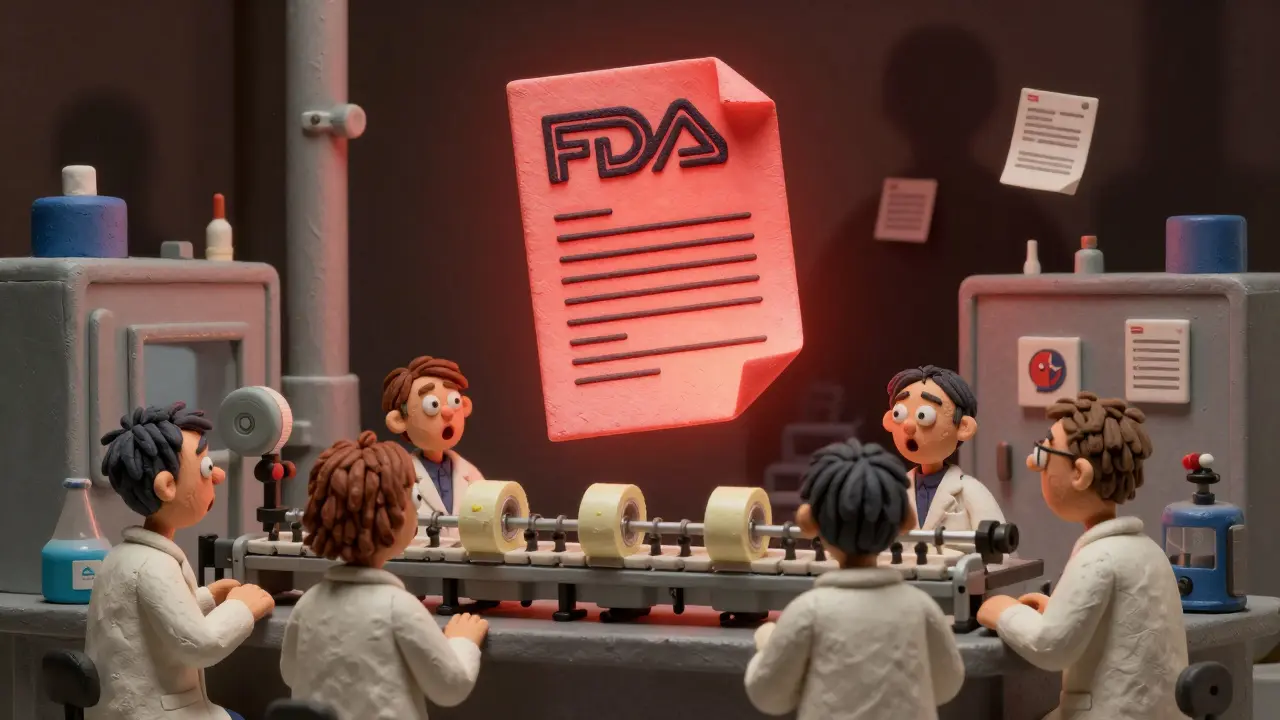
When the FDA sends a warning letter to a drug manufacturer, it’s not a gentle reminder. It’s a red flag that something serious is wrong with how medicines are being made. These letters don’t come out of nowhere. They’re the result of inspections where inspectors found clear, documented violations of Current Good Manufacturing Practices (CGMP). And if you’re a manufacturer-whether you’re based in the U.S., India, or elsewhere-you need to understand what these letters mean, what they demand, and what happens if you ignore them.
What Exactly Is an FDA Warning Letter?
An FDA warning letter is the agency’s formal way of telling a company: "You broke the rules, and we’re documenting it publicly." It’s not a suggestion. It’s not a notice of minor issues. It’s the step between an inspection report (Form 483) and something much worse-like an import ban, product seizure, or even a court order shutting down your facility. The FDA issues these letters under the Federal Food, Drug, and Cosmetic Act. They’re managed by the Office of Compliance in the Center for Drug Evaluation and Research (CDER). In 2023 alone, the FDA sent 327 warning letters to pharmaceutical manufacturers worldwide. That’s up from 289 in 2022-a 12.7% increase. And the trend isn’t slowing. The number of warning letters has nearly doubled since 2018. These letters aren’t secret. Within 15 business days of being sent, they’re posted online for anyone to see-investors, customers, regulators, even competitors. That means a warning letter doesn’t just affect your operations; it hits your reputation, stock price, and ability to win new business.What Do These Letters Actually Say?
Every warning letter follows a strict format. It’s not vague. It’s detailed. It points to exact violations with exact references to the Code of Federal Regulations (CFR). Most often, it cites 21 CFR Parts 210 and 211-the rules that govern how drugs are made, tested, and controlled. Take the July 2, 2025 letter to Daewoo Pharmaceutical Co., Ltd. The FDA found exposed skin-like a worker’s forehead-in an ISO 5 cleanroom. That’s a direct violation of sterile manufacturing rules. They also saw non-sterile tape being used on a filling line. That’s not a small oversight. That’s a contamination risk that could lead to deadly infections in patients. Another example: Oasis Medical, Inc. received a letter in July 2025 demanding they review every batch they made from January 2023 onward. Why? Because their quality control system failed to catch defects. The FDA didn’t just say "fix your process." They demanded specific data: "Complete results of your examination of retains/reserve samples for all batches." The letter doesn’t end with complaints. It demands action. You have 15 working days to respond. And your response can’t be vague. You need to prove you’ve found the root cause, fixed it, and put systems in place to stop it from happening again. That means a full CAPA (Corrective and Preventive Action) plan-backed by data, not promises.What Are the Most Common Violations?
Not all violations are the same. Some show up again and again. Here’s what the data tells us:- Inadequate investigation of out-of-specification (OOS) results-This appears in 63.4% of warning letters. A batch fails a test? You can’t just throw it out and make another. You have to find out why it failed. Did the equipment fail? Was the sample contaminated? Did someone skip a step? The FDA wants the full story.
- Poor quality unit oversight-57.8% of letters point to this. The quality unit isn’t just a department. It’s the last line of defense. If they’re not independent, empowered, and actively reviewing every batch, the FDA will call it out.
- Aseptic processing failures-78.3% of letters for sterile products cite problems here. That includes bad media fill tests, improper gowning, or uncontrolled airflow. One letter in 2025 specifically cited a worker touching a sterile surface with a gloved hand that had been used to adjust a door handle.
- Data integrity issues-This is rising fast. In 2023, 67% of letters mentioned it. That means deleted files, unapproved software changes, or falsified records. The FDA now uses forensic tools to detect tampering. If you think you can hide it, you’re wrong.
- Failure to test incoming materials-One letter in 2025 flagged a company that didn’t test glycerin and propylene glycol for diethylene glycol-a toxic contaminant that has caused deaths in the past.
Why Do Some Companies Get Warning Letters and Others Don’t?
This is a big complaint in the industry. Two companies with the same violation can get completely different outcomes. One gets a Form 483. The other gets a warning letter. A 2022 Government Accountability Office report found that 37% of similar CGMP violations led to warning letters at one facility but only inspection observations at another. Why? It’s inconsistent. Some FDA inspectors are stricter. Some regions have more resources. Foreign facilities are 22% more likely to get warning letters than U.S. ones for the same issues. There’s also a pattern: repeat offenders. In 2023, 85% of warning letters cited violations that had been flagged before-either in past letters, Form 483s, or even inspections at other facilities under the same company. Glenmark Pharmaceuticals got a letter in 2025 that referenced a similar violation from their 2019 inspection in India. The FDA is watching. And they’re connecting the dots across your global operations.What Happens After You Get a Warning Letter?
The clock starts ticking the moment you open that email. You have 15 working days to respond. But 15 days isn’t enough to fix a broken system. Most companies need 6 to 12 months of intensive work to get compliant. The cost? On average, $1.8 million for U.S. facilities. For foreign ones, it’s $2.7 million. Why so high? You need to hire experts-microbiologists, data integrity specialists, CAPA consultants. You need to retrain staff, upgrade equipment, overhaul documentation. One mid-sized generic manufacturer spent $4.2 million just to fix a visual inspection failure. Their product launch was delayed 14 months. Lost revenue: $28 million. And the FDA doesn’t always respond quickly. A 2022 survey found 54% of companies waited over 120 days for feedback on their response-even though the FDA says it takes 45 days. That means you’re stuck. No new products. No new markets. Just waiting. Small manufacturers are hit hardest. One Reddit user from a 15-person facility said they had to hire three consultants at $250/hour just to write the response. "It nearly bankrupted us," they wrote.
Can You Recover From a Warning Letter?
Yes. But it’s not easy. And it’s not quick. Teva Pharmaceuticals got a warning letter in 2021 for their Plant 27 facility in Israel. Their response was thorough: they rebuilt their quality system, hired new staff, upgraded their lab, and submitted detailed data proving the fixes worked. Within 11 months, the FDA removed them from import alert status. Their defect rate dropped by 30%. The key? Don’t treat it like a paperwork exercise. Treat it like a survival mission. You need:- A full root cause analysis-not just "human error," but why the system allowed it to happen.
- Verification that your fixes actually work. That means ongoing monitoring, not just one-time fixes.
- Training that sticks. Not a one-hour PowerPoint. Real, repeated, competency-based training.
- Documentation that’s complete, accurate, and auditable.
What’s Changing in 2026?
The FDA isn’t backing off. If anything, they’re ramping up. In 2023, they increased their budget for foreign inspections by 28.5%-to $112.7 million. They’re focusing more on data integrity and sterile manufacturing after the 2022 fungal meningitis outbreak. Their 2023-2027 Strategic Plan says they’ll target facilities with past violations to reduce repeat issues by 25%. New programs like the Risk-Based Certificate of Pharmaceutical Product Pilot (launched October 2023) mean even more scrutiny for companies exporting to global markets. If you’re making drugs for Europe, Canada, or Australia, your FDA record matters now more than ever. And the numbers are clear: warning letters are growing. From 14.2 per month in 2018 to 27.3 per month in 2023. By 2026, experts predict a 15-20% annual increase. The message is simple: if your quality system isn’t rock solid, you’re at risk. And the FDA is watching.What Should Manufacturers Do Now?
You don’t have to wait for a warning letter to act. Here’s what you can do today:- Review your last 12 months of inspection reports-even if you didn’t get a warning letter, look for patterns. Did you get the same observation twice?
- Test your CAPA system-can you trace every deviation to a root cause? Do you have proof the fix worked?
- Train your quality unit-are they truly independent? Do they have the authority to stop production?
- Audit your data systems-are records editable? Are user access logs turned on? Are backups verified?
- Prepare a response template-have a draft ready so if a letter comes, you’re not starting from zero.
What happens if I ignore an FDA warning letter?
Ignoring a warning letter almost guarantees worse consequences. The FDA may issue an import alert, blocking your products from entering the U.S. They can seize your inventory, sue your company, or even pursue criminal charges against individuals. Your reputation will be damaged permanently, and customers will stop buying from you. In many cases, companies that ignore these letters end up shutting down.
Can a warning letter be removed from the FDA website?
No. Warning letters are permanent public records. Even if you fully fix the issues and get cleared by the FDA, the original letter stays online. However, the FDA may post a follow-up letter or inspection report showing that the violations were corrected. This helps restore some credibility, but the original warning remains visible.
Do warning letters only affect pharmaceutical companies?
No. While most warning letters target pharmaceutical manufacturers, they also apply to medical devices, biologics, and even some dietary supplements. Any facility regulated under the FD&C Act can receive one. The rules for CGMP apply broadly to products that affect human health.
How long does it take to respond to a warning letter?
The FDA expects an initial response within 15 working days. But this is just a placeholder. A full, effective response requires months of investigation, testing, and documentation. Most companies submit a preliminary response within 15 days, then follow up with detailed evidence over the next 6 to 12 months.
Why do foreign manufacturers get more warning letters than U.S. ones?
Foreign facilities receive warning letters 22% more often than U.S. ones for similar violations. This isn’t because foreign manufacturers are worse-they’re not. It’s because FDA resources are stretched thin, and foreign inspections are often done by less experienced staff or under tighter time constraints. There’s also more scrutiny on high-volume exporters, like those in India and China, who supply a large share of U.S. drugs.


